
Summer school in Ontario is one of the most flexible academic tools available to secondary students, but the actual academic impact depends entirely on why a student enrolls and what they are working toward. Students use summer school to recover a failed credit, get ahead on their course load, complete a prerequisite before it becomes a Grade 12 scheduling problem, or free up room during the regular school year for courses that matter more to their university application. Understanding what summer school can and cannot do, and how Ontario summer credits factor into graduation requirements and university averages, is the information students and families need before making an enrollment decision.
Key Takeaways
Why Students Enrol in Summer School
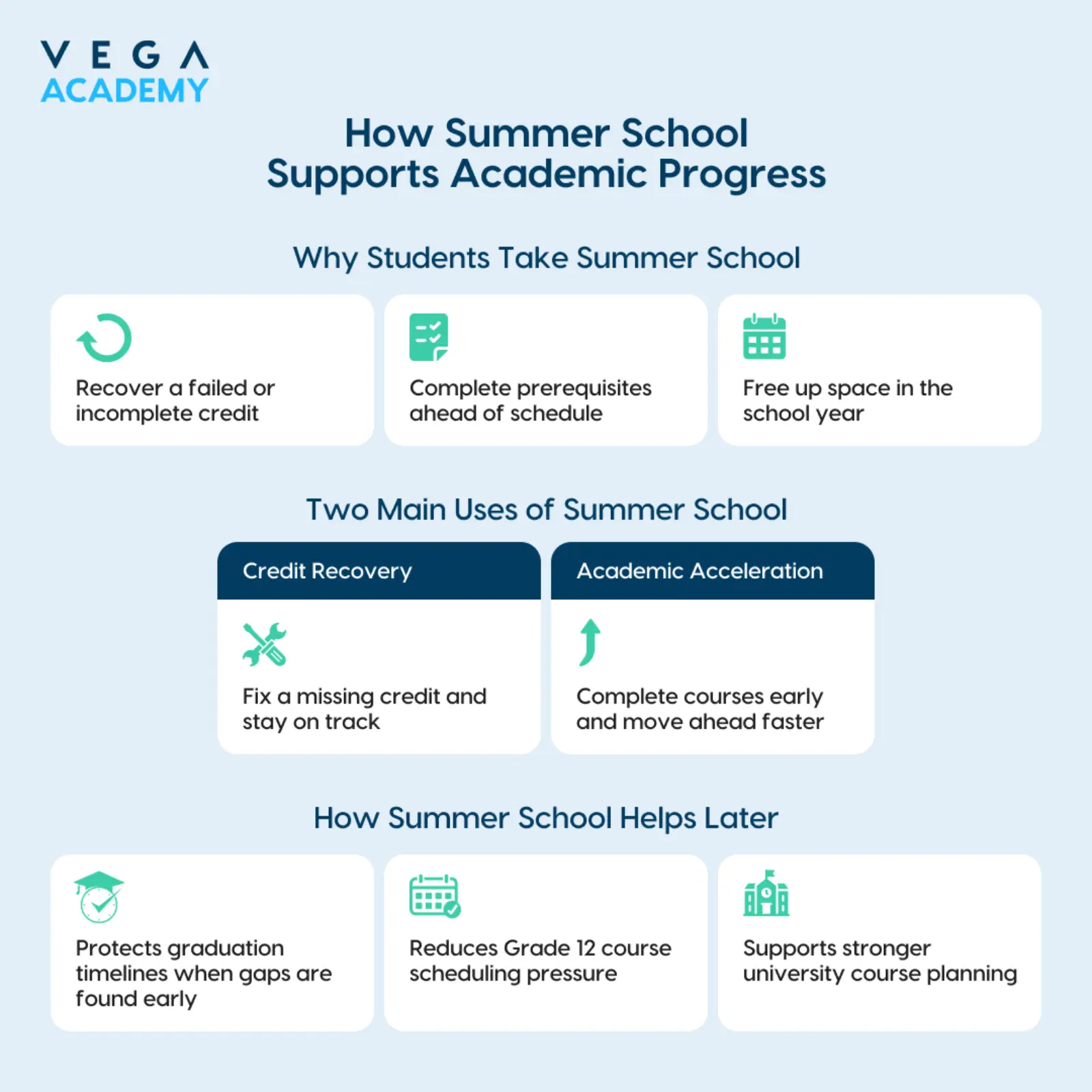
The reasons students enroll in summer school vary widely, and the academic outcome of that enrollment depends on the alignment between the reason for enrolling and the model of summer school chosen. Families who understand their student’s specific situation before selecting a program are in a much better position to choose the right structure and pacing. More information about how different summer program structures are designed can help families match the right option to their student’s actual needs.
Recovering a Failed or Incomplete Credit
Credit recovery is the most common reason students enroll in summer school, and it is also the situation where program choice and academic readiness matter most. A student who failed a course due to a specific and addressable gap in foundational knowledge will benefit from a summer school environment that provides individualized support alongside content delivery. A student who re-takes the same course in the same format that produced the original failure is likely to produce a similar result, which is why the quality of instruction and teacher accessibility in the summer school program selected is more consequential than its cost or convenience.
Completing Prerequisites Ahead of Schedule
- Grade 10 and 11 prerequisites: Completing a prerequisite course during summer school allows a student to access a higher-level course earlier in their secondary sequence, which creates scheduling flexibility and often produces better performance because the student has more time to develop subject fluency before the advanced course begins.
- Eliminating scheduling conflicts: Students who use summer school to complete one required course can free up a time slot during the academic year for a course that better serves their university application or provides an academic enrichment opportunity that would otherwise not fit into their timetable.
Accelerating the Course Sequence
Some students use summer school not to recover or catch up but to get ahead, completing courses earlier than the standard sequence allows in order to reach advanced content sooner or to create room for additional enrichment in their final secondary years. This accelerated learning approach is most effective for students who are genuinely ready for the course content and motivated by the subject area, not simply trying to compress their secondary experience. Students who rush through prerequisite courses without achieving genuine fluency often struggle more in subsequent advanced courses than if they had followed the standard sequence.
Credit Recovery vs Academic Acceleration
These two uses of summer school produce different transcript outcomes, different preparation effects, and different implications for graduation and university admission. Treating them as equivalent because both involve summer school is one of the most common planning errors families make. A clear understanding of the distinction, and of what each requires from the student, produces better decisions about when and how to use summer school as an academic tool. Families evaluating options can review program details and scheduling to understand which approach fits their student’s situation.
What Credit Recovery Requires
- Honest gap diagnosis: Effective credit recovery starts with understanding why the credit was not earned the first time. A student who failed due to attendance issues needs a different response than one who failed due to difficulty with specific mathematical concepts, and summer school programs vary significantly in their capacity to address each type of gap.
- Sufficient academic readiness for the compressed format: Summer school compresses a full semester of content into four to six weeks of daily instruction. Students who struggled in the regular format due to pace or workload management challenges may find the compressed format even more demanding, making individualized support a necessary feature rather than an optional add-on.
What Accelerated Learning Requires
Accelerated learning through summer school is best suited to students who are strong in the subject area, self-directed in their study habits, and clear about what they are trying to achieve by completing the course early. The compressed format is an advantage for motivated students who can maintain momentum and engage intensively with new material over a short period. For students who are uncertain about the subject matter or who rely on extended practice time to consolidate understanding, acceleration often produces surface-level completion without the depth of knowledge the subsequent course requires.
- Confirmed readiness before enrollment: Students considering accelerated learning through summer school should assess their current performance in prerequisite courses, their capacity for independent work, and the demands of the next course in the sequence before committing to the compressed format.
- Grade implications of acceleration: Ontario summer credits earned through an accelerated pathway appear on the transcript with the same weight as regularly delivered courses. A strong performance during summer school in a Grade 11 University-level course improves the student’s academic profile and confirms readiness for the Grade 12 sequence.
Impact on Graduation Timelines
Summer school has a direct effect on graduation timing when it is used to address credit shortfalls, and an indirect but meaningful effect when it is used strategically to optimize the final secondary year. The nature of that effect depends on when a credit gap is identified and how promptly it is addressed. Students and families who want to map the specific impact on their graduation and application timeline can request more information about how summer course completion integrates with overall academic planning.
When Summer School Preserves the Graduation Date
A student who identifies a missing compulsory credit or a failed elective at the end of Grade 10 or Grade 11 and completes summer school before the next academic year begins returns to the regular sequence with the gap resolved. The graduation timeline is unaffected, the credit is on the transcript, and the student enters the following year with full course flexibility restored. This is the most positive graduation impact of summer school, and it is only available when the gap is identified early enough for summer school to serve as a timely solution rather than a last resort.
When Summer School Reduces Grade 12 Pressure
- Freeing up Grade 12 timetable space: Completing a required but non-university-level course during summer school before Grade 12 begins frees up a slot in the final year for a University-level course that directly supports the application average or fulfills a prerequisite that had not yet been addressed.
- Eliminating prerequisite bottlenecks: Students who enter Grade 12 missing a prerequisite for a course they need in their university application profile face a compressed timeline that summer school in Grade 11 would have prevented entirely. Avoiding that situation through proactive summer enrollment is one of the clearest examples of strategic summer school use.
When Summer School Does Not Prevent a Delay
Students who discover multiple missing compulsory credits in the final semester of Grade 12, or who need to recover a prerequisite after university application deadlines have passed, are in situations that summer school alone cannot fully resolve. In these cases, the graduation date or the application cycle is affected regardless of summer enrollment, and the focus shifts to minimizing the delay rather than eliminating it. Identifying these situations earlier is always better, which is why annual credit audits and proactive academic planning are worth building into secondary school life from Grade 9 onward.
Planning Summer School Strategically
Strategic use of summer school produces compounding benefits across the secondary years because each decision about course sequencing affects what is possible in subsequent years. Families who plan summer school enrollments as part of a broader graduation and university preparation strategy, rather than responding to individual credit problems as they arise, give their students significantly more flexibility and a stronger application profile by the time Grade 12 arrives. Understanding how a specific school structures academic planning as part of its standard program can help families evaluate how proactively that support is offered. Learn more about how academic programs are structured by reviewing how we approach student academic planning.
Mapping Courses to University Prerequisites
The most effective summer school planning starts with identifying the university programs the student is targeting, mapping the prerequisites those programs require, and working backward from the Grade 12 application deadline to determine which courses need to be completed by when. Any prerequisite that cannot fit into the regular school year schedule without crowding out higher-priority courses becomes a candidate for summer school completion. This kind of backward planning is straightforward once the destination is clear, but it requires making the destination decision early enough that there is still time to act on it.
- Grade 11 as the key planning year: Grade 11 is the most consequential year for summer school planning because the courses completed or missed in that year directly determine the Grade 12 course options available for the university application cycle. Students who use summer school between Grade 10 and 11, or between Grade 11 and 12, typically arrive at their final year with more options and less pressure than those who did not.
- Matching summer school format to course type: Not all courses suit the compressed summer school format equally well. Courses that rely heavily on cumulative skill development, such as mathematics and language courses, benefit from the individualized support and pacing flexibility that independent or private summer school programs can provide more readily than large public summer programs.
Choosing the Right Summer School Environment
Public summer school programs offer accessibility and recognized Ontario summer credits at no additional cost, which makes them the default choice for many families. Private and independent summer school programs offer smaller class sizes, more individualized instruction, and greater scheduling flexibility, which makes them a better fit for students who need academic support alongside the credit rather than simply the opportunity to complete it. The right choice depends on what the student needs from the summer, not just what is most convenient to access.
Accelerate This Summer
Get ahead with focused academic summer programming.
Common Misconceptions About Summer School
Several persistent misconceptions about summer school in Ontario affect how families use it, sometimes leading to choices that do not produce the outcomes they expected. Addressing these directly makes the planning process cleaner and the decisions more reliable.
Summer School Is Only for Students Who Failed
This is the most common misconception about summer school, and it prevents motivated students from using it as an acceleration or planning tool. A significant proportion of students who enroll in Ontario summer school programs each year are using them for prerequisite completion, course load optimization, or accelerated learning rather than credit recovery. Families who assume summer school carries a remedial implication often miss the strategic benefits of using it proactively.
Summer School Grades Do Not Affect University Applications
This is false for Grade 12 University-level courses. Ontario summer credits earned in Grade 12 U-level courses are included in the transcript submitted to OUAC and are factored into the application average. Students who earn strong grades in summer school strengthen their application. Students who earn marginal passing grades in summer school on courses included in their top-six calculation may satisfy graduation requirements without improving their competitive position. The application consequence of summer school performance is real and should be factored into both the decision to enroll and the preparation invested in the course.
All Summer School Programs Are Equivalent
Public, private, and online summer school programs all award recognized Ontario secondary credits, but they differ substantially in class size, instructional quality, teacher accessibility, and the level of academic support provided. A student completing a summer school course in a class of 30 with a teacher covering material at a fixed pace is in a fundamentally different learning environment from a student completing the same credit in a class of 12 with a teacher who provides individualized feedback and adjusts pacing to the student’s progress. Both earn the same credit. The learning and grade outcomes are not reliably the same.
Frequently Asked Questions
How many courses can a student complete in one summer school session in Ontario?
Most Ontario summer school programs allow students to complete one credit per summer school session, with some programs offering two sessions within the summer period that allow a second credit to be completed. Public summer school sessions typically run four to six weeks with daily class time, which limits the practical number of credits that can be completed without the quality of learning being compromised by schedule compression. Students considering completing more than one credit in a single summer should evaluate the demands of each course carefully and confirm that the combination is manageable given the compressed timeline, particularly if both courses are University-level and factor into the application average.
Does summer school affect a student's standing in the regular school year?
Summer school credits are recorded on the Ontario transcript alongside regular school year credits and are recognized equally for graduation and university application purposes. There is no academic standing distinction between a credit earned during the regular school year and one earned during summer school, provided the credit was awarded by a registered Ontario school. Students sometimes worry that summer school completion will be viewed negatively by admissions offices, but the concern is unfounded: what admissions offices evaluate is the grade earned and the course level, not the time of year in which the credit was completed.
Is a private summer school worth the additional cost compared to a public summer school?
For students who need credit recovery with academic support, or who are completing a course where individual attention and subject expertise materially improve the outcome, private summer school typically justifies its additional cost through better academic results. For students who are genuinely ready for the course material, motivated to complete it independently, and choosing summer school as a scheduling tool rather than an academic support mechanism, public summer school provides the same credentials at no additional cost. The cost-benefit calculation depends on what the student needs from the summer school experience, not on a general comparison of program types.
Use Summer School to Shape the Academic Year That Follows
Summer school in Ontario is a versatile academic tool that benefits students most when it is chosen deliberately and used for clear purposes such as credit recovery, prerequisite completion, or accelerated learning. Each of these options requires a careful assessment of the student’s academic readiness, the quality of instruction available in the program, and how the timing may affect graduation and university application plans. Students tend to benefit the most when families make a thoughtful decision about what the summer enrollment is intended to achieve and select a program structure that supports that goal. For families evaluating options, the most practical next step is to review the student’s credit status, identify any gaps or opportunities in the course sequence, and determine which summer school format can best address those needs before the next academic year begins.
Enroll in Our Program
Build a stronger academic year starting this summer.