
Schools that once ran separate classes for science, art, math, and writing are rethinking that model. The shift toward STEAM (Science, Technology, Engineering, Arts, and Mathematics) reflects a practical question: do students learn these subjects better when they see how they connect? The answer, based on how STEAM programs perform in the classroom, is usually yes.
A STEAM curriculum integrates the arts and humanities into what was traditionally a STEM-focused structure. The purpose is not to water down technical content. It is to give students more entry points into that content and more ways to use it.
Key Takeaways
What a STEAM Curriculum Includes
STEAM programs vary by school, but the most effective ones share a common structure. Subjects are taught in relation to each other, not in isolation. A student studying geometry is also looking at architecture. A student writing code is also analyzing communication design. This cross-subject connection is what separates a STEAM curriculum from a school that simply offers art electives alongside science courses.
Three elements show up consistently in well-structured STEAM programs:
- Cross-subject integration. Students connect content across disciplines within the same lesson or project, not just within the same semester.
- Experiential learning. Students apply concepts through hands-on work: physical prototypes, performances, presentations, or community-facing projects.
- Skill-based outcomes. Programs track student development in areas like analytical thinking, oral communication, and collaborative problem-solving, not just subject-matter scores.
Schools that deliver on this structure tend to see students who are more comfortable with ambiguity and more capable of working across disciplines. According to a report from Americans for the Arts, students in arts-integrated schools showed a 22% improvement in academic motivation and performed better on standardized assessments compared to peers in traditional learning environments.
How STEAM Connects Science, Technology, Engineering, Arts, and Math
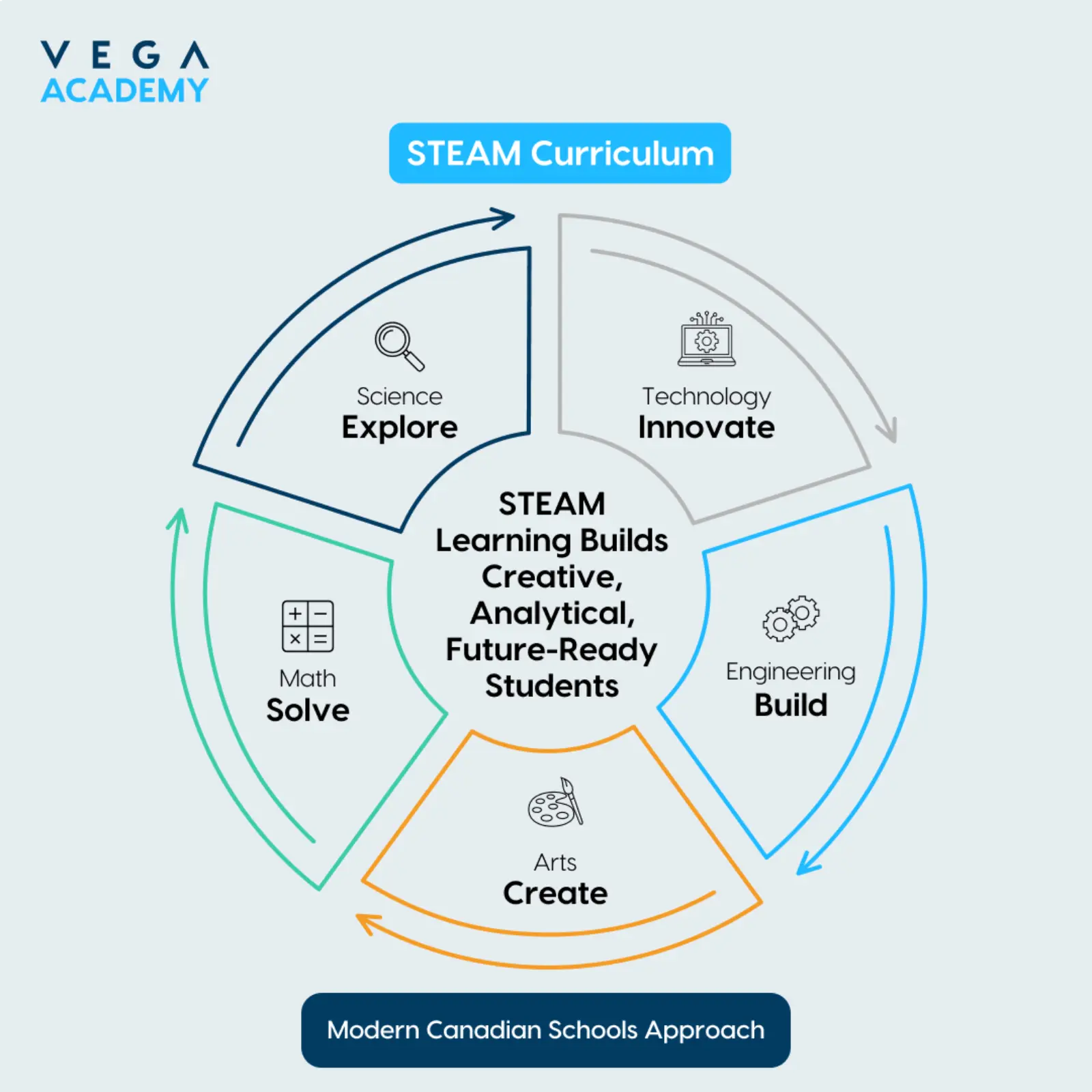
Each discipline in a STEAM curriculum plays a specific role. None of them functions as decoration. The arts component, in particular, is often misunderstood. Including it is not a concession to creativity for its own sake. It addresses a gap in how students process and communicate technical information.
Science in Context
Science instruction in a STEAM framework focuses on observation, hypothesis, and iteration. Students do not just memorize the scientific method. They use it within design challenges that require them to document findings, revise approaches, and present conclusions to an audience. Writing and visual communication skills become part of the science process, not a separate subject.
Technology in Application
Technology instruction moves beyond software tools and into systems thinking. Students examine how platforms, networks, and devices interact, and they are asked to evaluate those systems, not just use them. This means they are also doing work that touches media literacy, ethics, and user-centered design, all of which pull from the arts and humanities.
Engineering Through Design
Engineering activities in STEAM programs draw on student-directed problem solving. Students identify a problem, prototype a solution, test it, and present their process. The arts enter through the design phase, where students must consider aesthetics, user experience, and communication. These are not soft additions. They are part of what makes an engineering solution functional.
Arts for Critical Thinking
The arts component is where STEAM diverges most sharply from STEM. Students learn to analyze imagery, construct arguments through writing, produce work that communicates ideas to an audience, and evaluate the work of others. A study published in Education Sciences found that students who received arts-integrated instruction outperformed peers in analytical reasoning tasks by a significant margin. These are not peripheral skills. They are the skills that hold technical expertise together.
Mathematics for Reasoning
Math in a STEAM curriculum goes beyond calculation. Students use mathematics to analyze data from science projects, model patterns in music, or evaluate the proportions in architecture and product design. Connecting math to visible, applied outcomes tends to improve both engagement and retention, particularly for students who previously saw math as abstract or disconnected from various applications.
Why Schools Are Adopting STEAM Learning Models
The shift toward STEAM in Ontario and internationally is not trend-driven. It reflects specific gaps that emerged when employers, universities, and researchers began examining what graduates were actually prepared to do. Technical skills were present. Contextual and communicative skills were frequently absent.
The Ontario curriculum has progressively incorporated cross-disciplinary expectations at the secondary level. Schools that go further than the provincial baseline, building structured STEAM programs, tend to attract students and families who want preparation for competitive post-secondary programs and careers in fields that blend disciplines. Statistics Canada reports that graduates in fields requiring both technical and communication competency have higher employment rates within two years of graduation than graduates with technical credentials alone.
Private schools have been faster to adopt formal STEAM structures because they have more flexibility in curriculum design. This does not mean the model is only available in private settings. But it does mean that schools actively investing in STEAM infrastructure, integrated staffing, and project-based programming offer something different from a school that simply teaches STEM subjects and adds an art class.
Skills Students Build Through STEAM Curriculum
STEAM programs build skills that show up in multiple post-secondary and professional contexts. These are not limited to students who plan to enter science or technology careers. The outcomes apply across business, communications, design, healthcare, law, and the social sciences.
Analytical Thinking
Students learn to break down a problem before acting on it. They examine variables, question assumptions, and consider outcomes before committing to a direction. This process is practiced explicitly in science and math, then reinforced in design critiques and written arguments.
Adaptability
Project-based STEAM work requires students to revise. Prototypes fail. Data contradicts initial predictions. Written drafts go through multiple edits. Students develop tolerance for iteration, which is a functional skill in any field that requires continuous improvement.
Collaborative Work
Many STEAM projects are group assignments with distributed roles. Students learn to divide responsibilities, communicate progress, give and receive feedback, and produce a final output that reflects the work of multiple contributors. This mirrors how most professional work actually gets done.
Communication Across Formats
Students in STEAM programs are expected to communicate technical content in multiple formats: written reports, visual presentations, verbal defenses, and prototypes. The ability to translate complex information into a format that a non-specialist audience can understand is one of the most frequently cited gaps in recent graduate performance.
Examples of STEAM Learning Activities
The following examples are not hypothetical. They represent the type of structured activities that define effective STEAM programs at the secondary level.
Coding Projects
Students build applications or tools that solve a defined problem, then document their process and present the product to peers or faculty. The documentation requirement adds writing and communication to the technical work.
Robotics Design
Students design, build, and test physical systems. They must account for the user interface and aesthetics alongside the mechanical function. The design phase is evaluated separately from the build phase.
Science Experiments with Public Communication
Students conduct structured experiments and then produce a public-facing output, a poster, a short presentation, or a video, that communicates their findings to a general audience. The communication component is graded, not optional.
Art and Design Projects with Technical Constraints
Students create visual or physical work within defined technical parameters. A design brief might require students to use specific geometric properties, work within a material cost constraint, or produce work that meets an accessibility standard. These parameters bring math and engineering into what would otherwise be a purely creative assignment.
How Families Can Evaluate a STEAM Program
Not every school that uses the word STEAM is running a STEAM program. The label has become common enough that it warrants scrutiny. The following questions help families assess what a program actually delivers.
- Curriculum and outcomes. Ask the school to explain how subjects are taught in relation to each other. If the answer is that students take science and art in the same school year, that is not integration. Integration means the two subjects inform each other within shared assignments or projects.
- Teacher structure. Ask if teachers from different disciplines co-plan or co-teach. Programs where subject teachers work independently rarely produce meaningful cross-disciplinary learning.
- Student work samples. Request examples of student projects. A strong STEAM program produces complex, multi-stage work products, not just completed worksheets or individual subject reports.
- Post-secondary outcomes. Ask where graduates go after the program. Schools with genuine STEAM outcomes should be able to point to specific university placements, awards, or portfolio achievements that reflect the program’s approach.
- Technology integration. Ask how technology is used within the program, not as a standalone subject, but as a tool for doing work in other subjects. Programs that only teach technology in isolation are not fully implementing the STEAM model.
Frequently Asked Questions
What does a STEAM curriculum mean in practice?
Is a STEAM-focused curriculum suitable for all students?
How is STEAM different from a standard Ontario high school curriculum?
Apply STEAM Curriculum Principles for Strong Academic Outcomes
Vega Academy’s academic program is structured around these principles. Students work on cross-disciplinary projects, develop technical and communication skills within the same curriculum, and graduate with a portfolio of work that reflects both depth and range. Families looking for a program with a genuine STEAM structure can review the full academic offering to assess how it aligns with their students’ goals.
Apply STEAM Curriculum Principles for Strong Academic Outcomes
Schools that build genuine STEAM programs are not just adding subjects to a list. They are changing how students experience learning across all of those subjects simultaneously. The outcome is a student who can work with complex information, communicate across formats, and contribute to team-based projects, capabilities that apply if they enter engineering, medicine, communications, or any other field that requires both precision and judgment.
Vega Academy’s academic program is structured around these principles. Students work on cross-disciplinary projects, develop technical and communication skills within the same curriculum, and graduate with a portfolio of work that reflects both depth and range. Families looking for a program with a genuine STEAM structure can review the full academic offering to assess how it aligns with their students’ goals.