
Critical thinking in academic settings means more than questioning things for the sake of it. It involves evaluating sources before citing them, identifying the assumptions behind an argument, recognizing when two pieces of information contradict each other, and adjusting conclusions when new evidence appears. Students who develop these habits earlier tend to find university work less overwhelming, not because the content gets easier, but because they have a framework for handling unfamiliar problems.
Key Takeaways
What Critical Thinking Actually Involves
The term gets used so broadly in education that it risks losing practical meaning. In the context of high school academics, critical thinking refers to a set of specific cognitive habits: breaking down information into its components, evaluating the reliability of sources, recognizing bias or incomplete reasoning, and constructing arguments that can withstand scrutiny.
Students are not born with or without this capacity. Research in educational psychology consistently shows that it develops through deliberate practice. Students who are asked to justify their reasoning, rather than just produce a correct answer, show a stronger analytical performance over time.
The Core Processes Behind the Skill
Analysis, evaluation, and inference form the backbone of critical thinking. Analysis means breaking a complex idea into its parts to understand how they connect. Evaluation means judging the quality of evidence or the logic of an argument. Inference means drawing conclusions that follow from the available evidence without overclaiming.
In a history class, analysis might mean identifying the competing interests behind a political event. In a science class, evaluation means distinguishing between a well-created study and a poorly controlled one. In English, inference means understanding what a character’s actions reveal about their motivation without the author stating it directly. The skill looks different in each subject, but the underlying process is the same.
Moving Past Rote Learning
Memorization has a role in education. Knowing basic facts, formulas, and vocabulary allows students to function in a subject area. The problem is that memorization alone does not transfer. A student who has memorized the steps of a chemistry reaction cannot necessarily troubleshoot why their experiment produced the wrong result.
Students who develop analytical thinking can apply what they know to situations they have not seen before. That transfer capacity is what distinguishes high academic performers in courses that demand problem-solving rather than recall, and it is what university instructors consistently report as underdeveloped in incoming students.
Confidence in Independent Reasoning
There is a classroom behavior pattern that teachers recognize quickly: students who raise their hands before they are certain, willing to work through their thinking out loud, versus students who only participate when they already know the answer. The former group tends to improve faster because they treat uncertainty as part of the process rather than a signal to disengage.
That confidence does not come naturally to most teenagers. It develops when students practice forming and defending positions based on evidence, receive feedback that focuses on reasoning quality rather than correctness alone, and see that revising their thinking in response to new information is a sign of intellectual strength, not weakness.
Students at Vega Academy engage with academic programs that prioritize this kind of reasoning development across core and elective courses.
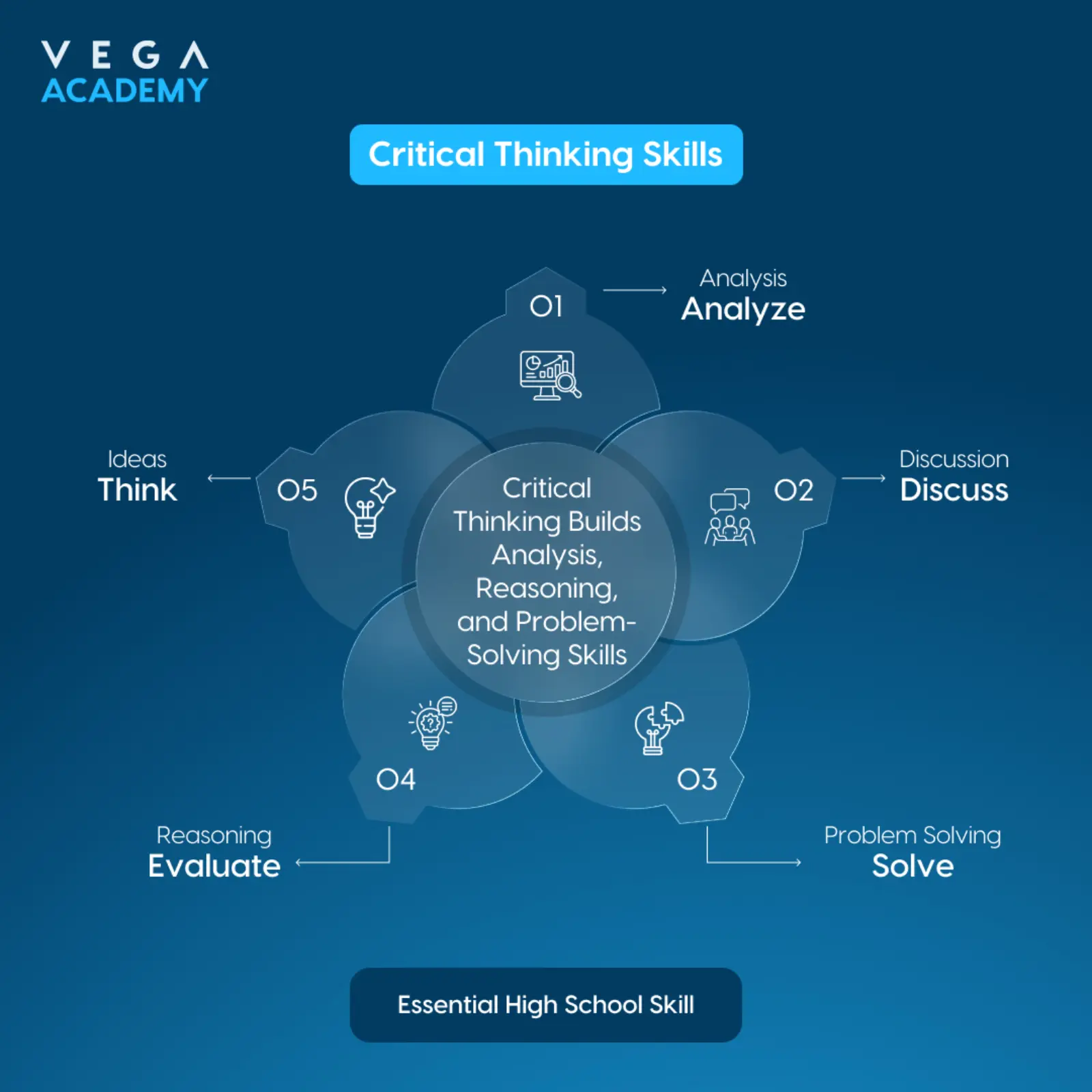
How Critical Thinking Improves Academic Performance
The connection between analytical thinking habits and academic results is well-documented. Students who approach assignments by questioning assumptions, structuring arguments logically, and evaluating their sources tend to produce stronger work across every subject area, not just those where critical thinking is explicitly taught.
Performance improvements appear in writing, where students learn to build coherent arguments rather than list observations. They appear in math and science, where students who understand why a method works can adapt it to unfamiliar problems. And they appear in reading comprehension, where students who ask questions about a text rather than passively absorbing it retain more and draw stronger conclusions.
Stronger Problem-Solving Skills Across Subjects
Problem-solving in academic contexts requires more than applying a memorized procedure. It requires recognizing what kind of problem you are dealing with, identifying what information you have and what you still need, testing a solution strategy, and adjusting when it does not work.
Students who develop these habits in one subject tend to apply them in others. A student who has learned to break down a geometry proof into steps often approaches a difficult essay prompt the same way, isolating the central claim before working outward. The skill generalizes across academic domains in a way that content knowledge alone does not.
Research from Stanford University supports the relationship between structured critical thinking practice and improved academic scores, particularly in assessments that require applied reasoning rather than recall.
Better Comprehension of Complex Material
Students often describe difficult subjects as confusing in a way that sounds like a content problem, when it is actually a reasoning problem. A student who finds calculus overwhelming may understand each individual concept when it is explained in isolation, but struggles to see how the concepts connect or how to apply them together.
Analytical thinking builds the mental scaffolding that holds complex information together. Students who practice identifying relationships between ideas, spotting patterns, and working through multi-step reasoning are better equipped to manage coursework that requires holding several concepts in mind at once, which is most advanced academic work.
Clearer Writing and Communication
Writing quality in high school tends to improve substantially when students understand that an essay is a reasoned argument, not a collection of information. Students who think critically about their topic before writing tend to construct clearer thesis statements, select evidence that actually supports their point, and anticipate counterarguments.
The same applies to spoken communication. Students who have practiced building and defending positions in class discussions carry those habits into presentations, debates, and eventually professional settings. Clear communication almost always starts with clear thinking, and high school is where that connection gets established.
Classroom Activities That Build Analytical Thinking
Telling students to think critically does not make them better at it. Specific classroom activities, structured over time and introduced progressively, are what actually develop the skill. Teachers who produce students with strong analytical habits tend to use a few common approaches consistently.
The most effective methods have one thing in common: they require students to do something active with information rather than receive it passively. Listening to a lecture about how to evaluate evidence is far less effective than actually evaluating evidence in front of peers and receiving feedback on your reasoning.
Case Study Analysis
Case studies work well in high school because they give students a bounded, legitimate problem to work through. The scenario is specific enough to be concrete, but complex enough that there is no single obvious answer. Students have to examine the situation, identify the competing factors at play, evaluate the available options, and defend a conclusion.
The analytical value comes from the constraint. Students cannot fall back on generic answers. They have to engage with the specific details of the case, which forces them to practice the kind of close reasoning that generalizes to other academic tasks. Teachers who debrief case studies carefully, examining what made some reasoning stronger than others, get the most out of this method.
Project-Based Learning
Extended projects ask students to sustain analytical effort over time rather than perform in a single sitting. A student working on a multi-week research project has to plan their approach, gather and evaluate sources, identify gaps in their argument, revise their conclusions based on what they find, and finally communicate their reasoning to an audience.
That sequence mirrors what adult intellectual work actually looks like in academic and professional settings. Students who have completed several substantive projects before university arrive with a practical understanding of how research works, what makes an argument credible, and how to manage a task that does not have a single correct answer waiting at the end.
Data from the National Training Laboratories indicates that active learning methods, including project-based approaches, improve knowledge retention significantly compared to passive instruction, with retention rates roughly 25 percent higher in applied learning contexts.
Data Interpretation Exercises
Charts, graphs, tables, and statistical summaries appear across almost every academic discipline. Students who learn to read them accurately, identify what they do and do not show, and spot when data is being misrepresented develop a form of analytical literacy that is broadly useful.
Data interpretation exercises also teach intellectual caution. A student who has practiced reading charts carefully learns to ask what the axis labels actually mean, what sample size was involved, and whether the visual presentation distorts the underlying numbers. That skepticism is an academic asset in every subject that draws on evidence.
Build Strong Thinking Skills
Help students succeed through guided academic skill development
How Discussion-Based Learning Strengthens Reasoning
Analytical thinking is partly a social skill. It develops faster when students have to defend their reasoning to other people, hear reasoning that differs from their own, and revise their positions in response to challenges. Discussion-based learning creates that environment deliberately.
There is also an engagement dimension. Students who participate actively in discussions tend to be more invested in the material. They have a stake in the question because they have already committed a position to it. That investment makes them more likely to follow up, read more carefully, and retain what they learned.
Structured Classroom Discussions
Effective classroom discussions are not open-ended conversations. They are organized around a central question, moderated to ensure that responses stay grounded in evidence, and brought to a conclusion that students can apply to future work. Teachers who run them well set clear expectations: positions must be supported, counterarguments must be addressed, and claiming something is obvious is not an argument.
Students who have regular experience with this kind of structured exchange develop faster and clearer reasoning. They learn that the quality of their argument matters more than the confidence with which they assert it, which is a lesson that takes time to internalize but is visible in their academic output once it does.
Peer-to-Peer Learning
Students learn from each other in ways that are distinct from what they take from direct instruction. Hearing a classmate explain a concept in a different language, or hearing them make an error and watching the class correct it, produces a different kind of understanding than receiving a correct explanation from a teacher.
Peer-to-peer learning also requires students to evaluate reasoning they cannot immediately defer to as authoritative. When a classmate makes an argument, students have to decide for themselves whether it holds up. That evaluative work strengthens exactly the kind of independent judgment that critical thinking involves.
Socratic Questioning
Socratic questioning as a teaching method involves asking students a sequence of layered questions that require them to examine their assumptions, follow their reasoning to its conclusion, and identify where their argument breaks down. It is slower than direct instruction, and students initially find it uncomfortable.
That discomfort is part of the point. Students who are accustomed to being given answers can find it genuinely difficult to have their assumptions questioned. Over time, students who experience Socratic questioning regularly begin to apply it to their own thinking before they voice it, which is exactly the internal reasoning habit that distinguishes rigorous academic work.
A study from the Harvard Graduate School of Education links discussion-based and inquiry-driven learning with higher academic engagement and improved reasoning outcomes, particularly among students who showed moderate performance prior to the intervention.
Long-Term Benefits That Extend Past High School
The skills built through analytical thinking practice do not expire at graduation. Students who develop strong reasoning habits in secondary school carry them into post-secondary education, professional environments, and adult decision-making contexts. The return on that investment grows over time.
University instructors across disciplines consistently report that incoming students struggle most with tasks that require sustained analytical work: building an argument across a long paper, evaluating conflicting sources, creating a research approach, and making a case for a conclusion under uncertainty. These are exactly the skills that high school critical thinking instruction addresses when it is done well.
Academic Readiness for Post-Secondary Study
First-year university courses in almost every faculty require students to do things that feel new: read academic sources critically, write papers with original arguments, participate in seminars where positions are challenged, and produce work that is evaluated on reasoning quality rather than recall accuracy. Students who have done versions of these things in high school find the transition significantly more manageable.
The gap between secondary and post-secondary expectations is one of the most well-documented problems in education. Students who are adequately prepared for the analytical demands of university-level work perform better in their first year and are less likely to disengage or withdraw. High school critical thinking instruction is one of the most direct ways to close that gap.
Readiness for Professional and Career Contexts
Employers across industries consistently identify analytical thinking, structured problem-solving, and clear communication as skills they expect from new graduates and struggle to find. These are not niche technical competencies. They apply in every role that involves interpreting information, making recommendations, or working through unfamiliar problems.
Students who develop strong reasoning habits in high school and refine them through post-secondary education arrive in the workplace with a durable professional advantage. That advantage is not tied to a specific credential or technical skill set. It transfers across sectors, roles, and the changing demands of a working career.
Adaptability and Continued Learning
Perhaps the most practically useful long-term benefit is the ability to learn new things independently. Students who have learned how to evaluate sources, structure their reasoning, and identify the gaps in their own understanding can apply those skills to any new domain they need to enter.
That capacity for independent learning becomes more valuable over time, not less. Industries change. Job requirements shift. The students who are best equipped to adapt are those who know how to approach an unfamiliar problem systematically, identify what they need to learn, and build that knowledge with critical judgment about its quality and relevance.
Prepare For Academic Success
Start your path with structured high school learning support
Frequently Asked Questions
What are critical thinking skills in high school, and how are they different from general intelligence?
Critical thinking refers to a specific set of learned habits: analyzing information rather than accepting it at face value, evaluating the quality of evidence before concluding, recognizing logical inconsistencies in an argument, and revising a position when new information warrants it. These are skills that develop with practice, not fixed attributes. A student with strong memorization abilities is not automatically a strong critical thinker, and a student who struggles with recall can still develop excellent analytical reasoning.
How do teachers actually develop analytical thinking in students rather than just discussing it?
The most effective approaches involve consistently asking students to do something active with information: defend a position, evaluate a source, find the flaw in an argument, or apply a concept to a new situation. Teachers who develop strong thinkers tend to focus feedback on reasoning quality rather than just correctness. They ask follow-up questions that expose assumptions, assign work that does not have a single correct answer, and create classroom environments where revising a position is treated as a sign of intellectual honesty rather than inconsistency.
Why do problem-solving skills matter for students beyond academic performance?
Problem-solving skills that students develop academically generalize to decisions and challenges outside the classroom because the underlying process is the same: identify the actual problem, gather relevant information, evaluate available options, choose the best approach given the constraints, and adjust when the initial approach does not work. Students who have internalized this process through academic practice apply it to personal decisions, professional challenges, and unfamiliar situations throughout their lives.
Preparing Students to Think Well Under Academic Pressure
Critical thinking skills do not make high school easier in the sense of requiring less effort. They make it more manageable because students have a process for handling difficult material rather than just hoping familiarity will carry them through. Students who can analyze information, evaluate arguments, and construct reasoned positions arrive at each academic challenge with tools that apply regardless of the subject.
The preparation that matters most for university, for careers, and for the decisions of adult life is not subject-specific knowledge. It is the ability to think clearly about unfamiliar problems, evaluate evidence honestly, and follow reasoning wherever it leads. High school is where that capacity gets built, and the investment compounds over time.