
Leadership skills for high school students are not just for student council presidents. They show up in how students communicate, collaborate, and take responsibility for their work. Universities and employers consistently look for evidence of these skills. High school is the right time to start building them in a structured way.
Key Takeaways
Why Leadership Skills Matter During High School
Leadership skills for high school students matter because they build competencies that do not develop from academic study alone. Classroom learning develops knowledge; leadership develops judgment. Students who practice leading while still in high school arrive at university with an advantage. They already know how to organize people, handle disagreement, and follow through on commitments.
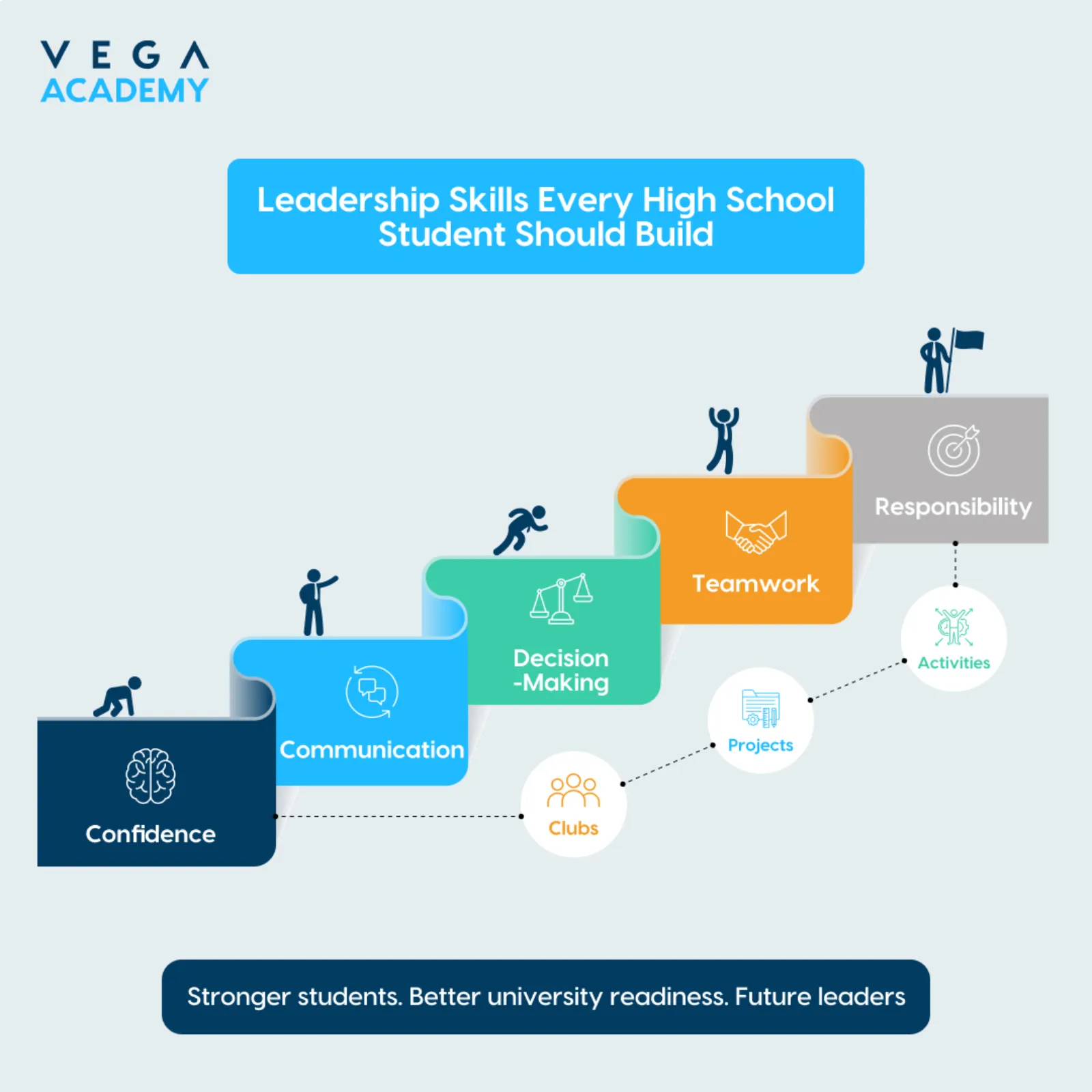
Confidence comes first and sits at the base of every other skill. Without it, students hesitate to speak, contribute, or take initiative. Communication grows from that confidence, allowing students to express ideas clearly and listen well. Decision-making comes next, developed through clubs, projects, and group responsibilities. Teamwork is built through activities in which students rely on one another to succeed. Responsibility sits at the top, the skill that ties all the others together. The outcome captured at the bottom says it well: stronger students, better university readiness, future leaders.
Confidence as the Starting Point
Confidence is the foundational leadership skill for high school students. It is not about being outspoken; it is about trusting your own thinking. Students who lack confidence often hold back ideas that could have contributed significantly. Building confidence happens through small, consistent actions: presenting in class, taking on a role, volunteering to lead. Each experience adds evidence to a student’s belief in their capacity. A school that creates these opportunities regularly produces students who enter university ready to participate, not just observe.
Why Leadership Differs From Academic Achievement
A student can earn strong grades while avoiding every leadership opportunity. That same student may struggle significantly in a university group project or job interview. Academic performance and leadership development are separate skills that reinforce each other. The research showing higher GPAs among student leaders suggests both can be built simultaneously. High schools that integrate leadership into the student experience produce graduates with both. Vega Academy’s regular day school program is structured to build both academic and leadership competencies.
Communication Skills Students Build Through Leadership
Communication is one of the first leadership skills for students that develops through practice, not instruction. You can teach a student the principles of good communication in a classroom. You cannot teach them to communicate well without putting them in situations that require it. Leadership roles create those situations consistently.
Speaking Clearly in Group Settings
Students in leadership roles regularly need to explain their thinking to others. This might be presenting a project update, running a meeting, or explaining a decision. Each of these situations requires speaking with clarity and precision under some pressure. Repeated exposure to these moments builds a skill that is often absent from purely academic programs. Students who have done this routinely before university are noticeably more confident in seminar discussions.
Listening as an Active Leadership Skill
Strong leaders listen as carefully as they speak. Understanding what team members need is as important as directing them effectively. High school projects and clubs give students regular practice in receiving feedback and adjusting. A student who has led a group and handled a disagreement well has practiced a skill most adults still find difficult. This kind of active listening is directly relevant to university group work and workplace collaboration.
Build Leaders From Day One
Decision-Making and Responsibility in Student Projects
Decision-making is a leadership skill for high school students that only develops through practice. Reading about how to make good decisions does not produce the same result as actually making them. Student projects that require practical choices, under legitimate constraints, with authentic outcomes, build this capacity directly. This is why project-based learning and student leadership opportunities produce different outcomes than passive instruction.
Learning From Decisions That Do Not Go as Planned
One of the most valuable parts of student leadership development is experiencing outcomes. A student who makes a poor scheduling decision and loses a week of project time learns something. That lesson sticks in a way that a lecture on time management does not. High school is the right environment for these experiences because the stakes are manageable. Making mistakes and correcting them before university is exactly how judgment gets built.
Responsibility as a Daily Practice
Responsibility is not a character trait that students either have or do not have. It is a habit built through consistent small commitments over time. A student who agrees to lead a club event and follows through is practicing responsibility. A student who agrees and does not follow through learns something equally important: the cost of that choice. Both lessons require practical situations, not hypothetical ones. Schools that give students genuine responsibilities create genuine accountability.
- Project ownership: Students who manage their own projects from start to finish develop accountability faster than those who complete assigned tasks.
- Timeline management: Setting and meeting self-imposed deadlines is a leadership skill that directly transfers to university coursework.
- Handling disagreement: Working through a genuine team conflict teaches more than any lesson on conflict resolution could.
- Presenting outcomes: Presenting the results of a project publicly builds both communication confidence and ownership of the work.
Leadership Opportunities Through Clubs and Activities
Clubs and extracurricular activities are where many leadership skills for high school students are built. The informal structure of a club creates room for students to take initiative without a grade attached to the outcome. That freedom is important because it encourages students to try things they would not attempt in a graded context.
What Students Gain From Leading a Club
A student who leads a club manages people, plans events, and handles budgets. They recruit members, resolve issues, and communicate updates to a broader audience. None of these activities appear on a test, but all of them develop teamwork skills. They also produce tangible outcomes that students can describe specifically in university applications. A student who can say “I organized a three-day fundraiser for 80 students” is communicating something distinct and credible.
Activities That Build Teamwork Skills Specifically
Teamwork skills develop most effectively when outcomes genuinely depend on collaboration. Sports, drama productions, debate teams, and community projects all create this dependency. A student who needs their teammates to succeed learns to support, communicate, and adapt. These are the same teamwork skills employers identify as missing from new graduates. Building them before university is a significant advantage in both admissions and career preparation. Vega Academy’s summer programs give students structured opportunities to practice exactly these collaborative and leadership skills.
- Student council: Running for and serving on the student council is one of the clearest paths to structured leadership experience.
- Sports teams: Team sports build communication, accountability, and the ability to perform under pressure alongside others.
- Community service: Organizing and leading community projects builds initiative, planning, and a sense of responsibility beyond the school.
- Academic competitions: Representing the school in debate, math, or science competitions combines leadership skills with academic depth.
How Leadership Skills Support University Preparation
Leadership skills for high school students directly support university preparation in specific, practical ways. University demands more than academic ability; it demands self-direction and collaboration. Students who have practiced both before arriving are better equipped to navigate the demands of post-secondary learning. This is not speculation; it is consistently documented in research on student outcomes.
What University Admissions Offices Are Looking For
Strong university programs look beyond grades when evaluating applicants. They want evidence that a student can contribute to a campus community. Leadership roles in high school provide exactly that evidence in specific and credible terms. A student who held a leadership role, managed a project, or led a team has something concrete to write about. A student who focused only on grades does not have the same kind of evidence to offer. Both groups may have strong marks; only one has also demonstrated student leadership development in practice.
Skills That Transfer Directly to University Life
Time management, group collaboration, and public speaking all appear constantly in university. Students who have already navigated these challenges in high school are not learning them under pressure. They are applying skills they already have. This creates the capacity to take on more advanced challenges earlier in their university careers. Student leadership development in high school is one of the most direct investments in post-secondary readiness available.
Frequently Asked Questions
At what age should high school students start building leadership skills?
Do leadership skills help with university applications?
Can introverted students develop strong leadership skills?
Give Students the Skills That Open Every Door
Leadership skills for high school students build the confidence, communication, and accountability that academic grades alone cannot demonstrate. The students who develop these skills through authentic opportunities, clubs, projects, teamwork, and responsibility arrive at university with more than knowledge. They arrive ready to contribute, and that distinction follows them throughout their academic and professional lives.