
Student centered learning puts the learner, not the lesson plan, first. Students actively build knowledge rather than passively receive it. Research consistently links this approach to stronger academic outcomes. It also prepares students for the independent thinking that higher education demands.
Key Takeaways
What Student-Centered Learning Looks Like
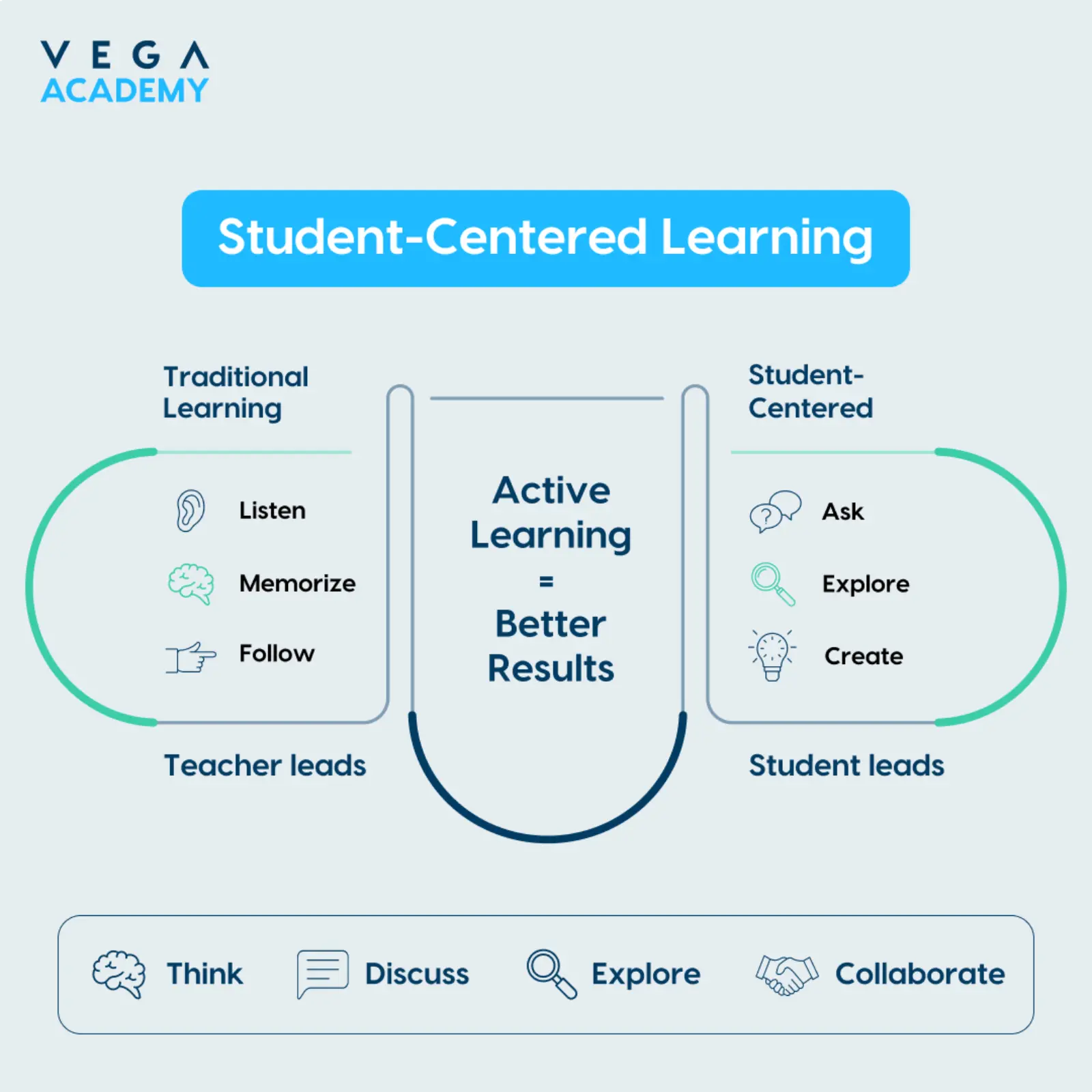
Student-centered learning shifts the classroom from delivery to discovery. Teachers create conditions for learning rather than controlling all content. Students ask questions, form ideas, and test them through guided practice. Vega Academy’s regular day school program builds this approach into every academic subject offered.
Student Agency and Choice
Agency means students have significant input into how they learn. They may choose project formats, research topics, or presentation methods. This ownership deepens engagement and builds intrinsic motivation over time. Students who feel ownership over learning are more likely to persist.
Inquiry Learning as a Core Method
Inquiry learning asks students to investigate questions rather than recall answers. It is one of the most researched modern teaching methods in education. Students form hypotheses, gather evidence, and draw conclusions independently. This mirrors how professionals in science, law, and business actually think.
Collaborative Learning Structures
Collaboration is a key feature of student-centered learning environments. Students work in pairs or groups to solve authentic, complex problems. Peer discussion deepens understanding in ways that lectures often cannot. It also builds communication skills that are essential after graduation.
Personalized Pacing and Feedback
Not all students learn the same concept at the same speed. Student centered learning allows for flexible pacing and differentiated support. Teachers give targeted, timely feedback rather than uniform grades alone. This reduces the gap between what students know and what they need.
Practical Connection Through STEAM
Strong student centered programs integrate STEM and STEAM education together. Students use math and science in creative, hands-on projects. Practical problems help them better understand and remember what they learn. This approach is common in many modern private schools in Ontario today.
Why Active Participation Improves Learning
Passive listening produces lower retention than active engagement. When students do something with knowledge, they hold it longer. Active participation also builds the metacognitive skills universities expect.
Deeper Processing of Information
Active tasks force students to process information at a deeper level. Explaining a concept to a peer requires more than remembering it. Creating a product from knowledge requires applying it under pressure. Both tasks produce stronger and more durable long-term memory encoding.
Building Self-Regulation and Independence
Student centered learning builds the habit of managing one’s own learning. Students learn to set goals, monitor progress, and adjust their strategies. These self-regulation habits transfer directly to university and workplace environments. They are among the strongest predictors of post-secondary academic success.
Motivation and Intrinsic Engagement
Students who take an active role in learning tend to enjoy it more. When they’re motivated by curiosity instead of just following instructions, they stay engaged longer. Teaching methods that spark interest help reduce boredom and disconnection. This leads to more students finishing their academic work successfully.
Learn Actively, Grow Faster
The Role of Teachers in Student-Centered Classrooms
Student centered learning does not reduce the teacher’s role. It transforms that role from information-giver to learning architect. Below explain what that transformation actually involves. Strong teachers are the foundation of any successful student-centered program.
Creating Purposeful Learning Experiences
Teachers in student centered classrooms plan with outcomes, not content, first. They create tasks that activate prior knowledge and challenge current thinking. The lesson becomes a scaffold rather than a script. This requires deeper pedagogical knowledge than lecture-based instruction does.
Facilitating Rather Than Delivering
Facilitation means guiding student inquiry rather than directing every step. Teachers ask questions that push students to think more precisely. They listen actively to student reasoning before offering their own. This approach is central to all modern teaching methods in progressive schools.
Providing Targeted Formative Feedback
Feedback in student centered learning is specific, timely, and forward-looking. It tells students not just what was wrong but how to improve. Research shows that formative feedback raises student achievement more than grading. Teachers who master feedback drive measurably better long-term academic results.
Building Trusting Learning Relationships
Students take intellectual risks only when they feel psychologically safe. Trusting teacher-student relationships are the prerequisite for genuine inquiry learning. Teachers who invest in knowing their students as individuals enable this safety. Small class sizes, like those at Vega Academy, make this consistently possible.
Classroom Examples of Student-Centered Learning
Student centered learning looks different across subjects and grade levels. But certain practical formats appear consistently in high-quality programs. Below give concrete examples of what this looks like daily. Each example connects to a documented teaching strategy with research support.
Socratic Seminars in Humanities
A Socratic seminar replaces lecture with structured student-led discussion. Students prepare by reading, then discuss ideas rather than answers. The teacher poses opening questions but does not answer them directly. Students build understanding collectively through evidence-based dialogue.
Project-Based Learning in STEAM
Students form solutions to legitimate problems across joint subject areas. A single project might require math, science, creativity, and written communication. This is how STEM and STEAM education comes alive in student centered classrooms. The output is an authentic product, not a test score.
Independent Research Investigations
Students identify a genuine question and investigate it over several weeks. This format mirrors academic research and builds university-level study skills. Inquiry learning in this form produces strong gains in self-regulation. It also develops the confidence to pursue unknowns independently.
Flipped Classroom Models
In a flipped model, students access direct instruction as homework. Class time is then used for application, discussion, and problem-solving. This inverts the traditional pattern to maximize active learning time. Research shows flipped classrooms improve both engagement and achievement outcomes.
Long-Term Academic Benefits
Student centered learning pays dividends well beyond the current school year. Students who experience it develop habits that persist through university. The research links this model to stronger persistence and career readiness. The bullets below summarize the documented long-term academic benefits.
- Higher university persistence: Students from student-centered schools complete post-secondary programs at above-average rates.
- Stronger critical thinking: Inquiry learning produces large gains in critical thinking per Mediana, Funa, and Dio’s 2025 meta-analysis, with an effect size of g = 0.913 overall.
- Better self-regulation: Independent learners manage deadlines, goals, and study habits more effectively in higher education.
- Greater career adaptability: Students trained through modern teaching methods can adapt their skills across changing job requirements.
- Improved collaborative skills: Employers consistently rank teamwork among the most valued competencies in new hires.
- Higher intrinsic motivation: Students who own their learning maintain academic effort through more challenging levels.
- Transferable academic skills: Research shows student-centered graduates have skills applicable across professions and industries.
Build Skills That Last
Frequently Asked Questions
At what age or grade level can students begin earning university credits?
Most students pursuing high school with university credits programs begin during Grade 11 or Grade 12, when they have the subject foundation and academic maturity the coursework requires. Some programs allow advanced Grade 10 students to begin with a single introductory credit-bearing course as a trial, though this depends entirely on the program structure and the student’s demonstrated readiness in the relevant subject area. The right entry point is determined by academic preparation and study habits rather than by age alone, which is why program-specific eligibility criteria are the most reliable guide for families assessing timing.
Is student-centered learning better than traditional instruction?
Neither model is universally superior for every student or subject. Student centered learning produces the strongest outcomes in contexts that require independent thinking, problem-solving, and deep comprehension. Schools like Vega Academy balance structured academic content with student-centered approaches, ensuring foundational knowledge is never sacrificed for the sake of method.
How does student-centered learning prepare students for university?
University demands independent research, self-directed study, and critical thinking. Student centered learning builds all three habits during secondary school. Students who arrive at university already comfortable with inquiry learning, self-regulation, and peer collaboration typically adapt faster, perform better in seminar-based courses, and persist through academic challenges at higher rates than those from lecture-only environments.
What should parents look for in a student-centered school?
Look for schools where students present, debate, and create rather than just recall. Ask even if teachers facilitate inquiry or primarily deliver content. Schools with small class sizes, like Vega Academy, can implement genuine student centered learning because teachers know every student individually and can tailor the approach to each learner’s needs and pace.
Put the Right Learning Model Behind Your Student’s Potential
Student centered learning is not a philosophy; it is a practice with proven results. It builds the independent thinking, collaboration, and self-regulation that universities reward. Schools that implement it well produce graduates who adapt, persist, and lead. The evidence across research, school outcomes, and employer feedback all point the same way.
Vega Academy applies student centered learning across all its programs. Small classes, STEAM integration, and inquiry-based teaching are daily standards. Explore the regular day school program or try the summer programs to experience what a genuinely student-centered education produces.