Not all private schools in Ontario offer the same academic experience, and the differences go well beyond tuition fees or school size. Curriculum structure, teaching philosophy, class composition, and program focus all vary significantly across independent schools, which means a school that is an excellent fit for one student may be entirely wrong for another. Understanding those differences before you commit to an application is the most practical thing a family can do to make sure the school they choose matches how their child actually learns.
Key Takeaways
Why Families Consider Private Education
Private schools attract families for a range of reasons, and academic quality is consistently near the top of that list. Parents looking at private education in Ontario often cite dissatisfaction with class sizes, concerns about academic pace, or a desire for a more structured and accountable learning environment as their primary motivations. For students with specific academic goals, including university preparation, accelerated programming, or targeted skill development, private schools offer structures that the public system is not always designed to accommodate.
Academic Accountability
Private schools are accountable to their enrolled families in a direct way that public schools, governed by boards and ministry directives, are not. If academic standards slip or a student’s progress stalls without explanation, parents have more leverage to demand a response. Accountability shapes how teachers plan, how schools communicate student progress, and how problems are identified and addressed.
Focused Learning Environments
Many private schools are built around a defined academic philosophy, such as inquiry-based learning, accelerated university preparation, or arts integration, which allows them to attract students and families who are specifically aligned with that approach. A school with a clearly defined academic identity tends to produce more consistent outcomes for the students it is designed to serve than a generalist institution trying to meet every need simultaneously.
Explore Summer Programs
Give your student an academic edge this summer.
Curriculum and Academic Oversight
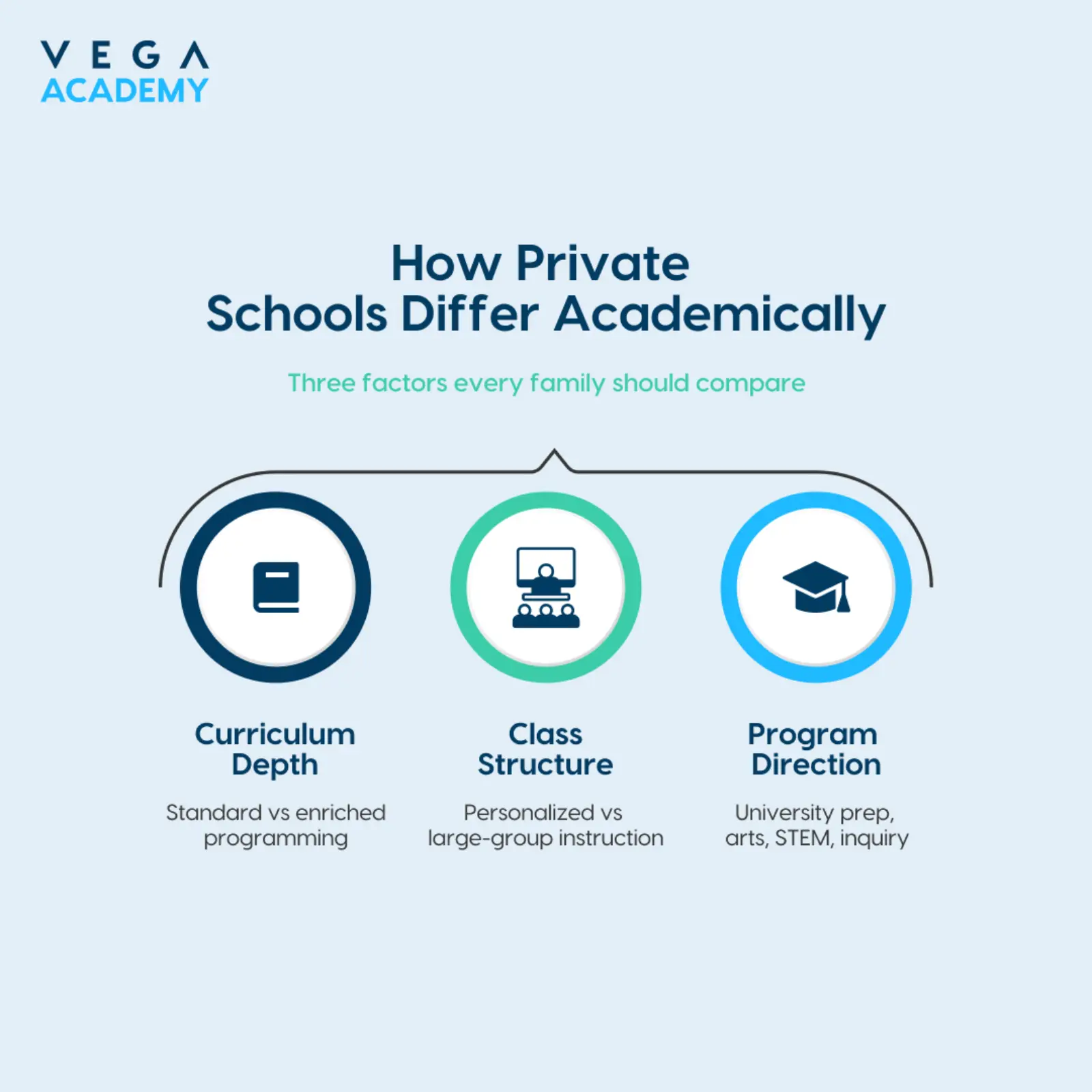
Ontario’s private schools are required to follow the Ontario curriculum for credit-bearing courses, but the way that curriculum is delivered, the depth to which it is taught, and the supplementary programming surrounding it vary considerably. Some private schools follow the standard provincial curriculum closely, while others layer additional academic content, independent research components, or enrichment tracks on top of the baseline requirements. Understanding where a school sits on that spectrum tells you a great deal about what kind of academic experience your student will actually receive.
Ontario Curriculum vs. Improved Programming
All Ontario private schools offering secondary credits must align with Ministry of Education guidelines, which set a floor for what is taught. The ceiling, however, is set by the school itself. Some private schools offer programming that goes significantly beyond the provincial standard in core subjects, including advanced mathematics sequences, extended essay requirements, or integrated STEM tracks that have no public system equivalent.
University Preparation Focus
Private schools that position themselves as university preparation institutions typically build their curriculum around the specific academic skills and documentation that selective universities look for. This includes not just grades but portfolio development, extracurricular depth, and personal statement preparation. Families interested in this track should review program details and admissions criteria carefully to confirm the school’s university placement history matches their expectations.
Class Size and Teaching Approach
One of the most tangible academic differences between private schools and public schools is class size. Smaller classes are not simply more comfortable. They change the nature of instruction by giving teachers the capacity to identify individual learning gaps early, provide real-time feedback, and adjust the pace of content delivery to the actual comprehension level of the group rather than the median student in a class of thirty.
The Impact of Small Class Sizes
- More instructional contact time: In a class of 10 to 15 students, each student receives more direct interaction with the teacher per session than in a class of 25 to 30. That difference compounds across a full school year into substantially more personalized instruction.
- Faster identification of gaps: Teachers in smaller classes notice when a student is struggling with a concept earlier and have more flexibility to address it before it affects performance on assessments. In larger classes, gaps often go undetected until a test result reveals them.
- Higher student engagement: Smaller class sizes reduce the ability to disengage silently, which raises participation rates and produces the kind of active discussion-based learning that improves comprehension and retention more effectively than passive note-taking.
Teaching Philosophy Differences
Some private schools operate on a traditional direct-instruction model where teachers lead structured lessons, while others use inquiry-based or project-led approaches that ask students to drive their own learning with teacher guidance. Neither approach is universally superior, but they produce very different classroom experiences and suit different learning styles. A student who needs clear structure and explicit instruction will struggle in a heavily inquiry-based environment, and vice versa.
Evaluating Academic Fit
Choosing the right private school means evaluating the fit between a student’s academic profile and the school’s specific structure, not simply selecting the school with the best reputation. The most effective way to assess fit is to visit the school, observe a class, speak directly with current teachers about how they handle students who need either acceleration or additional support, and review recent student outcomes in the areas that matter most to your family. You can also request more information directly from the schools you are considering to get a clearer picture of their academic approach and student support model before committing to a formal application.
Questions to Ask During School Visits
- Academic pacing: Ask how the school handles students who move faster or slower than the class average, since the answer reveals how flexible and individualized the instruction actually is in practice.
- Assessment approach: Ask how student progress is assessed and communicated to families. Frequent, transparent reporting is a positive indicator of academic accountability and teacher engagement with individual student outcomes.
- University outcomes: Ask for data on where graduating students have been accepted in recent years, including acceptance rates at specific institutions, as this gives you a concrete measure of the school’s university preparation effectiveness rather than a general claim about academic quality.
Frequently Asked Questions
Are all private schools in Ontario regulated by the province?
Private schools in Ontario are required to register with the Ministry of Education and must follow provincial curriculum requirements for any credit courses they offer. However, the oversight applied to registered private schools is less prescriptive than what governs the public system, which gives independent schools more flexibility in how they deliver instruction and structure their programs. Families should review a school’s registration status and ask directly about curriculum alignment to confirm that credits earned will be recognized for university application purposes.
How do private schools in Ontario differ from independent schools?
In Ontario, the terms private school and independent school are often used interchangeably, but independent schools is the term more commonly used by schools that are members of formal accreditation bodies like the Ontario Federation of Independent Schools or the Canadian Accredited Independent Schools association. Membership in these bodies typically indicates that the school has met a defined set of academic and governance standards reviewed by external evaluators. Checking a school’s accreditation status is a useful early filter when comparing options across the private education landscape in Ontario.
What academic advantages do private schools typically offer over the public system?
The most consistent academic advantages that private schools offer are smaller class sizes, more individualized instruction, and greater curriculum flexibility. These structural features allow private schools to serve students whose learning pace or style is not well accommodated by the standardized delivery model the public system uses at scale. For families evaluating these advantages in a specific school context, reviewing the school’s program structure and academic approach gives a clearer picture of how those advantages translate into daily learning outcomes for enrolled students.
Choosing the Right Private School Starts With the Right Questions
Private schools in Ontario can provide meaningful academic advantages when the school’s structure, teaching style, and university preparation approach align closely with how a student learns and performs. Institutions at similar price points may deliver very different outcomes depending on curriculum depth, class dynamics, and instructional philosophy. The strongest choice comes from visiting campuses, asking detailed questions about results and support systems, and selecting a school that demonstrates transparency, clarity about its ideal student profile, and consistent academic outcomes rather than relying on reputation alone.
Apply to Our School
Start your application to our day school program.