
STEAM education in Canada gives students a framework that connects science, technology, engineering, arts, and mathematics into a single, cohesive learning experience rather than treating them as separate subjects with separate skill sets.
As Canadian universities increasingly prioritize applicants who can demonstrate applied thinking, creative problem-solving, and cross-disciplinary competence, the schools and programs that integrate STEAM education in Canada give students a meaningful advantage in competitive admissions and in their first years at university.
At Vega Academy, applied learning and university-preparatory academic standards are built into the same program model, reflecting the same integrated philosophy that STEAM education in Canada.
Key Takeaways
What STEAM Education Means in Modern Schools
STEAM education in Canada refers to an instructional approach that connects Science, Technology, Engineering, Arts, and Mathematics through project-based, inquiry-driven learning rather than isolating each subject in its own curriculum silo.
The inclusion of the arts is what distinguishes STEAM from STEM, and it is precisely what makes the approach more reflective of how professional problems are actually solved: with both analytical precision and creative judgment.
The Origin of STEAM and What the A Adds
STEAM education grew from the recognition that STEM and STEAM education without the arts produced technically capable graduates who struggled with the communication, design, and creative problem-solving that most professional roles require.
The arts component does not mean art classes added to a science curriculum; it means that aesthetic reasoning, narrative construction, and design thinking are integrated into how students approach every subject. When a student uses visual design to present a data analysis or structures an engineering proposal as a persuasive argument, they are practicing the STEAM approach.
STEM vs STEAM: What the Difference Actually Means
The debate around STEM vs STEAM often focuses on even if the arts belong in a technically oriented curriculum, but the more accurate framing is that STEAM completes STEM by adding the dimension that technology and science alone cannot address: human context.
STEM vs STEAM is not a competition between disciplines; it is a recognition that the most effective practitioners in science and engineering are also strong communicators, ethical reasoners, and creative thinkers. Canadian universities increasingly assess these qualities in applicants alongside grades and test scores.
Applied Learning as the STEAM Methodology
Applied learning is the pedagogical engine of STEAM education in Canada, shifting instruction from content delivery to problem engagement. Students do not simply study scientific concepts; they apply them to real questions, produce tangible outputs, and reflect on what their process revealed. This applied learning model builds retention, motivation, and transferable thinking skills simultaneously, which is why research consistently shows that students in applied learning environments outperform their peers on both engagement and achievement measures.
How STEAM Differs From Traditional Subject Teaching
Traditional high school instruction assigns subjects to independent timetable blocks, teaches them in isolation, and assesses them separately, which makes it difficult for students to recognize how their learning connects. STEAM education in Canada deliberately connects those subjects through shared projects, cross-disciplinary challenges, and assessment criteria that reward synthesis as well as content recall.
A student building a science experiment, writing about its implications, and presenting findings visually is practicing STEAM integration within a single task.
Why Schools Are Expanding STEAM Programs
Schools across Canada are expanding STEAM education because workforce research, university admissions data, and student engagement evidence all point in the same direction: students who graduate with integrated, applied skill sets perform better across every post-secondary outcome than those with purely content-based preparation.
Labor Market Demand for STEAM Skills
The Canadian and global labor markets are creating STEAM-adjacent roles faster than traditional education systems are producing graduates prepared to fill them. Bureau of Labor Statistics projections indicate STEM jobs are growing at 10.4% between 2023 and 2033, nearly three times the growth rate of non-STEM occupations, and the creative and communication skills that STEAM adds to technical training are precisely what employers report as missing from recent graduates. STEAM education in Canada positions students at the intersection of technical competency and human skill, which is where most high-value roles now sit.
University Requirements Shifting Toward Integrated Competencies
Canadian universities, particularly those with competitive professional programs in engineering, health sciences, and business, are placing increasing weight on portfolio evidence of interdisciplinary learning, collaborative projects, and applied problem-solving rather than relying solely on grade averages.
A student who can demonstrate through a project that they applied science knowledge, communicated findings clearly, and iterated based on feedback has evidence of the competencies that admission committees for these programs specifically seek.
Student Engagement and Retention Benefits
One of the most consistent findings in STEAM education research is that students in STEAM environments report higher engagement, greater confidence, and stronger motivation than peers in traditional subject-isolated curricula. When learning feels connected to real problems and produces visible outcomes, students invest more of themselves in the process. Schools that have adopted STEAM models report lower disengagement rates, improved attendance, and higher teacher satisfaction alongside the academic outcome improvements.
Explore Vega Academy Programs
Real-World Skills Developed Through STEAM Learning
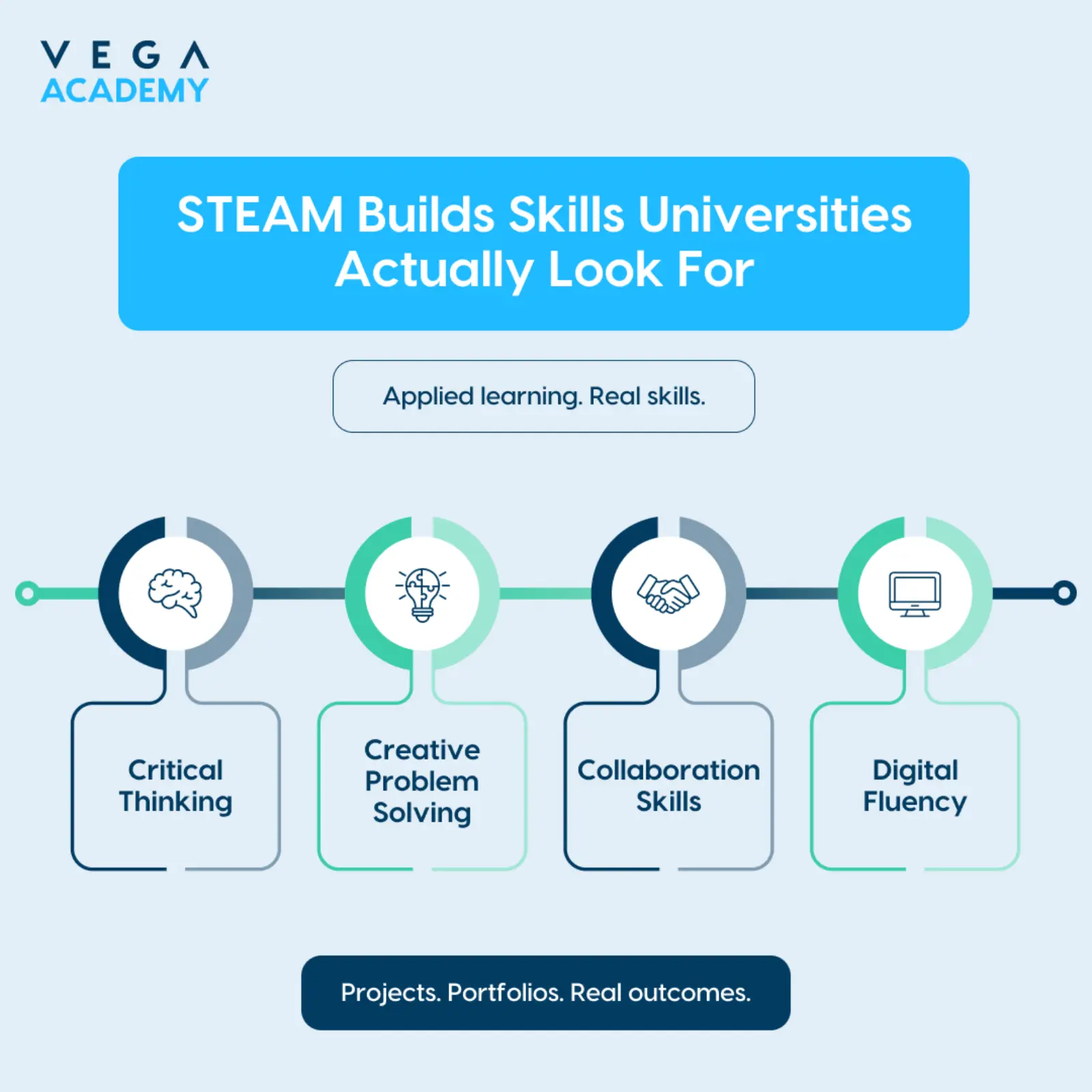
STEAM education in Canada produces a specific set of transferable skills that apply across academic programs, professional fields, and personal contexts. These are not generic competencies listed on graduate attributes documents; they are observable, assessable skills that students practice through every project, presentation, and cross-disciplinary challenge in a STEAM program. The list below outlines the core skills that STEAM education consistently builds.
- Critical thinking: Students learn to evaluate evidence, question assumptions, and form conclusions through structured inquiry that STEAM projects require at every stage.
- Creative problem-solving: Integrating the arts into technical challenges trains students to generate multiple approaches to a single problem rather than defaulting to the first formula that appears to apply.
- Cross-disciplinary communication: Presenting a science project as a created visual report, or writing an argument about an engineering decision, trains students to move fluidly between technical and humanistic modes of expression.
- Collaborative project management: Most STEAM projects require team coordination, role division, and shared accountability, building the professional collaboration skills that university group work and workplace teams demand.
- Iterative refinement: STEAM methodology treats revision as a core learning event rather than a sign of failure, which builds the resilience and process orientation that long-term academic and career success requires.
Interdisciplinary Learning Across Science and Technology
Interdisciplinary learning is the structural principle that makes STEAM education in Canada more than a collection of subjects taught in the same building. When science informs technology choices, technology enables engineering experiments, engineering produces artifacts that require artistic communication, and all of it depends on mathematical precision, students experience knowledge as a connected system rather than a series of isolated units.
How Project-Based Learning Builds Interdisciplinary Connections
Project-based learning is the most common vehicle for interdisciplinary learning in STEAM education in Canada because it requires students to draw on multiple disciplines to complete a single authentic task. A project asking students to design a sustainable urban space, for example, requires scientific knowledge of materials and ecology, technological tools for modeling, engineering principles for structural soundness, aesthetic design for livability, and mathematical calculations for scale and cost. No single subject contains the full toolkit the project requires.
The Role of the Arts in Science and Technology Courses
The arts are not ornamental additions to STEAM science and technology courses; they are functional components that make technical content more communicable, more human-centered, and more innovative. A student who writes a narrative about a scientific discovery retains the content more deeply than one who recites facts for a test, because narrative construction requires the student to understand causality and sequence well enough to communicate them. The arts component of STEAM education in Canada consistently produces better scientific communication and stronger design thinking alongside the technical competencies.
Connecting Mathematics to Creative and Applied Contexts
One of the consistent challenges in mathematics instruction is helping students understand why the subject matters beyond its own internal logic. STEAM education in Canada addresses this by embedding mathematical reasoning in applied and creative contexts where the purpose is visible. A student who calculates the proportional scaling needed for an architectural model, or who analyzes the statistical data behind a health study they are presenting, experiences mathematics as a tool for thinking rather than as an abstract sequence of procedures to memorize.
Technology as a Bridge Between Disciplines
Technology occupies a unique position in STEAM education in Canada because it functions as both a subject and a tool: students learn about technology while also using it to explore every other discipline in the framework. Coding, data visualization, digital fabrication, and simulation tools give students the means to test scientific hypotheses, produce engineered prototypes, create artifacts, and present mathematical findings in ways that deepen engagement with each underlying discipline while building digital fluency simultaneously.
How STEAM Supports University Preparation
STEAM education in Canada aligns closely with what leading Canadian universities describe as their ideal incoming student profile: academically rigorous, intellectually curious, collaborative, and capable of independent inquiry. Vega Academy’s university pathway program is built on exactly this alignment, combining advanced academic content with applied learning experiences, mentorship from International Business University students, and early exposure to university-level expectations.
Building the Portfolio Evidence Universities Are Requesting
STEAM projects produce the portfolio evidence that competitive university programs increasingly want alongside traditional transcripts. A student who can submit a design project that demonstrates scientific research, technical skill, and clear communication has concrete proof of the competencies that a grade average alone cannot show. This kind of applied learning portfolio is particularly valuable for programs in engineering, architecture, design, health sciences, and any field where professional practice involves making, not just knowing.
Developing the Academic Habits University Requires
University academic culture expects students to work independently, manage long-cycle projects, seek information proactively, and produce original analysis rather than reproduce content. STEAM education in Canada builds all of these habits through its project-based structure, because students must take ownership of complex tasks, seek resources across multiple disciplines, and produce outputs that demonstrate original synthesis. Students who enter university with these habits already established adapt to the independent study demands of post-secondary learning significantly faster than those accustomed to teacher-directed instruction.
The Role of Innovation and Technology in STEAM
Innovation and technology are the engines of STEAM education in Canada, both as subjects and as tools through which every other STEAM discipline is practiced and expressed.
Teaching Innovation as a Learnable Practice
Innovation is often treated as a natural talent rather than a learnable skill, but STEAM education in Canada consistently demonstrates that when students are given the structure, tools, and permission to generate, test, and iterate ideas, they develop innovation as a reliable practice rather than as an occasional inspiration. The iterative design cycles at the core of STEAM projects, where students build, test, revise, and rebuild, are the same cycles that professional innovation processes use across every industry.
Digital Tools as Amplifiers of STEAM Learning
Digital tools extend the reach of STEAM education in Canada by making phenomena visible that would otherwise be inaccessible, by enabling rapid prototyping that would be impossible with only physical materials, and by connecting students to data sets and collaborative tools that reflect professional practice. Coding environments, simulation software, 3D design tools, and data visualization platforms are not separate technology courses in a STEAM model; they are instruments that students pick up and put down as their projects require them.
Challenges Schools Face When Implementing STEAM
Implementing STEAM education in Canada effectively requires schools to address real structural challenges that range from curriculum design to teacher preparation. Below, identify the most common implementation barriers and what distinguishes schools that overcome them from those that do not.
Teacher Preparation and Interdisciplinary Confidence
Most teachers are trained within a single discipline and are assessed and certified within that discipline, which makes it genuinely difficult for them to confidently facilitate learning at the intersections of science, technology, engineering, art, and mathematics simultaneously. Effective STEAM education in Canada requires schools to invest in ongoing professional development that builds teachers’ comfort with cross-disciplinary facilitation rather than expecting their subject expertise alone to carry a STEAM program.
Resource and Infrastructure Requirements
STEAM education in Canada often requires physical and digital infrastructure that traditional classroom setups do not provide: maker spaces, design labs, coding environments, and collaborative project areas. Smaller schools with limited capital budgets face genuine barriers in building these environments from scratch, which is one of the reasons that independent and private schools with purpose-built academic environments have been early adopters of effective STEAM models in Ontario and across Canada.
Balancing STEAM With Ontario Curriculum Requirements
Schools implementing STEAM education in Canada must ensure that the interdisciplinary project work they introduce still covers the Ontario curriculum expectations that students are assessed against for university admissions. This is not an irresolvable tension, but it requires careful curriculum mapping so that STEAM projects are created to simultaneously address specific curriculum outcomes rather than supplementing them as extracurricular enrichment, which is where many early STEAM programs fell short.
How Schools Design Effective STEAM Learning Environments
Effective STEAM learning environments share a set of design principles that are more important than the physical space or the technology available. Below identify the structural and pedagogical decisions that distinguish STEAM programs that produce the outcomes the research supports from those that adopt the label without the substance.
Designing for Student Agency and Inquiry
Effective STEAM education in Canada places students in the position of investigators rather than recipients, which means the learning environment must be structured to support open-ended questioning, independent research, and iterative building rather than step-by-step instruction toward a predetermined answer. This requires teachers to function as facilitators and mentors rather than as primary knowledge sources, and it requires students to develop the tolerance for uncertainty that genuine inquiry demands.
Integrating University Connections Into the Program
STEAM education in Canada is most effective when students can see and experience the university and professional contexts their learning is preparing them for, rather than being told those connections exist. Vega Academy’s IBU partnership and North Star mentorship program put university students and professors in direct contact with high school learners throughout the academic year, giving STEAM-oriented students concrete exposure to how their applied learning skills are valued and practiced at the post-secondary level.
Building Assessment Into the Creative Process
Assessment in an effective STEAM environment is not a separate event that follows learning; it is embedded in the learning process through portfolio documentation, peer review, presentation critique, and reflection protocols that help students understand their own development across the full STEAM framework. This approach to assessment mirrors the professional feedback cycles that STEAM careers involve, making the assessment experience itself a form of applied learning rather than an interruption of it.
Starting With Strong Academic Foundations
The most effective STEAM education in Canada does not sacrifice content knowledge for project variety; it uses rigorous academic content as the foundation on which interdisciplinary projects are built. Students who do not understand the science cannot engineer a credible solution; students who are not mathematically fluent cannot design with precision; students who have not read widely cannot communicate their findings with the clarity and persuasion that STEAM education demands. Academic rigor and STEAM methodology are not in tension; each one makes the other more effective.
Frequently Asked Questions
What is the difference between STEM and STEAM education in Canada?
How does STEAM education in Canada help with university admissions?
Students who enter the admissions process with a portfolio of applied projects that demonstrate these skills have a substantive advantage over those whose application consists entirely of grades and extracurricular lists. Vega Academy’s connection to International Business University through its IBU partnership gives students early exposure to university-level expectations and relationships with university staff and students that directly strengthen their admissions readiness.
Is STEAM education in Canada only for students interested in science and technology careers?
A student interested in law benefits from the evidence-based argumentation and data interpretation skills that STEAM builds; a student interested in healthcare benefits from the design thinking and patient communication skills that arts integration provides; a student interested in business benefits from the analytical and creative synthesis that STEAM education in Canada consistently develops.
Choose an Education That Builds More Than a Transcript
STEAM education in Canada is the most coherent answer to the question of what skills students actually need to succeed in university, in competitive careers, and in a world that requires both technical precision and human judgment. Vega Academy is built around the principles that make STEAM education effective: rigorous academic content, applied learning experiences, university-level mentorship, and the expectation that students will produce work that demonstrates real competency rather than remembered content. If you are ready to experience an education created for what comes next, explore the Vega Academy day school program or review summer program options to find the pathway that fits your academic goals and timeline