
Summers used to be the season families treated as a pause on learning. That has shifted over the past several years, especially among families thinking seriously about competitive university admissions in Canada and abroad. A growing number of high school students now spend part of their summer in structured academic programs, not because their school year fell short, but because the right summer experience gives them something the regular calendar rarely allows: time to go deep on one subject, explore a new academic environment, and build the kind of independence universities are looking for.
The difference between a summer well spent and a summer simply filled comes down to structure, mentorship, and intention. A student who spends six weeks in a program built around academic skill-building, exposure to university-style learning, and honest feedback walks into September with a different level of readiness than a student who spent the same six weeks in a loosely organized camp.
Why Summer Learning Matters
Summer learning is often framed as a way to prevent knowledge fade, the gradual loss of skills that can happen over a long break. But for students with their sights set on competitive university programs, that framing undersells what a well-structured summer can actually do. The real opportunity isn’t just maintaining ground. It’s gaining it.
Here’s why summer learning makes a meaningful difference for university-bound students:
Deeper Focus Than The School Year Allows
During the regular semester, a student might spend 40 minutes a day on any one subject while managing five or six others simultaneously. A summer program removes that pressure and replaces it with concentrated, sustained attention, the kind of focus that produces genuine understanding rather than surface familiarity.
A Chance to Get Ahead, Not Just Keep Up
Students who use the summer to strengthen a challenging subject or explore a new one walk into September with less academic anxiety. That confidence shift shows up in class participation, in the quality of their written work, and in their willingness to ask for help when something doesn’t click.
Low-Stakes Practice for High-Stakes Skills
University coursework rewards students who can manage their own deadlines, work independently, and engage critically rather than just memorize. A summer program built around those expectations gives students a chance to practice them before the full weight of first year arrives.
Early Exposure to University-Style Learning
Sitting in a class that expects discussion, defends arguments, and moves faster than a high school course is a different experience entirely. Students who’ve already navigated that environment, even for a few weeks, end to feel more prepared when it counts.
Momentum That Carries Into the School Year.
The effects of a productive summer don’t stay in summer. Students return to their regular programs with sharper skills, clearer study habits, and a stronger sense of what they’re capable of academically.
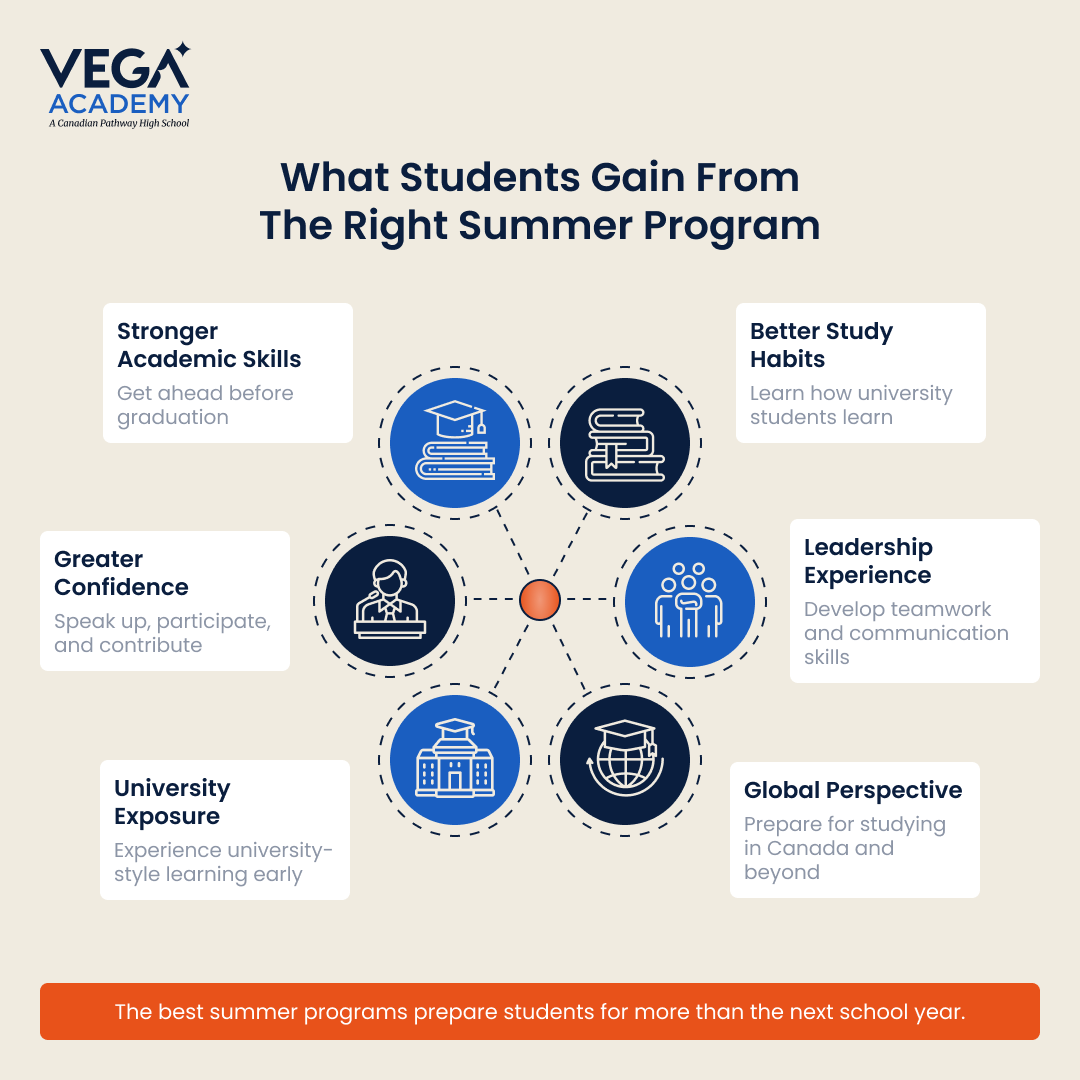
Academic Benefits Beyond the School Year
The most obvious benefit of a summer academic program is the subject-matter progress itself, strengthening a weak area in math, getting a head start on a Grade 11 or 12 course, or exploring a subject the regular timetable doesn’t offer. The benefits extend well past the curriculum.
Academic Readiness
Universities expect students to arrive comfortable with independent study, managing multiple deadlines, and producing work that goes beyond a textbook chapter. A summer program built around these expectations gives students a low-stakes environment to practice them before the academic and social pressure of the first year arrives all at once.
Cultural Exposure
For international students, a Canadian summer program offers something a standard semester abroad cannot: a shorter, lower-pressure introduction to Canadian classroom norms, communication styles, and academic expectations, backed by dedicated student support. Students arrive at their full program with a clearer sense of what to expect, which shortens the adjustment period once the academic year begins in earnest.
Future Study Planning
A summer spent at a Toronto-based academic program also gives students and families a genuine trial run. Instead of committing to a full year sight unseen, a family can use a summer term to evaluate the academic environment, the support structure, and the program’s overall fit before making a longer-term decision.
Building Confidence Through New Experiences
Confidence is one of those outcomes that’s hard to capture on a transcript but shows up almost immediately in how a student carries themselves academically.
Students who try something unfamiliar over the summer, a subject they’ve never studied formally or a learning environment that pushes them to think and argue rather than memorize, tend to come back to their regular school year more willing to take intellectual risks.
This matters more than it might seem. University-level coursework rewards students who are comfortable being wrong in front of others, who can defend a position under questioning. And who don’t freeze when a professor asks a follow-up they didn’t anticipate.
Those are learned behaviors tied closely to sharper analytical thinking, and a summer program that creates space for genuine intellectual exploration, rather than just content delivery, is one of the more reliable ways to build them before university actually starts.
STEAM Learning During the Summer
STEAM-focused summer programming, covering science, technology, engineering, arts, and mathematics, has become one of the more sought-after formats for students aiming at competitive programs in business, data analytics, health sciences, or engineering. The appeal isn’t simply exposure to these fields. It’s the chance to apply concepts to applied problems in a setting where mistakes are part of the learning process rather than something to avoid.
A student working through an applied math or data project over the summer is doing something different from completing a worksheet. They’re forming a hypothesis, testing it, getting it wrong, and revising, which is precisely the kind of intellectual habit that strong university applications and strong first-year performance both depend on.
Leadership Development Through Summer Programs
Leadership is another quality universities look for that doesn’t develop naturally inside a standard classroom structure built around individual grades. Summer programs that incorporate group projects, peer mentorship, or student-led presentations give students a low-pressure setting to practice organizing others, taking initiative, and communicating a point of view clearly.
Some of the most effective leadership development happens informally, through students mentoring each other on a shared project or taking the lead on a presentation simply because the structure of the program invites it. These moments tend to matter more to a student’s long-term development than a formal title or position ever could.
University Exposure Before Graduation
One of the more distinctive aspects of a summer program tied to a university partner is direct access to university-style teaching, university facilities, and university students themselves. At VEGA Academy, that connection runs through the partnership with International Business University, where students sit in live university classes, attend networking events, and explore campus life well before their actual application year.
This kind of exposure changes how students think about the transition to university. Instead of imagining what a lecture hall or a professor’s expectations might be like, they’ve already experienced it. That familiarity tends to translate into a calmer, more confident first semester once they actually enroll.
International Student Summer Experiences
For students coming from outside Canada, a summer program offers a bridge between their home academic system and the expectations of Canadian or North American higher education. Beyond the academics, there’s a practical adjustment: getting comfortable with a new city, a new style of classroom discussion, and a different relationship between student and teacher than many international students are used to.
A summer term gives international students the chance to work through that adjustment in a shorter, supported window, instead of facing all of it at once during their first full semester. Students who’ve already spent a summer in Toronto tend to settle into their day school or university programs with noticeably less friction.
Toronto as a Living Classroom
Toronto’s downtown core puts students within walking distance of major financial institutions, cultural landmarks, and one of the most diverse urban environments in North America. A summer program based in the city center isn’t simply located somewhere convenient. It uses the city itself as part of the learning experience, a site visit relevant to a business case study, or simply the day-to-day experience of navigating a global city independently.
Students who spend a summer in downtown Toronto leave with more than academic content. They leave with practical experience managing their own schedule, their own transportation, and their own independence in a way that mirrors, in miniature, what university life will actually demand of them.
How Families Evaluate Summer Programs
With so many summer options available, families benefit from a clear set of criteria rather than choosing based on marketing alone. Questions are always welcome, and the admissions team is available to walk through any of the criteria below in more depth.
- Academic structure: Does the program have a defined curriculum and clear learning objectives, or is it loosely organized around general enrichment?
- Class size and mentorship: Will the student receive individual attention, or are they one of dozens in a lecture-style format?
- University connection: Does the program offer direct exposure to university-level teaching, facilities, or mentorship from current university students?
- Outcome clarity: Can the program describe specifically what a student will be able to do differently after completing it?
- Location and environment: Does the setting itself contribute to the learning experience, or is it incidental to the program?
Choosing the Right Summer Opportunity
The right summer program depends heavily on where a student currently stands and what they’re trying to build. A student who is strong academically but wants leadership experience needs a different format than a student trying to close a skill gap before Grade 11 math. A student preparing to study abroad needs cultural and academic exposure that a purely local program may not provide.
Families considering VEGA Academy’s Summer Programs can speak directly with the admissions team about which track best matches a student’s current academic standing and future goals, strengthening core subjects, building STEAM project experience, or getting an early, structured look at university-level expectations.
Key Takeaways
Frequently Asked Questions
What age or grade level is appropriate for an academic summer program?
How does a summer program affect a student's regular school year performance?
Should international students choose a summer program before committing to a full academic year abroad?
Starting the Conversation Early
The students who get the most out of a summer program are usually the ones whose families started the conversation early, rather than scrambling to fill a calendar gap in late spring. Looking at summer options with the same intention as a regular school year decision, asking about structure, mentorship, and university connection, tends to produce a far better outcome than choosing based on convenience alone.
Families interested in how VEGA Academy structures its summer offerings, including the academic tracks available and how the program connects to university-level learning through the partnership with International Business University, can reach out directly to start that conversation.