
AI is already inside most students’ daily lives. It filters their search results, curates their feeds, and writes on demand. Students who do not understand how it works cannot use it wisely. AI literacy is what separates students who use AI as a tool from those who are used by it.
Key Takeaways
What AI Literacy Means for Students
What is AI literacy, exactly, and how is it different from knowing how to use ChatGPT? AI literacy is the ability to understand, evaluate, and use AI tools responsibly. It includes knowing how AI makes decisions and where it falls short. Vega Academy’s curriculum model integrates AI literacy as a practical skill across all subject areas.
Understanding What AI Can and Cannot Do
AI tools are powerful, but they have consistent and predictable limitations. They generate plausible text, not verified facts. They do not know what they do not know. Students who understand this use AI outputs as a starting point. Those who do not often submit inaccurate work with full confidence. That gap is exactly what AI literacy training is created to close.
AI and Digital Literacy as Connected Skills
AI and digital literacy are related but not the same skill set. Digital literacy covers using technology tools safely and effectively. AI literacy adds a deeper layer: understanding how the tools think. A digitally literate student can use software; an AI-literate student can evaluate it. Both skills are increasingly required at the same time in professional settings. Schools that teach one without the other are only solving half the problem.
The Difference Between Using AI and Understanding It
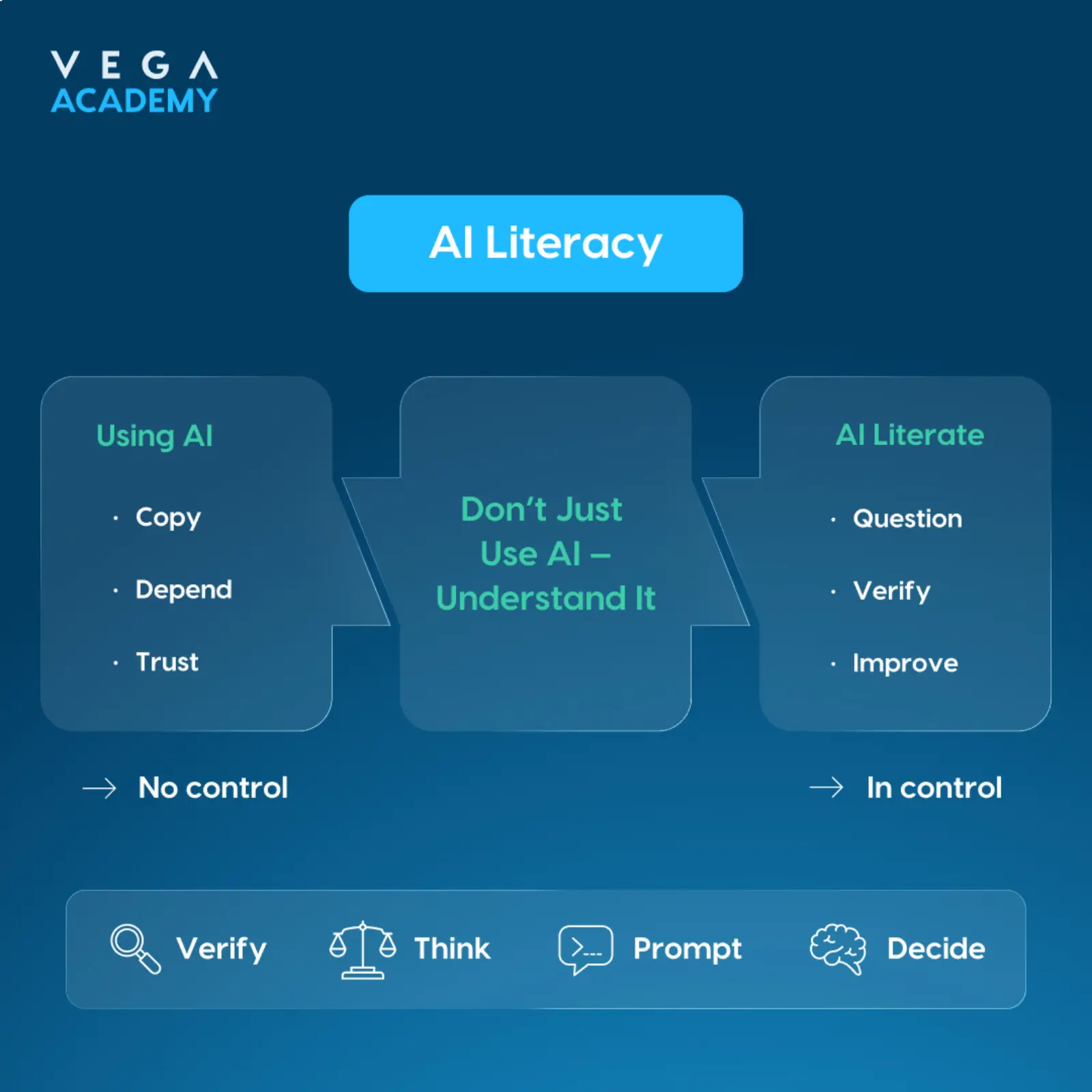
Most students are already using AI in schools on a daily basis. But using a tool is not the same as understanding how it works. A student who can only use AI is dependent on what it produces. A student with AI literacy can question, verify, and improve the output. That critical layer is the defining feature of genuine artificial intelligence education. It is also the layer that employers actively look for when hiring.
How AI Literacy Connects to Critical Thinking
AI literacy is not a technical skill; it is a thinking skill. It requires students to ask: how was this output generated? Whose data trained this model and what biases might that produce? Is this information accurate, and how would I verify it independently? These are the same critical thinking questions strong academic programs already teach. AI literacy extends that thinking into one of the most consequential tools students face.
Why Artificial Intelligence Is Changing Education
Artificial intelligence education is no longer an optional addition to the curriculum. AI is already embedded in how students research, write, and present work. Schools that ignore this shift are preparing students for a world that no longer exists.
AI Is Already Inside the Classroom
AI in schools is not a future scenario; it is a current fact we live in. Over 60% of K-12 teachers already used AI tools in the 2024 to 2025 school year. Students use AI for research, writing, brainstorming, and solving math problems. The tools are in every pocket, on every laptop, and in every browser. School policies that pretend otherwise are managing a situation that has already changed. The effective response is teaching students how to use these tools with judgment.
AI Is Changing What Skills Employers Require
Employers are hiring for AI competence faster than schools are teaching it. ChatGPT and prompt engineering are among the most added skills on LinkedIn. Upskilling workers in AI is now the top strategy for 47% of business leaders. This means students leaving school without AI literacy training are already behind. The gap between what schools teach and what employers require is measurable now. AI literacy for students is the direct educational response to that gap.
AI Is Reshaping Academic Assessment
AI has fundamentally changed what academic assessment looks like. Essays submitted without process documentation are now difficult to verify. Schools are moving toward oral defenses, drafts, and process-based evaluations. This shift requires students to own their thinking, not just their final product. Students with genuine AI literacy can demonstrate their reasoning openly. Those who use AI without understanding it cannot survive this new standard.
AI Is Creating a New Kind of Academic Inequality
Students with access to AI tools and AI literacy training have a structural advantage. Those without access or instruction are falling further behind each semester. This is a new form of digital literacy gap that schools must address deliberately. AI in schools with unequal reach creates unequal outcomes. Structured AI literacy programs are the most direct way to close that gap. Schools that build AI literacy into every program, not just technology electives, lead here.
Learn AI. Lead Tomorrow.
Vega Academy builds AI literacy into every subject area.
Responsible Use of AI Tools in Schoolwork
Responsible AI use is a central part of what AI literacy actually teaches. It is not enough to know how to get output from an AI tool. Students must understand when to use it, how to verify it, and when not to rely on it.
Academic Integrity and AI
Academic integrity in the AI era requires a new level of transparency. Submitting AI-generated work as original is dishonest by most school standards. But using AI as a research or brainstorming tool with proper disclosure can be legitimate. The key distinction is between using AI to think and using it to replace thinking. Students with AI literacy understand that distinction and can apply it correctly. Those without guidance often get the boundary wrong in both directions.
Verifying AI Outputs Before Using Them
AI tools can produce confident-sounding statements that are completely false. This is sometimes called hallucination, but the academic term is error. Students who accept AI output without checking it will eventually submit false information. Verification means finding the original source and confirming the claim independently. This is a foundational research skill that AI literacy training makes more urgent. Schools that teach source verification alongside AI use prepare much stronger students.
Understanding AI Bias and Its Implications
AI models are trained on human-generated data, which includes human biases. Those biases appear in the outputs students use for essays and research. A student who cannot recognize AI bias will reproduce it unintentionally. AI and digital literacy education address this directly and practically. Students learn to question whose perspective a model was trained to represent. That critical lens applies equally to media, research, and professional communication.
Privacy and Data Responsibility
Many students submit personal information to AI tools without realizing the risk. AI platforms can retain and potentially use data entered into prompts. Submitting a school assignment with personal details creates an unreviewed data trail. AI literacy training teaches students what data to withhold and why. Digital literacy and AI literacy overlap most directly in this area of practice. Students who understand data responsibility are safer online in every context.
AI as a Tool for Research and Learning
When students understand AI literacy, AI becomes a genuine learning accelerator. It can help students explore unfamiliar topics, test their own understanding, and identify gaps. The difference between AI as a crutch and AI as a tool is literacy.
Using AI for Structured Brainstorming
Brainstorming with AI is one of the clearest legitimate uses for students. A student can prompt an AI to generate multiple angles on a topic. They can then evaluate those angles using their own judgment and course knowledge. This process builds critical evaluation skills rather than bypassing them. The student remains the thinker; the AI is a conversation partner. AI literacy training is what teaches students to maintain that distinction under pressure.
Accelerating Topic Research with Appropriate Skepticism
AI can summarize large amounts of content faster than any search engine. Students can use this to build initial topic maps for a research paper. But the sources underlying those summaries must always be independently checked. An AI summary is a starting point, never a citation-worthy source. Students who understand this use AI to accelerate, not replace, authentic research. This is exactly the productive pattern that artificial intelligence education encourages.
Getting Feedback and Testing Arguments
AI tools can provide feedback on the structure and clarity of student writing. Students can ask AI to argue against their thesis to test its strength. This adversarial prompting is a legitimate and rigorous study technique. It forces students to anticipate counterarguments before submitting their work. Good AI literacy training teaches students to use AI as a thinking partner. That is fundamentally different from using AI to complete thinking for them.
Personalized Learning Through AI Platforms
Adaptive AI learning platforms adjust difficulty to match each student’s level. Students who understand AI literacy can evaluate even if those adjustments are accurate. They can also identify when a platform’s model of their understanding is wrong. This metacognitive layer is what distinguishes passive from active AI learning. Schools like Vega Academy integrate AI platforms with human teacher oversight. That combination produces the strongest and most balanced learning outcomes.
Skills Students Gain Through AI Literacy
AI literacy for students is not a single technical skill. It is a cluster of interconnected cognitive, ethical, and practical abilities. Students who receive structured AI literacy training develop all of the following. These skills are transferable across every subject and every career pathway.
Prompt Engineering and Effective Communication
Prompt engineering is the skill of writing clear, effective AI instructions. A poorly written prompt produces a vague and unhelpful AI response. A well-written prompt produces targeted, relevant, and actionable output. Learning to write good prompts teaches students to communicate precisely under constraints. That precision carries directly into academic writing, professional emails, and presentations. Prompt engineering is the AI literacy workshop skill that most immediately improves academic work.
Source Evaluation and Information Verification
AI literacy forces students to develop stronger source evaluation habits. Because AI outputs can be wrong, students learn to check everything by default. This habit extends naturally to evaluating websites, articles, and social media. Students who learn to distrust AI blindly become better consumers of all information. That critical stance toward sources is one of the most valued university skills. AI in schools has made information verification a core competency rather than a bonus skill.
Ethical Reasoning About Technology
AI raises ethical questions that no previous technology has raised quite this directly. Who owns AI-generated content? What happens when AI is wrong and no one checks? How should AI be used in hiring, healthcare, or criminal justice? Students who engage with these questions develop practical ethical reasoning skills. Artificial intelligence education that includes ethics produces more responsible graduates across every field.
Adaptability to Emerging Technology
The specific AI tools students use today will be replaced within a few years. Students who understand AI principles will adapt to new tools much faster. AI literacy is not about mastering one platform; it is about mastering a mindset. That mindset asks: how does this tool work, and what are its limits? Students who apply that question consistently will adapt to technological change throughout their careers. This adaptability is precisely what the fastest-changing sectors of the economy need most.
Collaboration with AI as a Professional Competency
Future workplaces will not choose between humans and AI. They will require humans and AI to collaborate effectively. Students who practice this collaboration in school arrive at work already prepared. They know how to delegate routine tasks to AI and retain judgment on complex ones. That delegation skill is exactly what 47% of business leaders say they need most. AI literacy training builds this collaborative capacity from secondary school through graduation.
- Critical thinking: AI literacy sharpens the ability to evaluate claims and verify sources independently.
- Prompt precision: Students learn to communicate clearly and specifically to produce useful AI outputs.
- Ethical judgment: AI literacy training develops the ability to identify bias and apply ethical reasoning.
- Data awareness: Students understand what personal and academic data they share and with whom.
- Research independence: AI-literate students verify AI output rather than accepting it as authoritative.
- Tech adaptability: Understanding AI principles allows students to adjust quickly to new tools.
- Collaborative AI use: Students learn to integrate AI into workflows without replacing their own thinking.
- Academic integrity: AI literacy establishes a clear and principled framework for responsible AI use in school.
Frequently Asked Questions
What is AI literacy and why do students need it?
How is AI literacy different from just knowing how to use AI tools?
How can I get started with AI literacy training for my students?
The Students Who Learn AI Literacy Now Will Lead Later
AI literacy is not a future skill to prepare for; it is a present requirement. Students who understand AI now will direct how it is used in their fields. Those who only use it without understanding will be directed by those who do. This is not a technology question; it is an education quality question. Schools that take AI literacy seriously produce students who are not just technically capable. They produce graduates who are thoughtful, adaptable, and genuinely difficult to replace.
Vega Academy builds AI literacy into its academic programs as a core competency. It is not treated as an elective or an add-on; it is part of how every subject is taught. Explore the regular day school program or the summer programs to find the right entry point for your student’s AI literacy journey.
Start Learning AI Now
Vega Academy’s summer program covers AI literacy in practice.