
STEM and STEAM education differ in that one defines a multidisciplinary framework, while the other focuses on how that framework is actually taught and experienced in learning environments. While the conversation around these two concepts has existed for years, both aim to prepare students with the critical thinking, creativity, and technical skills needed in an increasingly complex world. By looking beyond the surface, where STEAM integrates the arts into STEM and STEAM education shapes how that integration is delivered, families can better understand which approach aligns with their goals for meaningful, future-ready learning.
Key Takeaways
What STEAM Education is in Schools
STEAM education focuses on five interconnected disciplines: science, technology, engineering, arts, and mathematics. The approach uses applied learning and problem-solving as primary methods. Vega Academy’s regular day school program integrates STEAM thinking into its core academic curriculum.
The Core Subjects of STEAM Education
STEAM instruction connects these five disciplines in practical ways. Students learn by working through real problems rather than memorizing facts.
S – Science
Science in STEAM programs is hands-on and inquiry-based. Students create experiments to test their own questions. They learn to observe, measure, and draw evidence-based conclusions. This approach builds scientific thinking from the earliest grades.
T – Technology
Technology in STEAM goes beyond using computers and screens. Students learn to create with technology, not just consume it. Coding, robotics, and digital creation are common technology applications. These skills connect directly to the fastest-growing job categories today.
E – Engineering
Engineering teaches students to solve problems with systems thinking. Students design, build, test, and improve physical or digital solutions. The engineering process mirrors authentic professional workflows and develops persistence and logical decision-making under constraints.
A – Arts
Arts in STEAM bridges creativity and analytical thinking. Students apply design principles, visual communication, and creative expression across all disciplines. This integration encourages innovative approaches to problem-solving and helps students communicate their ideas more effectively.
M – Mathematics
Mathematics in STEAM is applied, not abstract. Students use math to interpret data from their own science experiments and apply calculations within engineering and technology projects. This context makes mathematical concepts more meaningful and memorable.
How Applied Learning Defines STEAM Instruction
Applied learning is the foundation of strong STEAM programs. Students work on projects that connect classroom content to real-world situations. Applied learning builds transferable skills that last well beyond the classroom, and it is the key reason STEAM graduates are consistently prepared for the demands of modern careers.
What STEAM Education Adds to STEM Learning
STEAM education adds the arts to the existing STEM framework. The A in STEAM stands for Arts, which is broadly defined. It includes visual art, creative thinking, music, theatre, and writing. The goal is not to replace STEM; it is to strengthen it.
Why the Arts Were Added to STEM
The arts were added to STEM for a practical reason. Industries began asking for graduates who could both build and communicate. Technical skill alone does not produce good product design. It does not produce clear data visualization or user-centered software either. STEAM recognized that creativity was being systematically trained out of students. Adding the arts restored that balance without compromising technical depth.
What Arts Integration Looks Like in the Classroom
Arts integration does not replace math with painting. In a STEAM classroom, students might visualize data through illustration. They might use theatrical storytelling to explain a scientific process. They might apply creative principles to an engineering prototype. The arts become a tool for deeper engagement with STEM content. This is the practical difference in how STEM vs STEAM plays out daily.
How STEAM Supports Diverse Learners
Not every student thrives in a purely analytical learning environment. Some students access scientific concepts most naturally through creative work. STEAM creates multiple entry points into the same subject matter. This makes technical content more accessible across different learning styles. It also improves retention by connecting logic with imagination. Students who once felt excluded from STEM often thrive in STEAM programs.
Key Differences Between STEM and STEAM Education
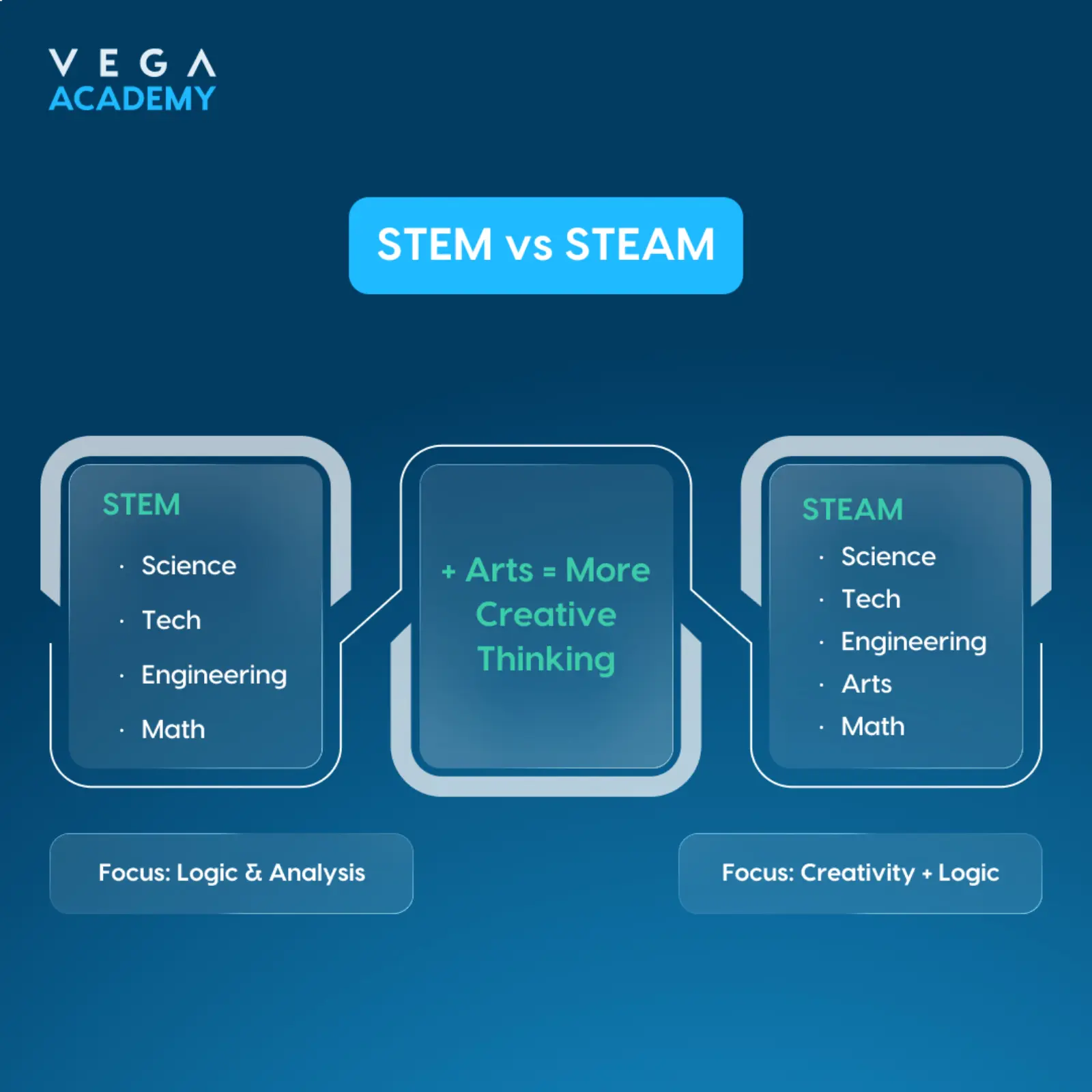
The STEM vs STEAM education comparison comes down to scope. STEM focuses on technical disciplines with structured, analytical methods. STEAM broadens that scope by including creative and humanistic perspectives. Both produce capable graduates; they produce them with different strengths.
Curriculum Structure
STEM curricula center on technical problem-solving within four disciplines. STEAM curricula weave creative thinking across all five areas. In STEM education, art and creativity are not separate subjects. They appear inside math, science, engineering, and technology units. This integration requires more flexible lesson planning from teachers. It also produces projects that look and communicate differently.
Assessment Approaches
STEM programs are typically assessed through tests, projects, and data output. STEAM programs are assessed through portfolios, presentations, and creative products. Both methods measure understanding, but they measure different things. STEM assessment emphasizes precision and correct technical answers. STEAM assessment also values originality, communication, and creating quality. This broader rubric captures a wider range of student competencies.
Career Preparation
STEM graduates are well prepared for technical roles in most industries. STEAM graduates add design, communication, and creative capacity on top. Employers in technology increasingly seek both kinds of graduates. UX design, product development, and health communication all need both. The STEM and STEAM education distinction matters less at the senior level. Most senior technical roles eventually require creative and human skills.
- Technical depth: STEM builds a stronger analytical focus in core science and math disciplines.
- Creative breadth: STEAM adds creative thinking, communication, and artistic problem-solving.
- Student engagement: Research shows STEAM programs often produce higher student motivation levels.
- Applied learning access: Both models use applied learning, but STEAM uses more creative project formats.
- Skill transferability: STEAM graduates can apply skills to a wider range of industries and roles.
Why Many Schools Are Expanding STEAM Programs
Schools across Canada and North America are expanding STEAM education programs. The reasons are both research-based and market-driven. Student outcomes data and employer demands point in the same direction. STEAM is not a trend; it reflects a structural shift in what education needs to produce.
Employer Demand for Creative Technical Skills
Technical employers now list creative and communication skills in job postings. Software companies want engineers who can explain their work to non-engineers. Medical device companies want designers who understand both biology and aesthetics. AI companies want developers who can make complex systems understandable. These are not soft skills; they are professional requirements. STEAM programs produce graduates who meet this dual demand from day one.
Student Engagement and Retention
Student disengagement in STEM programs is a well-documented challenge. Many technically capable students leave STEM due to a lack of a creative outlet. STEAM programs retain more students across demographic groups. The arts component gives technically inclined students a broader identity. It also attracts students who would never have considered STEM alone. Schools expanding STEAM programs typically report stronger enrollment stability.
The Role of Schools Like Vega Academy
Private schools have the flexibility to build genuine STEAM models. They are not constrained by the same curriculum delivery pressures as public schools. Vega Academy’s approach to STEAM-focused learning embeds arts and applied learning into every academic subject. Students do not experience STEAM as a special class or add-on program. They experience it as the default way their school teaches everything.
Skills Students Build Through STEM and STEAM Learning
Both STEM and STEAM programs build skills beyond subject knowledge. The best programs produce graduates ready to think, not just recall. The bullets below outline the skills consistently developed across both models.
- Critical thinking: Students learn to analyze evidence and reach reasoned conclusions independently.
- Problem-solving: Applied learning projects require generating and testing original solutions.
- Collaboration: Most STEAM projects require productive teamwork across different strengths.
- Creative design: STEAM adds the ability to solve technical problems with aesthetic awareness.
- Data literacy: Students learn to interpret, visualize, and communicate numerical information.
- Technical communication: STEAM graduates explain complex ideas to both technical and general audiences.
- Resilience: Engineering and creating projects builds tolerance for failure and iteration.
- Digital fluency: Both models develop comfort with technology tools across many contexts.
How Families Can Evaluate STEM or STEAM Programs
Not all programs that use the STEM or STEAM label deliver on the promise. Families should look past the label and ask specific questions. Below are practical criteria to evaluate any program honestly. Use these to compare schools, ask the right questions, and decide with confidence.
Ask About Applied Learning Frequency
Strong STEM and STEAM programs use applied learning most of the time. Ask how often students complete hands-on projects versus seated instruction. Programs that default to textbooks are not genuinely STEAM-aligned. Look for portfolios of student work, not just test score averages. The presence of prototypes, presentations, and creative outputs is a good sign. Their absence is a signal that the program is STEAM in name only.
Look for Genuine Arts Integration
True STEAM education integrates art into other subjects, not alongside them. Ask even if art projects connect directly to science or math units. If the art class and the math class never intersect, it is not STEAM. Look for student work that combines technical and creative skills in one piece. create challenges, science-themed murals, and data visualizations are good examples. Ask a student to describe their most recent project for the clearest answer.
Assess Teacher Quality and Training
STEAM instruction requires teachers trained in cross-disciplinary thinking. A science teacher who is not comfortable with creative work will avoid it. Ask even if teachers have received specific STEAM professional development. Look for evidence of teacher collaboration across departments. Schools where teachers plan together produce stronger integrated curricula. Single-subject siloes rarely produce a genuine STEM vs STEAM education distinction.
Review Graduate and Student Outcomes
Ask where graduates from this program go after completing their diplomas. Strong STEAM programs produce students accepted to competitive university programs. They also produce students with portfolios, not just transcripts. Vega Academy’s summer programs let students experience this approach before committing to full enrollment. Outcomes data from actual graduates is the most reliable evaluation tool available.
Try STEAM This Summer
Frequently Asked Questions
Is STEAM better than STEM for university preparation?
Does STEAM education produce weaker math and science outcomes?
How can I find a genuine STEAM school in Ontario?
Choose the Learning Model That Fits Your Student’s Future
The STEM vs STEAM education question has no single right answer. Both models are grounded in applied learning and technical preparation. STEAM broadens that foundation to include the full range of professional skills. The right choice depends on your student’s strengths and post-secondary goals.
Vega Academy offers a curriculum built on STEAM principles throughout. Applied learning and arts integration are not extras; they are the standard. Explore the regular day school program or the summer programs to see what a complete STEAM education model looks like in a high school setting.