
The Ontario Secondary School Diploma is the foundational credential for university admission across Canada, but not all OSSD programs are built with the same university outcomes in mind. An OSSD university pathway goes further than standard diploma completion by structuring coursework, credit selection, and academic support specifically around the requirements that competitive university programs expect. For families evaluating secondary school options, understanding how a pathway program is designed and what it actually produces for students is the most practical place to start.
Key Takeaways
What an OSSD University Pathway Means
The OSSD is awarded to students who complete a defined set of compulsory and elective credits under Ontario’s secondary school curriculum, along with literacy and community involvement requirements. A university pathway program uses the same diploma structure as its foundation but organizes credit selection, course sequencing, and academic enrichment around the profile that university admissions processes reward. The result is a diploma that satisfies all Ministry of Education requirements and simultaneously positions the student as a strong candidate for competitive post-secondary admission.
The Role of Credit Selection
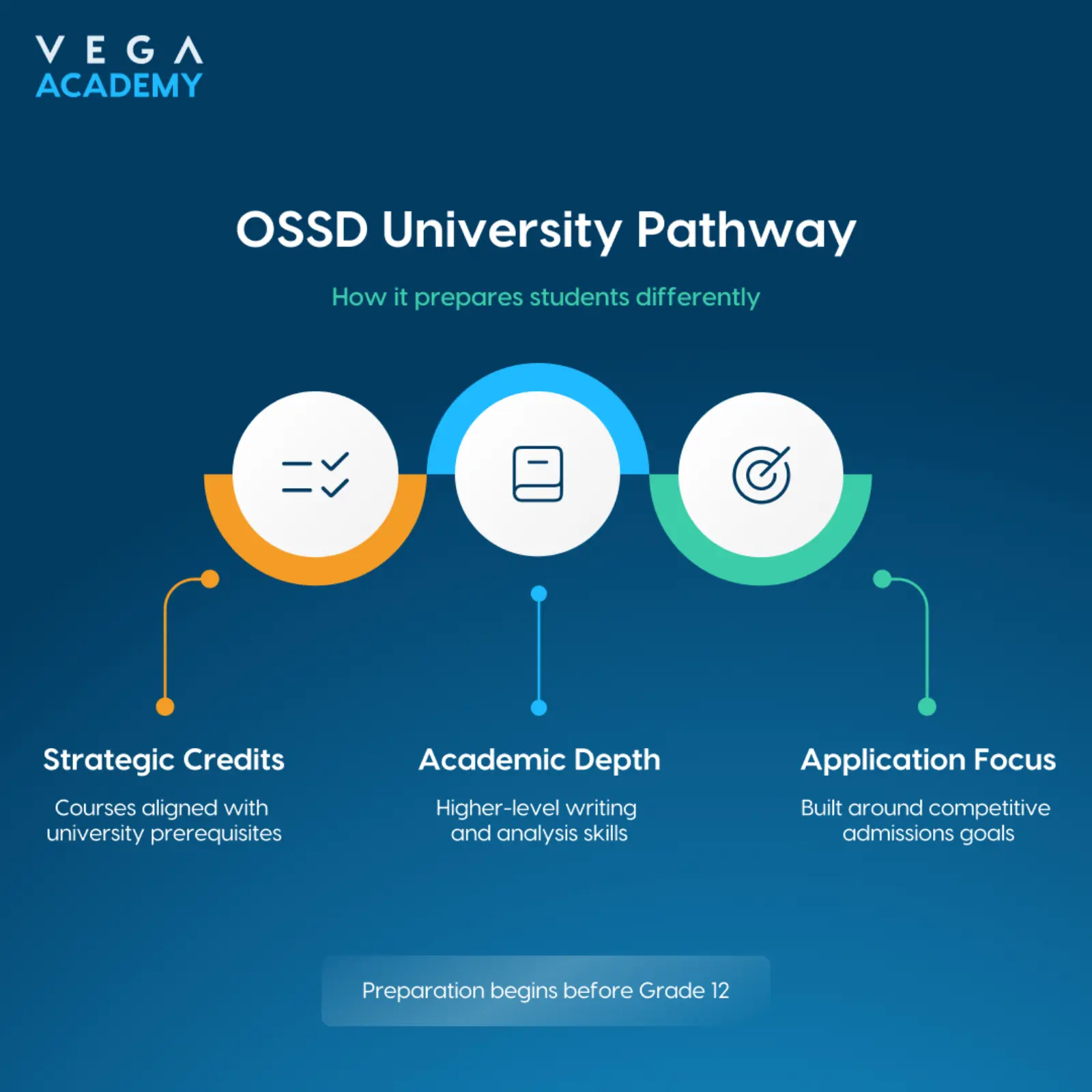
Not all OSSD credits contribute equally to a university application. University programs specify prerequisite courses and weight certain subjects heavily in admission calculations, so the credits a student takes in Grades 11 and 12 determine both their eligibility for specific programs and the strength of their application average. A university pathway builds its course plan around those requirements from the start rather than addressing them reactively in Grade 12.
University-Track vs. Standard OSSD Completion
- Prerequisite coverage: A university-aligned OSSD pathway confirms that a student has completed all required prerequisites for their target programs before applying, eliminating the risk of arriving at Grade 12 with a strong average but missing a required course that disqualifies the application.
- Grade 12 U-level course concentration: University admission averages in Ontario are typically calculated from the top six Grade 12 University-level courses. A pathway program structures the Grade 12 year around maximizing performance in those specific courses rather than distributing effort across a broader and less strategically focused course load.
- Documentation and transcript preparation: Pathway programs typically support students in organizing transcripts, identifying relevant supplementary applications, and preparing the academic documentation that competitive programs require beyond the standard application form.
Academic Design Behind a University-Aligned Pathway
A well-designed OSSD university pathway is not simply a rigorous course load. It is a structured academic environment where curriculum delivery, support resources, and assessment standards are aligned with the expectations students will encounter in their first year of university. Families interested in how a specific program is built can review program details and fee structure to understand what the pathway covers and what the enrollment commitment involves.
Curriculum Depth and University Benchmarks
Courses in a university pathway program are taught at a level of analytical depth that goes beyond standard secondary delivery. Teachers structure lessons around the critical thinking, written argumentation, and independent problem-solving skills that university marking rubrics reward, not just the content knowledge that provincial examinations assess. Students completing these courses develop a working familiarity with the academic standard they will face in their first year before they arrive on campus.
Ossd University Credits and Their Value
- Advanced course content: Pathway programs cover the OSSD curriculum while extending subject depth in ways that prepare students for first-year university coursework in their intended field. A student in a science-focused pathway, for example, will engage with laboratory methodology and research documentation at a level that standard high school science does not reach.
- Writing and analytical preparation: University-level written work is assessed differently from secondary school assignments. Pathway programs build these skills explicitly through structured essay practice, source-based argumentation, and iterative feedback that reflects university marking standards rather than provincial rubrics.
- Academic habits and self-management: A university pathway high school environment expects students to manage their workload with limited external prompting, track their own progress, and seek support proactively. Building those habits in secondary school is one of the most consistent predictors of smooth first-year university performance.
Support Structures Within the Pathway
A pathway program without structured academic support is simply a demanding course load. Effective university pathway programs pair high academic expectations with responsive teacher access, clear progress tracking, and early identification of subject-area gaps before they affect application averages. Students who struggle in a pathway program and receive no support are worse off than if they had remained in a standard program, which is why the support model is as important to evaluate as the curriculum itself.
Explore Summer Programs
Build your university pathway with focused summer academics
Who Benefits Most From This Structure
An OSSD university pathway is not the right structure for every student, and identifying the right fit requires an honest assessment of how a student currently learns and what they are working toward academically. Students who benefit most are those who are motivated by clear goals, capable of self-directed study, and ready to be held to academic standards that push beyond their current comfort level. Families who want to evaluate fit before committing can request detailed program information to assess how the program structure matches their student’s learning profile.
Goal-Oriented Students With Specific University Targets
- Students with defined post-secondary goals: A student who knows they want to study engineering, health sciences, or commerce benefits significantly from a pathway that structures their secondary credits, course sequencing, and preparation specifically around those admission requirements rather than general academic readiness.
- Students who need structure and accountability: Pathway programs provide a clear academic framework with defined expectations, which suits students who perform better with structured goals and regular feedback than with open-ended course selection and minimal academic guidance.
Students Transitioning From Other Systems
International students and students moving from curriculum systems outside Ontario frequently benefit from a structured OSSD university pathway because it provides not just academic preparation but systematic guidance through the Ontario credit system, the OUAC application process, and the specific requirements that Canadian universities apply to applicants from different educational backgrounds. Without that guidance, students navigating a new academic system often discover gaps in their application profile too late to address them.
High-Potential Students Seeking a Competitive Edge
Students who already perform well academically and are targeting competitive programs at selective universities benefit from the pathway structure because it shifts the question from admission eligibility to which programs will compete for them. A strong student in a standard secondary program may have the grades but lack the course profile, supplementary preparation, or documented academic depth that top-ranked program admissions require. A pathway builds that profile deliberately rather than leaving it to chance.
What Parents Should Confirm Before Enrolling
Enrolling a student in an OSSD university pathway program is a meaningful academic commitment, and the questions families ask before enrollment determine how well-informed that commitment is. The most important areas to investigate are the program’s track record with university placements, the specific support structures in place for students who need additional help, and how the program handles credit recognition at the universities the student is targeting. Families can also learn more about how the school approaches university preparation to assess alignment with their expectations before making a final decision.
University Placement History
- Acceptance data by program and institution: Ask for data on where graduating students have been accepted in recent years, including specific faculties and universities, as this gives a concrete picture of the pathway’s actual outcomes rather than its stated goals.
- Average improvement over the program duration: Ask how student averages typically change between Grade 10 entry and Grade 12 graduation within the pathway. A program that consistently produces measurable grade improvement alongside strong university placements is demonstrating real academic value, not just selecting high-performing students at intake.
Credit Transfer and Recognition
- Ontario university recognition: Confirm that all OSSD credits completed through the pathway are recognized by the Ontario Universities Application Centre and accepted by the universities the student is applying to. This is a baseline requirement that every pathway program should be able to confirm without qualification.
- Ossd university credits and advanced standing: If the program offers any courses for university credit or advanced standing, ask which universities recognize those credits, what grade is required to trigger recognition, and what documentation students need to provide during their university enrollment process.
Frequently Asked Questions
Is an OSSD university pathway recognized the same way as a standard OSSD by Ontario universities?
Yes. An OSSD university pathway produces the same Ministry of Education-recognized Ontario Secondary School Diploma that standard secondary programs produce, which means it meets all admission eligibility requirements for Ontario universities through OUAC. The pathway designation refers to the program’s internal academic structure and focus, not to a different credential type. What differs is the quality and strategic alignment of the academic preparation that led to the diploma, which shows up in the student’s course profile, application average, and supplementary documentation rather than in the credential itself.
Can a student enter an OSSD university pathway mid-program, such as in Grade 11?
University coursework assumes students can research using academic databases and judge source credibility without guidance. Students who build this skill in high school adjust faster to university-level research expectations.
How does a university pathway high school program differ from tutoring or test preparation?
Tutoring and test preparation are supplementary supports designed to address specific gaps within an existing academic program. A university pathway high school program is the primary academic environment, responsible for delivering the full curriculum, awarding OSSD credits, and shaping the complete academic profile that universities will assess. The difference in scope is significant: a pathway program builds the student’s full secondary record, course by course, with university admission as the organizing objective, while tutoring supports performance within a structure that someone else controls.
Choose the Pathway That Prepares You for the University You Want
An OSSD university pathway is effective because it aligns course selection, academic rigor, support systems, and application planning around clear university entry requirements from the very beginning. This structured approach ensures students build the grades, prerequisites, and academic profile that competitive programs expect. Families make stronger decisions when they evaluate pathways against specific university goals, asking detailed questions about placements, grade averages, credit recognition, and support systems to assess real outcomes rather than relying on general program descriptions.
Start Your Application Now
Enroll in a program built for university-bound students.