
A failed or incomplete credit in secondary school does not have to mean a delayed graduation, but addressing it effectively requires understanding what credit recovery options are available, how each model works within the Ontario system, and how the timing of recovery affects both the graduation timeline and the university application process. Credit recovery is more common than most families realize, and the students who navigate it successfully are those whose families identified the gap early and responded with a structured plan rather than hoping the situation would resolve itself. Understanding the full range of support options available through different secondary school environments is the starting point for any family managing a credit shortfall.
Key Takeaways
Why Students Need Credit Recovery
Credit gaps in high school develop for a range of reasons that are not always visible to families until they surface in a transcript review or a guidance counsellor conversation. Understanding the most common causes helps families recognize risk factors early and take action before a single failed credit becomes a pattern that affects graduation planning and post-secondary options.
Academic Difficulty in Specific Subjects
Some students perform well across most of their secondary courses but struggle significantly in one or two subject areas, particularly mathematics, senior sciences, or language courses at the University level. A course that is repeated without addressing the underlying gap in foundational knowledge often results in a second failure, which is why credit recovery programs that include targeted academic support are more effective than simple course repetition for students in this situation.
Attendance and Health-Related Disruptions
- Extended absences: Illness, mental health challenges, or family circumstances that require extended time away from school can result in credit incompletion even for students who were performing adequately before the disruption. Credit recovery in these cases is often straightforward because the academic capability is present and the barrier was circumstantial.
- Transition disruptions: Students who transfer between schools, move between provinces, or transition from international curricula into the Ontario system sometimes arrive with credit gaps that do not reflect academic difficulty but rather differences in how prior learning is recognized and mapped to Ontario secondary credit requirements.
Course Selection Errors
Students who take College-level courses when their university program requires university-level prerequisites sometimes discover the gap late in secondary school and need to complete the correct course through credit recovery before applying. This situation is entirely preventable with early graduation planning; instead, it is one of the more common reasons students find themselves needing ossd credit recovery in their final secondary year.
Different Credit Recovery Models in Ontario
Ontario’s secondary system offers several distinct credit recovery pathways, and the right choice depends on the type of credit needed, the student’s timeline for graduation and university application, and the academic support required to pass the course successfully. Families evaluating these options can review program structures and scheduling details to understand what each model involves before making a decision.
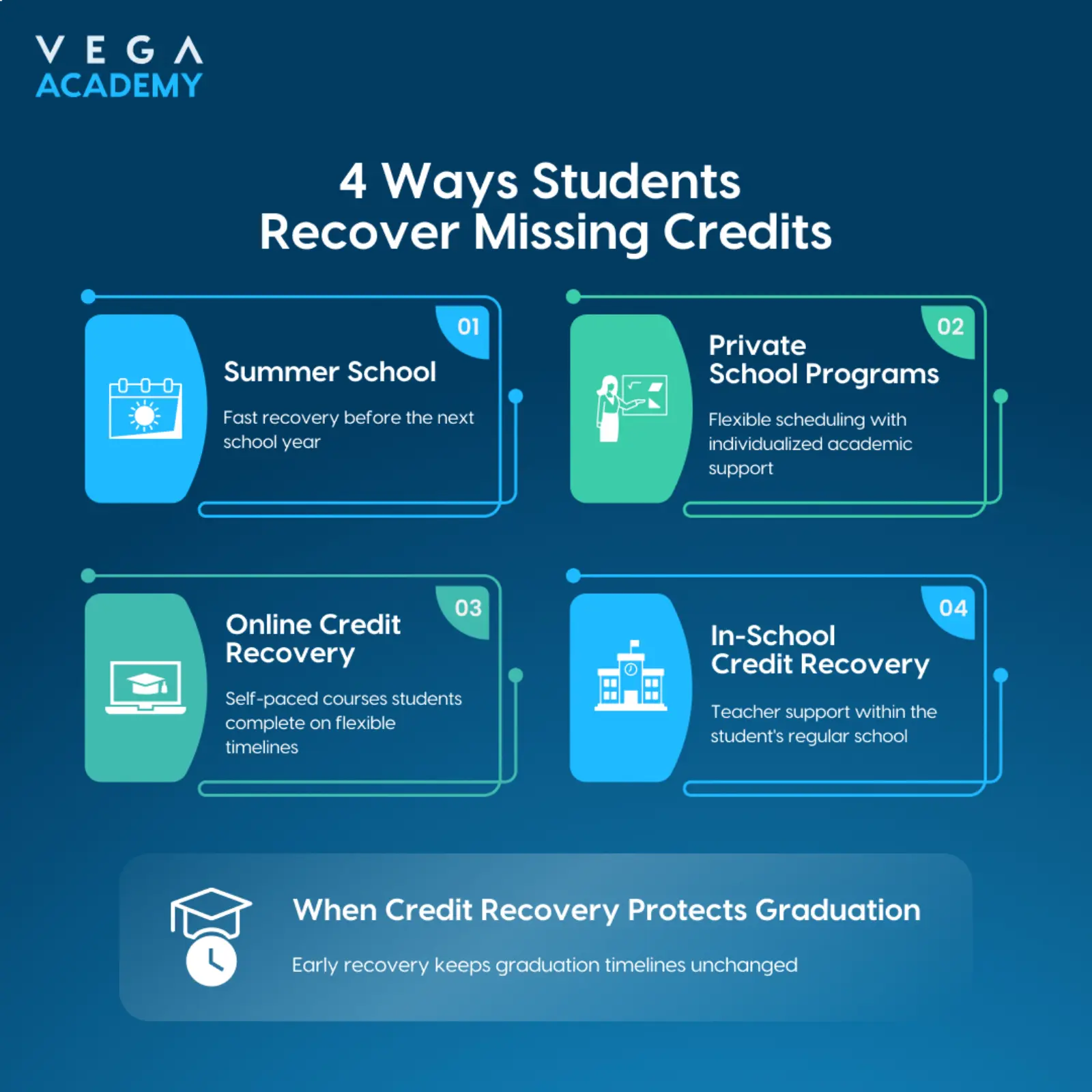
Summer School Credit Recovery
Ontario’s publicly funded summer school programs offer credit recovery courses in a compressed format, typically running over four to six weeks in July and August. They are widely available and accessible at no additional cost for eligible students, making them the default option for many families. The compressed timeline requires sustained daily engagement, which works well for motivated students with a single credit to recover, but can be challenging for students who struggled with the course material during the regular school year and have not addressed the underlying academic gaps.
- Timeline fit: Summer credit recovery allows students to complete a missing credit before the fall semester begins, preserving their Grade 12 course load and graduation timeline without requiring a schedule change during the academic year.
- Grade implications: Grades earned in summer school credit recovery appear on the student’s transcript and, for Grade 12 University-level courses, factor into the application average calculated by Ontario Universities Application Centre. Students who have not addressed the reasons for an original course failure may not perform significantly better in a compressed summer format.
Private School and Independent Program Credit Recovery
Private and independent secondary schools offer credit recovery through both semester-based enrollment and accelerated individual course completion, providing more scheduling flexibility and often more individualized academic support than publicly funded options. For students who need credit recovery alongside targeted academic assistance rather than simple course repetition, a private school credit recovery program can address both the missing credit and the underlying subject-area gap simultaneously.
- Flexible scheduling: Independent programs can often schedule credit recovery courses on timelines that fit around a student’s existing academic commitments, including completing a single course outside of normal school hours or during a non-standard semester.
- Individualized support: Smaller class sizes and more accessible teachers in independent school environments allow credit recovery students to receive the subject-specific help they need rather than progressing through compressed content at a pace that does not account for individual learning gaps.
E-Learning and Online Credit Recovery
Ontario’s provincially delivered e-learning system and several registered private online schools offer credit courses that students can complete on a flexible schedule, which makes online credit recovery a practical option for students managing full-time school alongside a missing credit. The self-directed nature of online credit recovery suits students who are organized and motivated, but can result in slow progress or incomplete courses for students who require external structure to maintain academic momentum.
Impact on Graduation and University Entry
The effect of credit recovery on graduation timing and university admission depends on when the credit gap is identified, which recovery model is used, and how the recovered credit interacts with the student’s overall course profile and application average. A student who identifies a missing credit in Grade 11 and completes credit recovery over the summer has a very different outcome than one who discovers the gap in the final semester of Grade 12.
When Recovery Preserves the Graduation Timeline
Credit recovery that is completed before or during the final year of high school typically does not delay graduation. A student who fails a Grade 10 required course and completes it through summer school before Grade 11 begins returns to their original graduation timeline with the missing credit addressed and no disruption to their Grade 11 and 12 course sequence. Early identification is the single most important factor in preserving the graduation date.
When Recovery Delays Graduation
- Final-year credit shortfalls: Students who enter Grade 12 with a compulsory credit outstanding and do not complete recovery before their graduation date will not receive their diploma in the expected semester. The delay is typically one semester, assuming the missing credit is addressed immediately, but it can extend if multiple credits are outstanding.
- Prerequisite gaps discovered late: Students who discover in Grade 12 that they are missing a university prerequisite course have limited options that can be completed before application deadlines. Late prerequisite recovery may require deferring university applications by a year or applying to programs that do not require the missing prerequisite and transferring to the target program after the first year.
University Application Implications
For students applying to Ontario universities, credit recovery grades in Grade 12 University-level courses factor directly into the application average. A student who recovers a Grade 12 prerequisite through summer school with a strong result improves both their eligibility and their average simultaneously. A student who recovers the same credit with a marginal passing grade may satisfy the graduation requirement without improving their competitive position in the application pool. The quality of the credit recovery outcome matters, not just the completion.
When Credit Recovery Is the Right Choice
Credit recovery is appropriate any time a missing or failed credit is creating a barrier to graduation, prerequisite completion, or university program eligibility and the student has the academic readiness to successfully complete the course through an available recovery model. The decision about which model to use should account for the student’s learning profile, the time available before the next application or graduation deadline, and the academic support the student will need to succeed. Families who want to assess the right approach for their student’s specific situation can request more information about credit recovery options and academic support available through different program types.
Signs That Credit Recovery Is the Appropriate Response
- Single credit shortfall with clear cause: A student who failed one course due to a specific, addressable cause such as an extended illness, a family disruption, or a single subject-area gap is an excellent candidate for credit recovery. The academic pattern is otherwise strong, and the missing credit is a specific problem with a specific solution.
- Course type mismatch needing correction: A student who completed a College-level course in a subject where University-level is required for their target program needs to complete the correct course version, which is a credit recovery situation even if the original course was passed. The missing element is not the credit itself but the correct course type.
When to Consider Broader Academic Restructuring
Students with multiple missing credits, a pattern of incomplete courses across subjects, or persistent difficulty maintaining engagement with secondary school may need more than individual credit recovery courses. In these cases, a broader academic restructuring through enrollment in an independent school with individualized programming may address the underlying issues more effectively than addressing each missing credit separately through standard recovery models.
Planning Ahead to Avoid Delays
The most effective credit recovery strategy is one that never becomes necessary because graduation planning was thorough enough to prevent credit gaps from developing undetected. Graduation planning that reviews credit completion status, prerequisite coverage, and course level alignment at the end of each secondary year gives families the information they need to address gaps while options are still plentiful. Families can learn more about how proactive graduation planning is built into specific high school programs by reviewing how academic planning is structured within different secondary school environments.
Annual Credit Audits
Reviewing a student’s credit completion status and course level alignment at the end of each school year identifies any gaps while there is still time to address them through summer credit recovery or adjusted course selection in the following year. A student who completes a credit audit after Grade 10 and discovers a missing compulsory credit has two full years to address it. The same student who discovers the gap in October of Grade 12 has almost no options that do not affect their graduation date or university application timeline.
- Compulsory credit checklist: Mapping the student’s completed credits against the full list of OSSD compulsory requirements each year confirms that no required course has been missed or incorrectly substituted, preventing the kind of late-stage surprise that creates timeline pressure.
- Prerequisite coverage review: Confirming that the student’s course plan covers all prerequisites for their target university programs before the end of Grade 11 leaves a full final year to address any gaps through credit recovery without affecting the application timeline.
Working With Schools That Prioritize Graduation Planning
Schools that build graduation planning into their standard student support model are better positioned to identify credit recovery needs before they become timeline emergencies. Independent and private secondary schools with smaller student loads and more direct family communication typically provide more proactive credit monitoring than large public schools, where guidance counsellors manage hundreds of students simultaneously. Choosing a school environment with a strong graduation planning infrastructure is itself a form of credit recovery prevention.
Frequently Asked Questions
Does a grade earned through credit recovery affect a university application average?
Can OSSD credit recovery be completed through a private school if a student is currently enrolled in a public school?
How long does OSSD credit recovery typically take?
Address Credit Gaps Early and Protect Your Graduation Timeline
Credit recovery is a practical and well-established part of Ontario’s secondary education landscape, and students who need it are not in an unusual or unrecoverable situation. The families who navigate it successfully are those who identify the gap promptly, choose the recovery model that fits the student’s learning needs and timeline, and approach the recovery course with the academic seriousness that its consequences for graduation and university admission deserve.
Graduation planning that includes regular credit audits, prerequisite checks, and honest conversations with school guidance staff is the most reliable way to keep credit recovery a manageable single-course solution rather than a multi-credit crisis that compresses options and creates timeline pressure. For students who need support going through this process, the right school environment makes the difference between a setback that is addressed efficiently and one that compounds into a more significant delay.