
A university pathway high school is not simply a school that mentions university in its marketing. It is a secondary school whose entire academic structure, from course sequencing and curriculum depth to teaching approach and student support, is organized around producing graduates who are genuinely ready for competitive university admission and first-year academic success. The difference that structure makes, compared to a standard secondary school delivering the same Ontario curriculum, shows up consistently in the course profiles, application averages, and university performance of the students who go through it.
Key Takeaways
Why Families Look Beyond Traditional High School Models
The standard public secondary school model delivers the Ontario curriculum competently for the majority of students it serves, but families with specific university goals for their children frequently encounter limitations in what that model provides. Class sizes that prevent individualized attention, guidance counsellor caseloads that limit the depth of university planning support, and academic pacing that reflects the median student rather than the prepared one are structural constraints that a university pathway high school is specifically designed to remove. Families who want to understand how a pathway-focused school approaches these gaps can learn more by reviewing how our program is structured.
The Limits of Standard Secondary Delivery for University-Bound Students
A public secondary school in Ontario typically serves hundreds of students across a wide range of academic intentions and post-secondary paths. The resources, pacing, and support structures within that school are calibrated to serve that full range rather than to optimize outcomes for the subset of students targeting competitive university admission. Students who need more than the standard model provides often find the gap most acutely in Grade 12, when it is too late to change the course decisions and academic habit formation that earlier years produced.
What Families Are Actually Looking For
- Smaller class sizes with more teacher contact: Families who move their students to a university pathway high school consistently cite class size and teacher accessibility as primary motivations, because individual attention during secondary school is the structural feature most directly linked to grade improvement and academic confidence.
- Strategic course planning built into the school experience: Rather than relying on a student to independently navigate prerequisite requirements and university program eligibility, pathway schools provide structured course planning as part of the standard enrollment experience, ensuring that the right credits are completed in the right sequence.
What Defines a University Pathway High School
The term university pathway high school describes a school whose academic design, from curriculum delivery to student support, is organized around the specific outcomes that competitive university admission and successful first-year performance require. It is not a designation awarded by a regulatory body but a description of how the school operates in practice. Families evaluating specific schools should look past the label and assess if the actual program structure, course offerings, and fees reflect a genuine pathway commitment rather than a marketing position.
Curriculum Delivery at University-Adjacent Depth
A genuine university pathway high school delivers the Ontario secondary curriculum at a level of analytical depth and academic rigor that goes beyond standard provincial requirements. Teachers structure lessons around the critical thinking, written argumentation, and independent problem-solving skills that university marking rubrics reward. Students completing courses in a pathway school are not just learning content but developing the academic processing skills that make the content useful at the post-secondary level.
Structured University Preparation as a Core Program Feature
- Course sequence planning: Pathway schools map each student’s credit selection to their target university programs from the start of secondary school, ensuring that prerequisites are covered, course level selections are appropriate, and the Grade 12 profile positions the student competitively for the programs they are applying to.
- Application support integration: University preparation in a pathway school is not a separate service added on top of the academic program. It is built into the school’s standard offering, covering OUAC application guidance, supplementary application support, and personal statement preparation as part of what the school provides to every enrolled student.
How University Pathways Prepare Students Earlier
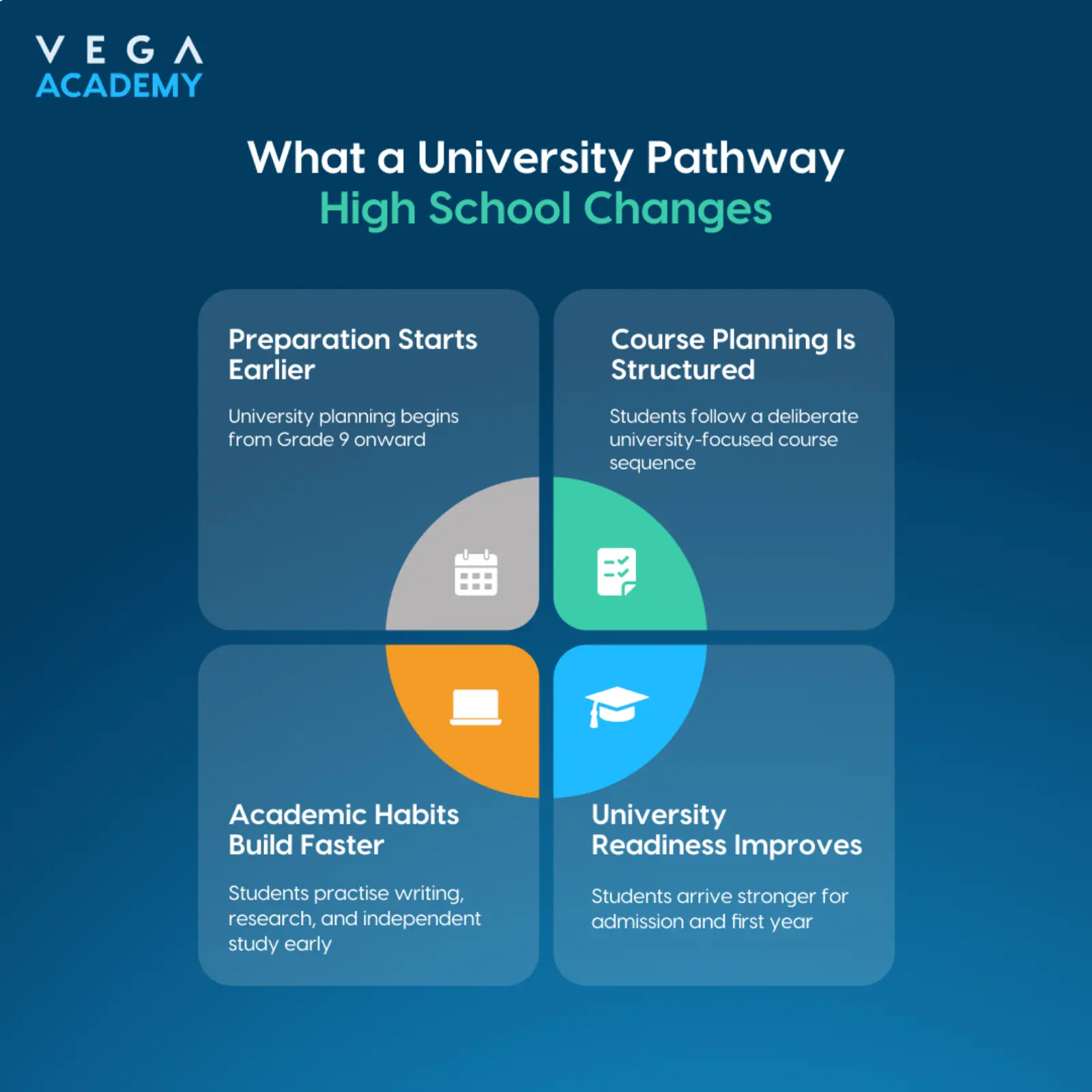
One of the most consistent advantages of a university pathway high school over a standard secondary program is that preparation begins in Grade 9, not in the final semester of Grade 12 when application deadlines are approaching. The academic habits, subject fluency, and course profile that determine university admission quality are built across four years of secondary school, and a school that is not actively building them from year one is leaving significant development time unused.
Building Academic Habits From Grade 9
- Independent work capacity: Pathway schools require students to manage significant independent reading, research, and writing workloads from the first secondary year, developing the self-direction and time management skills that first-year university demands before the stakes of those demands are as high.
- Analytical writing from the start: Written assignments in pathway schools are evaluated against standards that reflect university-level expectations for argument structure, evidence quality, and original analysis. Students who have spent four years writing to that standard arrive at university with a genuine skill base rather than an adjustment period.
Early Prerequisite Mapping
A university pathway high school maps each student’s course sequence to their post-secondary goals as early as Grade 9. This means that by the time a student reaches Grade 11, all required prerequisites are in the plan, any adjustments needed to support a change in university program targets can be accommodated with time, and the Grade 12 year can be dedicated fully to performing at the highest possible level in the courses that matter most for the application average.
Academic Benefits Students Experience Before Graduation
The academic benefits of attending a university pathway high school are not confined to the application process. They accumulate across the secondary years and produce measurable differences in performance, confidence, and subject-area mastery that students carry into every academic context they enter after graduation. Families who want to see how these benefits are built into a specific program can request more information about the academic structure and student support available.
Grade Improvement Through Targeted Instruction
Students who enter a university pathway high school from a larger public school environment frequently experience relevant grade improvement within their first two semesters, not because the academic standards are lower but because the instructional conditions are better. Smaller classes, more accessible teachers, and faster identification of subject-area gaps mean that problems are addressed before they affect assessment outcomes rather than after.
- Gap identification and response: In a pathway school with classes of 10 to 18 students, a teacher notices when a student is confused about a concept before the next test reveals it. That early intervention prevents the compounding effect of foundational gaps that account for much of the grade decline students experience in demanding senior courses.
- Higher engagement and academic confidence: Students who receive regular individualized feedback on their work develop more accurate self-assessment and greater academic confidence than those who receive periodic standardized assessments in a large-group setting. That confidence translates directly into performance on high-stakes university application cycle assessments.
University Credit Exposure and Transition Readiness
Some university pathway high schools offer access to high school with university credits, which allows students to complete coursework at the post-secondary level during secondary school and arrive at university with credits already recognized toward their degree. This is one of the clearest structural advantages a pathway school can provide, and it produces two distinct benefits: the practical value of banked credits and the preparation value of having already performed at the university standard before arriving there.
What High School With University Credits Provides
- Credit banking and degree timeline reduction: Students who complete recognized university-level courses during secondary school can apply those credits toward their degree upon enrollment, reducing the number of courses required in the first or second year and, in some cases, completing a four-year degree in three years.
- Demonstrated post-secondary readiness: A transcript showing successful completion of university-level coursework is a concrete signal to admissions offices that the applicant has already met the academic standard of the institution, which carries more weight in a competitive admission context than a strong grade in a standard secondary course.
The OSSD University Pathway and What It Produces
An OSSD university pathway that includes university credit exposure produces graduates who are not encountering the post-secondary academic standard for the first time in September of their first year. They have written essays evaluated against university rubrics, managed independent reading loads, and performed under examination conditions calibrated to the university level. The adjustment period that most first-year students find challenging is either compressed or eliminated for students who have come through a genuine OSSD university pathway.
Comparing Pathway Schools to Standard OSSD Schools
Both university pathway high schools and standard Ontario secondary schools award the same Ministry of Education-recognized Ontario Secondary School Diploma. The credential is identical. What differs is the academic preparation, course profile depth, and university readiness that the student arrives at graduation with, which determines what that diploma actually opens up for them in the application process.
Where the Difference Shows Up in Practice
- Application average quality: Students who complete Grade 12 University-level courses in a pathway school environment with smaller classes and higher instructional depth tend to produce stronger application averages than students completing the same courses in larger, less individualized settings, because the teaching conditions that produce deep understanding of complex material are structurally different.
- Supplementary application preparation: Pathway schools build supplementary application support into their standard program because they are preparing students for the full admission process, not just the academic transcript component. Students applying to programs with portfolio, personal statement, or interview requirements through a pathway school have support structures that most standard secondary schools do not provide.
What Parents Should Evaluate When Comparing Schools
Evaluating a university pathway high school requires asking questions that go beyond class size and tuition. The most informative evaluation focuses on demonstrated outcomes: where graduates have been admitted, how application averages have changed across the secondary years, and what specific support structures are in place for students who need additional academic help alongside their regular program. Families can also review how our school positions students for university success to understand the specific approach behind our outcomes.
Outcome-Focused Questions
- University placement data: Ask for specific university and faculty admission data from recent graduating classes, not general statements about university-bound rates. Specific placement data tells you what the pathway actually produces, not what it aspires to.
- Average trajectory through the program: Ask how student grades typically progress between Grade 9 entry and Grade 12 graduation. A pathway school that produces consistent grade improvement is demonstrating real instructional value, not simply admitting high performers and maintaining their averages.
Program Structure Questions
- Course planning process: Ask how the school maps course selection to university program targets for individual students. A genuine university pathway high school has a structured and documented process for this, not a general recommendation to take University-level courses.
- Support for struggling students: Ask what happens when a student falls behind in a subject area within the pathway program. The answer reveals if the school has a genuine academic support infrastructure or is primarily designed for students who do not need it.
Long-Term Impact on University Performance
The impact of attending a university pathway high school does not end at the admission letter. Students who have spent four secondary years developing university-level academic habits, receiving individualized instruction, and performing against rigorous assessment standards arrive at university better prepared to sustain their performance across a full degree program, not just to survive the first semester.
First-Year Transition Outcomes
The first year of university is academically challenging for most students because it is their first encounter with the self-directed learning, demanding assessment standards, and independent workload management that post-secondary education requires. Students from pathway schools have already developed those capacities during secondary school, which means the first-year transition is an adjustment in environment rather than an adjustment in academic skill level. That difference shows up in first-year grade retention and in the rate at which students from pathway backgrounds choose programs and courses commensurate with their abilities rather than defaulting to easier options out of uncertainty.
- Academic confidence under pressure: Students who have been consistently challenged and consistently supported during secondary school arrive at university with a more accurate and more positive self-assessment of their academic capacity, which directly influences the academic risks they are willing to take and the programs they pursue.
- Sustained performance beyond first year: The habits of independent work, proactive support-seeking, and analytical engagement with difficult material that pathway schools develop during secondary school continue producing academic returns throughout the full degree program and into graduate-level education for students who pursue it.
Frequently Asked Questions
At what grade level should a student enroll in a university pathway high school?
Is a university pathway high school appropriate for students who are not yet certain about their university program targets?
How does a university pathway high school handle students who are not performing at the expected level?
The Right High School Changes More Than the Application
A university pathway high school changes the secondary experience in ways that matter well beyond the OUAC application portal. It changes the academic habits a student develops, the depth of subject knowledge they build, the university program targets they are prepared to pursue, and the confidence with which they enter their first year. Those changes are the product of four years of deliberate academic structure, not a single preparation course or a guidance appointment in Grade 12.
Families who are evaluating secondary school options for a university-bound student are making one of the most consequential academic decisions available to them. The school a student attends during secondary school shapes the academic profile they arrive at university with, the habits they rely on once they are there, and the programs they are positioned to access. Choosing a university pathway high school is choosing to make that preparation deliberate rather than incidental.