
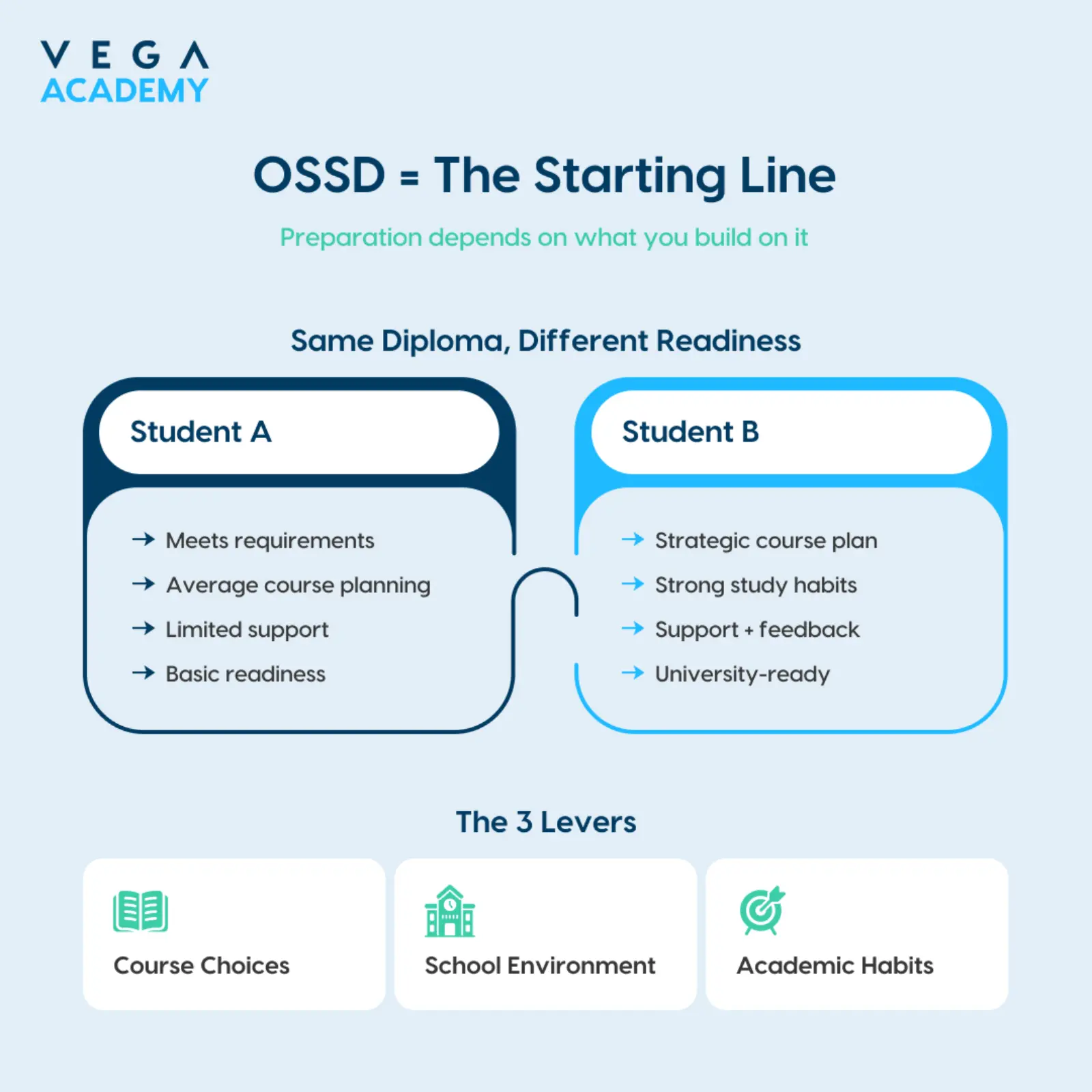
The Ontario high school diploma is the credential that opens the door to university, college, skilled trades, and professional careers across Canada, but what it actually prepares a student for depends heavily on how that diploma was earned and in what academic environment. Two students can hold the same Ontario high school diploma with similar grade averages and arrive at university or the workforce with vastly different levels of readiness, depending on the school they attended, the courses they chose, and the academic habits they developed along the way. Understanding what the diploma represents, what the Ontario secondary school requirements behind it involve, and where different educational environments deliver better outcomes is the information families need to make an informed school choice before Grade 9.
Key Takeaways
What the Ontario High School Diploma Represents Today
The Ontario high school diploma, formally known as the Ontario Secondary School Diploma, is awarded by the Ministry of Education to students who complete the credit and requirement framework established under the provincial curriculum. It is recognized by every university, college, and employer in Canada as evidence that a student has completed secondary education to the Ontario standard, and it serves as the primary application credential for post-secondary admission across the country. Understanding what that credential signals, and what it does not guarantee, is the starting point for any family thinking seriously about secondary school planning.
Recognition and Portability
The Ontario high school diploma is one of the most widely recognized secondary credentials in Canada. Graduates applying to universities in Ontario, British Columbia, Alberta, Quebec, or Atlantic Canada do so on the basis of their OSSD credit profile and grades, and admissions offices across the country have established policies for evaluating Ontario transcripts. For students with international university aspirations, the OSSD is recognized by a significant number of institutions in the United States, the United Kingdom, and Australia, though specific program prerequisites may require supplementary coursework depending on the institution.
What the Credential Signals to Admissions and Employers
To a university admissions office, the Ontario high school diploma signals that a student has completed the provincial curriculum requirements, including the Grade 12 University-level courses from which admission averages are drawn. What it does not signal is the depth at which that curriculum was taught, the academic environment in which the student developed their skills, or the student’s readiness for the specific demands of the program they are applying to enter. Those dimensions are communicated through grades, course profiles, supplementary applications, and in some cases portfolios, not through the credential itself.
- Employment recognition: For students entering the workforce directly after secondary school, the Ontario high school diploma is the baseline credential that most employers require for entry-level positions and apprenticeship programs. It confirms completion of secondary education without indicating specialized training or post-secondary qualification.
- College and trades entry: For students applying to Ontario college programs or registered apprenticeships, the Ontario high school diploma fulfills the basic educational entry requirement. Specific programs may require prerequisite courses in mathematics, sciences, or technology, which reinforces the importance of strategic course selection regardless of the post-secondary path.
Understanding OSSD Credit Requirements and Structure
The Ontario secondary school requirements for diploma completion are defined in Ontario’s education policy and govern every public, Catholic, and registered private secondary school in the province. The framework is structured enough to guarantee a baseline of academic exposure across all graduating students while remaining flexible enough to accommodate a wide range of post-secondary intentions through course type differentiation. Knowing how the framework is organized is practical preparation for making good course decisions across the secondary years.
The Credit Framework
Students must earn 30 credits to qualify for the Ontario high school diploma, of which 18 are compulsory and 12 are elective. Compulsory credits cover English, mathematics, science, Canadian history, arts, health and physical education, and French as a second language, among others. Elective credits are chosen by the student and their family from the broader curriculum catalogue, and the choices made here have direct implications for university program eligibility and application competitiveness.
- Compulsory credits: The 18 compulsory credits make sure that all graduates have exposure to core academic disciplines, including language, mathematics, science, and social studies, providing the broad foundation that post-secondary education and most careers expect.
- Elective credits: The 12 elective credits are where course strategy matters most. Students targeting competitive university programs should use their elective credits to complete all necessary prerequisites and to build a Grade 12 course profile that maximizes both eligibility and admission average calculation.
- Non-credit requirements: Beyond the 30 credits, graduating students must complete 40 hours of community involvement, pass the Ontario Secondary School Literacy Test or its equivalent course, and satisfy the school’s compulsory credit requirements in specific subject areas. These requirements apply universally regardless of the school or program type.
Course Type Differentiation
Ontario secondary courses are offered at different levels, including University-level, College-level, Mixed, Open, and Locally Developed, each designed for a different post-secondary trajectory. University-level courses are specifically required for Ontario university admission and form the basis of the application average. Students who complete College-level courses rather than University-level courses in core subjects may find themselves ineligible for specific university programs even if their grades are strong, which is one of the most common and consequential misunderstandings in secondary school course planning.
How OSSD Aligns With University Admission Expectations
University admission in Ontario is administered through the Ontario Universities Application Centre, which evaluates applicants on the basis of their top six Grade 12 University-level course grades. The Ontario high school diploma provides the framework within which those grades are earned, but alignment with university expectations goes well beyond meeting the minimum requirements for graduation. Families who want to understand how a school-specific program positions students for competitive university applications can review program details and admissions information to assess how course planning and academic preparation are structured within a specific school environment.
The Top-Six Average Calculation
Most Ontario universities calculate admission averages from the highest six Grade 12 University-level courses on a student’s transcript, which must include any prerequisites specified by the program being applied to. A student’s OSSD can be fully completed and their graduation requirements fully met while their top-six average still falls below the threshold for competitive program admission. The Ontario high school diploma and competitive university readiness are related but distinct outcomes, and treating them as the same thing is one of the most common planning errors families make.
- Prerequisite identification: Each university program specifies the Grade 12 U-level courses required for admission consideration. Students who do not complete those courses before applying are ineligible, regardless of their grade average, making early prerequisite identification one of the highest-value activities in secondary school planning.
- Average optimization: Because the top-six calculation uses the highest six qualifying grades, students benefit from taking additional university-level courses beyond the minimum if there is a reasonable expectation that performance in extra courses will produce a higher average than courses already completed. This is a strategic consideration that pathway programs are designed to address systematically.
Supplementary Applications and Program-Specific Criteria
Many competitive university programs in Ontario require more than an OSSD transcript for admission. Portfolios, audition recordings, personal statements, reference letters, and supplementary questionnaires are required for programs in health sciences, education, fine arts, and several engineering faculties at major Ontario universities. Students applying to these programs through a standard secondary school experience may find that they have met the academic requirements but lack the documented experience and supplementary materials that competitive applicants have been building throughout their secondary years.
Where Traditional OSSD Delivery Falls Short for Some Students
The standard public secondary school system delivers the Ontario high school diploma effectively for the majority of students it serves. For students with specific academic goals, particular learning profiles, or targeted post-secondary intentions, however, the structure of large public schools creates consistent friction points that affect outcomes. Recognizing those friction points is not a criticism of the public system but a practical acknowledgment that standardized delivery produces variable results across a diverse student population.
Class Size and Instructional Depth
Ontario public secondary school classes regularly enroll 25 to 30 students per section, which limits the amount of individualized attention and instructional adjustment a teacher can realistically provide. Students who need to work at an accelerated pace, who require additional explanation on specific concepts, or who benefit from a teaching style that differs from the standard delivery model may find that their learning needs are not consistently met within that class size constraint. The impact accumulates gradually across a four-year secondary program and often shows up as a grade average that does not reflect a student’s true academic potential.
- Pace misalignment: Students who could move faster through content than the class average are frequently held to the class pace, which reduces engagement and can produce habits of minimal effort that are difficult to reverse when the academic demands of university arrive.
- Gap identification delays: In large classes, subject-area gaps go undetected longer because there is less individual attention available to notice them. Students who fall behind on a foundational concept in one unit may carry that gap through subsequent units without anyone identifying the root cause.
Limited Academic Counselling for Competitive Programs
Public school guidance counsellors typically manage caseloads of 300 or more students, which limits the amount of individualized university planning support they can provide. Students targeting competitive programs need detailed, program-specific guidance on prerequisite selection, course sequencing, supplementary application requirements, and application strategy that most public school counselling departments do not have the capacity to provide comprehensively. This gap most often affects first-generation university applicants and families who are not already familiar with how the Ontario admissions process works.
OSSD Pathways That Support University Transition
Recognizing the limitations of standard delivery for university-bound students, a range of structured pathway programs have developed around the OSSD framework to provide the academic depth, course strategy, and preparation that competitive university admission requires. An OSSD university pathway program uses the same diploma structure as any Ontario secondary school, but organizes curriculum delivery, credit selection, and student support specifically around the university outcome the student is working toward. Families evaluating these options can request more information about specific programs to understand how they structure the pathway to university admission.
High School With University Credits
Some pathway programs offer students the opportunity to complete a high school with university credits alongside their OSSD requirements. These programs deliver certain courses at a level of academic depth and using assessment standards that are recognized for university credit by partner post-secondary institutions, allowing students to arrive at university with credits already earned. The advantage extends beyond credit banking: students who have completed university-level work in secondary school arrive in first year having already adjusted to the academic standard, which meaningfully reduces the difficulty of the transition period.
- Credit recognition process: University credits earned in a high school with a university credits program must be formally assessed for transfer recognition by the receiving university. Students should confirm the transfer policy with their target institution before completing the coursework, as recognition policies vary by university and by faculty.
- Academic preparation value independent of credit transfer: Even when credits are not formally transferred, the academic preparation value of completing university-level work in secondary school is significant. Students who have written analytical essays evaluated against university rubrics, managed heavier independent reading loads, and performed under university-style examination conditions are better prepared for first year than their transcripts alone reveal.
Academic Enrichment and Accelerated Tracks
Beyond university credit programs, some private secondary schools offer enrichment tracks that extend the depth of OSSD curriculum delivery in specific subject areas without the formal university credit structure. These tracks are valuable for students who are capable of more rigorous work than the standard curriculum provides but who are not yet ready for the full accountability of a university-credit course. Enrichment tracks typically feed into stronger Grade 12 performance and more competitive application averages because they develop the analytical and writing skills that university-level assessment rewards.
How School Environment Shapes OSSD Outcomes
Two students completing the same Ontario high school diploma requirements in different school environments can emerge with very different levels of preparation, not because of differences in curriculum but because of differences in how the curriculum is delivered, how closely student progress is monitored, and how much academic support is available. The school environment is one of the most significant variables in secondary outcomes, and it is one that families have meaningful ability to influence through school selection. Understanding what differentiates school environments helps families evaluate options beyond rankings and reputations. More about specific program approaches can be found by reviewing how different programs build academic preparation.
Class Size and Teacher Availability
- Smaller class impact: Schools with class sizes of 10 to 18 students allow teachers to adjust instruction pace, identify individual gaps quickly, and provide the kind of real-time feedback that improves performance on assessments before deficiencies become entrenched patterns.
- Teacher access outside class: In environments where teachers are accessible for questions outside of scheduled class time, students develop the habit of addressing confusion immediately rather than carrying uncertainty forward into the next unit, which has a compounding positive effect on performance across the full secondary program.
Academic Accountability Structures
Private and independent secondary schools operate with a direct accountability relationship to enrolled families that public schools, governed by boards and ministry oversight, do not replicate. When a student’s progress stalls or a grade average drops without a clear explanation, parents in independent school environments have more direct recourse and receive more responsive communication than in large institutional settings. That accountability dynamic shapes how teachers plan, how schools communicate, and how problems are addressed before they affect application outcomes.
Peer Environment and Academic Culture
The academic culture of a school, the degree to which academic effort is normalized and valued among the student body, shapes individual student behavior in ways that are difficult to replicate through individual tutoring or parental support alone. Students in academically focused environments where university preparation is a shared expectation tend to develop stronger study habits, higher academic standards for their own work, and more realistic expectations about the effort university will require. This cultural dimension is one of the most consistent differentiators between secondary school environments that produce strong university transitions and those that do not.
Questions Parents Should Ask Before Choosing an OSSD School
Selecting the right school for secondary education is one of the most consequential academic decisions a family makes, and the questions asked during school evaluation determine how well-informed that decision is. Generic questions about class size and extracurricular programs provide some information, but the questions that reveal the most about a school’s actual academic outcomes are more specific and are best asked directly to school leadership or academic staff during a visit or information session.
University Outcome Questions
- University placement data: Ask for specific data on where graduating students have been admitted in recent years, including the faculties and institutions, not just confirmation that graduates attend university. Specific placement data reveals the school’s actual outcomes rather than its aspirational positioning.
- Average trajectory through the program: Ask how student averages typically change between Grade 9 entry and Grade 12 graduation. A school that consistently produces grade improvement over the four secondary years is demonstrating genuine academic development, not just selecting high-performing students at intake.
Academic Structure Questions
- Gap identification and response: Ask how the school identifies when a student is falling behind in a specific subject and what the standard response process looks like. The answer reveals how proactive and individualized the school’s academic monitoring actually is in practice.
- Course planning for university targets: Ask how the school structures course selection for students with specific university program goals. A school with a genuine OSSD university pathway will have a systematic course planning process tied to specific admission requirements, not a general recommendation to take university-level courses.
What Long-Term Preparation Really Looks Like
The Ontario high school diploma’s long-term value is not determined at graduation. It is determined by the academic habits, subject knowledge, and self-management skills the student developed while earning it, because those are the inputs that produce performance in first-year university, success in early career roles, and the adaptability that longer professional trajectories require. A diploma earned through four years of consistent academic challenge and supported skill development is a different preparation than one earned through four years of minimal resistance and passive content consumption, even when the transcripts look similar on paper.
Academic Habits That Compound Over Time
The habits students form in secondary school, how they manage deadlines, how they respond to difficult material, how much independent work they do beyond the minimum required, and how they seek help when they need it, determine their trajectory in every academic and professional context they enter afterward. Schools that actively develop those habits rather than simply delivering content produce graduates who are better prepared for the demands of university and work, regardless of the specific grades on their transcripts.
- Independent work capacity: Students who have been required to complete substantial independent work, research, and writing throughout secondary school arrive at university knowing how to manage unstructured academic time, which is one of the most common failure points in first-year transitions.
- Resilience under academic difficulty: Students who have encountered genuine academic challenge during secondary school and have developed strategies for working through difficulty are substantially more likely to persist through first-year university setbacks than those who have not encountered meaningful resistance before university.
Preparation for Specific Post-Secondary Paths
What the Ontario high school diploma prepares a student for most directly is determined by the courses taken, the depth at which they were taught, and the skills developed in the process. A student who has completed all prerequisites for their target program, maintained a competitive average, developed strong analytical writing skills, and built familiarity with independent academic work is prepared for the specific post-secondary path they are targeting. A student who has completed the diploma requirements without those elements is prepared for graduation, which is a different and less useful form of readiness.
Frequently Asked Questions
Is the Ontario high school diploma accepted for university admission outside of Ontario?
What is the difference between an Ontario high school diploma earned at a private school versus a public school?
How early should families start planning around the Ontario high school diploma requirements?
Make Your OSSD Work for the Future You Are Planning
The Ontario high school diploma is a framework shaped by school environment, course selection, instructional quality, and the academic habits a student builds over four years. Two students can graduate with the same diploma and similar grades, yet arrive at university with very different levels of readiness, often due to decisions made in Grades 9, 10, and 11 rather than Grade 12 alone. Families who understand how the OSSD framework connects to university admissions and plan their course pathways early gain a meaningful advantage. Choosing the right school, structuring the right courses, and building strong academic habits ultimately shape what the diploma prepares a student for.