
Coding education has moved well past the category of optional enrichment. In most fields today, the ability to read, write, or at least understand code is a professional baseline. High school is the earliest point where students can build that foundation in a structured, supported environment. For students considering careers in science, business, create, or healthcare, starting with coding for students now shortens the learning curve later.
Key Takeaways
Why Coding Is Becoming a Core Academic Skill
Coding education has gone from an elective to a graduation requirement in several regions. In the United States alone, 11 states now require computer science to graduate. That policy shift reflects a broader change in how schools assess academic readiness.
How Employers Are Driving the Demand
Employers across sectors now list coding literacy as a baseline skill. That applies to roles in data, operations, healthcare, and product management. Students who skip coding education start at a disadvantage in many non-technical fields.
What Changed in the Past Decade
A decade ago, coding was considered a specialty skill for software engineers. Today, professionals in marketing, finance, and logistics use scripting tools daily. The line between technical and non-technical roles has shifted considerably.
According to the State of Computer Science Education report by Code.org, nearly twice as many U.S. high schools offered computer science in 2023-24 compared to 2017-18. That growth reflects institutional recognition of coding education as a standard academic subject.
Programming Languages Students Often Learn First
Most high school coding programs start students with beginner-friendly languages. The choice of language depends on the course goal, from web development to data analysis. Starting with the right language builds confidence and a clear technical foundation.
Python
Python is the most common entry point in high school coding education. Its readable syntax makes it easy for students to focus on logic, not formatting. It is also one of the most widely used languages in data science and automation.
Scratch and Block-Based Languages
Younger students and beginners often start with block-based environments like Scratch. These platforms introduce sequencing and conditional logic without requiring typed syntax. Many students transition from Scratch to Python or JavaScript after one semester.
JavaScript
JavaScript is the standard language for web development and front-end programming. High school students who learn it can build functional websites and interactive tools. It also connects coding for students directly to visible, shareable output.
Start Coding This Year
Vega Academy offers structured programming for high school students.
How Coding Strengthens Logical Thinking
Programming for students trains the brain to break complex problems into smaller steps. That process, called decomposition, applies directly to math, science, and writing tasks. Students who practice it regularly tend to perform better on analytical assessments.
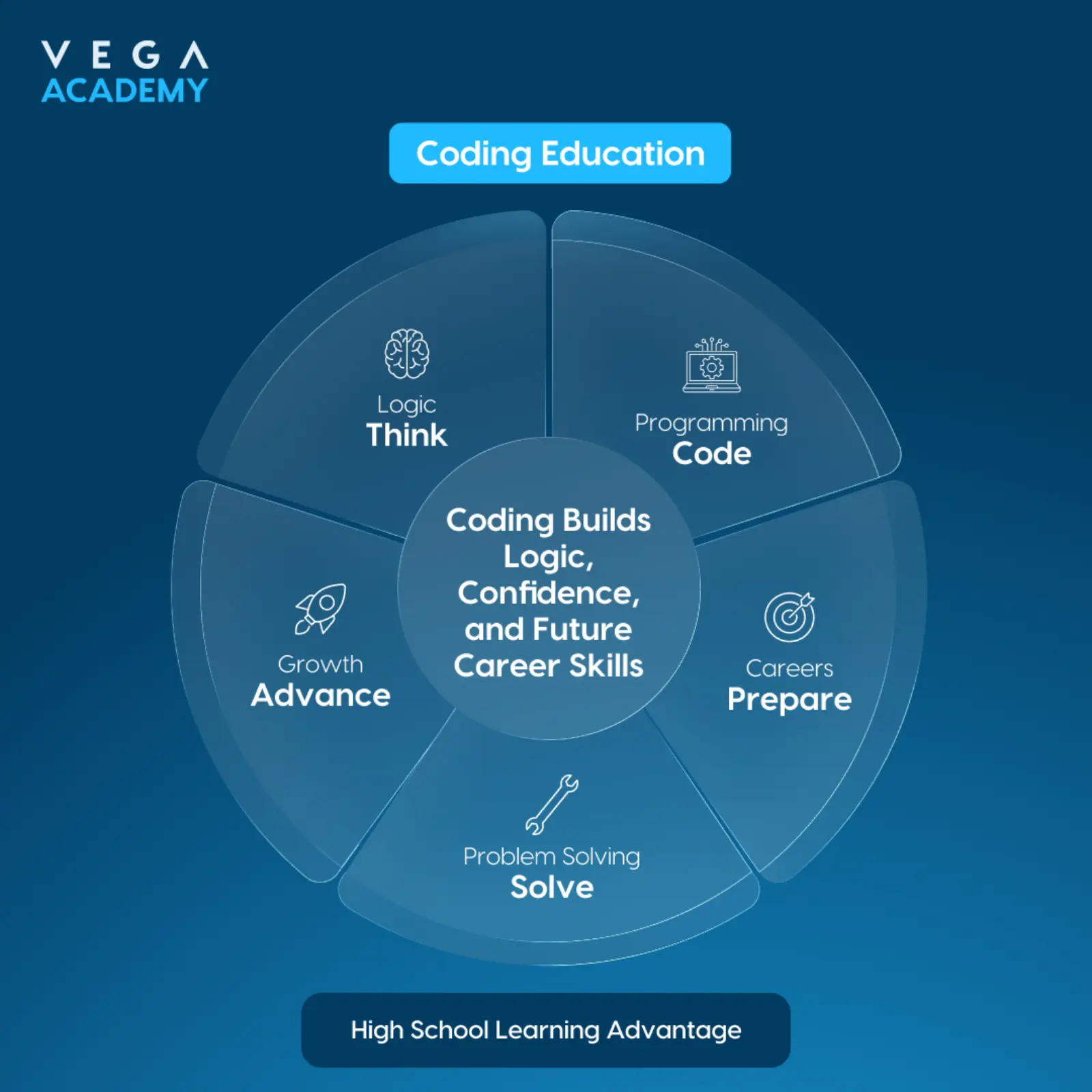
The diagram below from Vega Academy maps the five core outcomes of coding education at the high school level. Each segment represents a distinct but connected skill set. Together, they form the academic and professional foundation on which the program is built.
Debugging as a Thinking Exercise
Debugging requires students to locate the source of a specific error in their code. The process teaches patience, systematic observation, and precise reasoning. These are the same cognitive habits used in lab research, legal analysis, and engineering.
Pattern Recognition Across Subjects
Coding education builds the habit of identifying patterns in large sets of information. Students apply this skill to biology data, historical timelines, and financial models. It is a transferable academic skill with broad use across disciplines.
Coding Skills That Support Future Careers
Coding education opens career paths that go well beyond software development. Many fields now expect candidates to work with scripts, platforms, or automation tools. Students who learn to code in high school graduate with that exposure already in place.
The U.S. Bureau of Labor Statistics projects that employment of software developers will grow 15 percent from 2024 to 2034. That pace is several times faster than the average growth rate across all occupations.
- Software development: Graduates with coding backgrounds qualify for roles building applications and platforms.
- Cybersecurity: Security analysts use code to monitor, test, and protect digital systems.
- Healthcare technology: Medical informatics and health data teams require programming literacy.
- Financial analysis: Analysts use Python and R to process and model large financial datasets.
- UX and product design: Designers with coding skills prototype directly in front-end environments.
How Schools Introduce Coding in High School
Schools use several delivery formats to teach coding education at the high school level. The structure depends on available resources, staff expertise, and curriculum requirements. Private schools often have more flexibility to build integrated, multi-year coding tracks.
Standalone Computer Science Courses
The most common format is a dedicated computer science or programming course. Students meet the course as a subject separate from math or science. These courses cover language fundamentals, algorithms, and applied project work.
Integrated Curriculum Approaches
Some schools integrate coding into existing subjects like math or economics. Students write scripts to model data sets as part of their regular coursework. This approach connects coding for students to subjects they already take.
At Vega Academy, coding education is part of a forward-structured academic program. Students gain technical skills alongside a full Ontario-accredited curriculum. The program is available to both domestic and international students through Vega Academy’s admissions process.
Globally, the K-12 coding courses market was valued at USD 1.8 billion in 2024. It is expected to reach USD 4.2 billion by 2033, according to Data Horizzon Research. That trajectory reflects sustained institutional and commercial commitment to programming for students worldwide.
Frequently Asked Questions About Coding Education
Do high school students need prior experience to learn coding?
How does coding education fit into a university application?
Can students who are not planning a tech career benefit from coding education?
Coding Education Gives Students a Concrete Academic Advantage
Students who study coding in high school arrive in post-secondary programs with skills most of their peers lack. That head start affects how they process problems, approach coursework, and qualify for opportunities. Coding education at the secondary level is not preparation for one career path; it is preparation for most of them.
Apply to Vega Academy
Ontario-accredited high school with structured coding programs.