
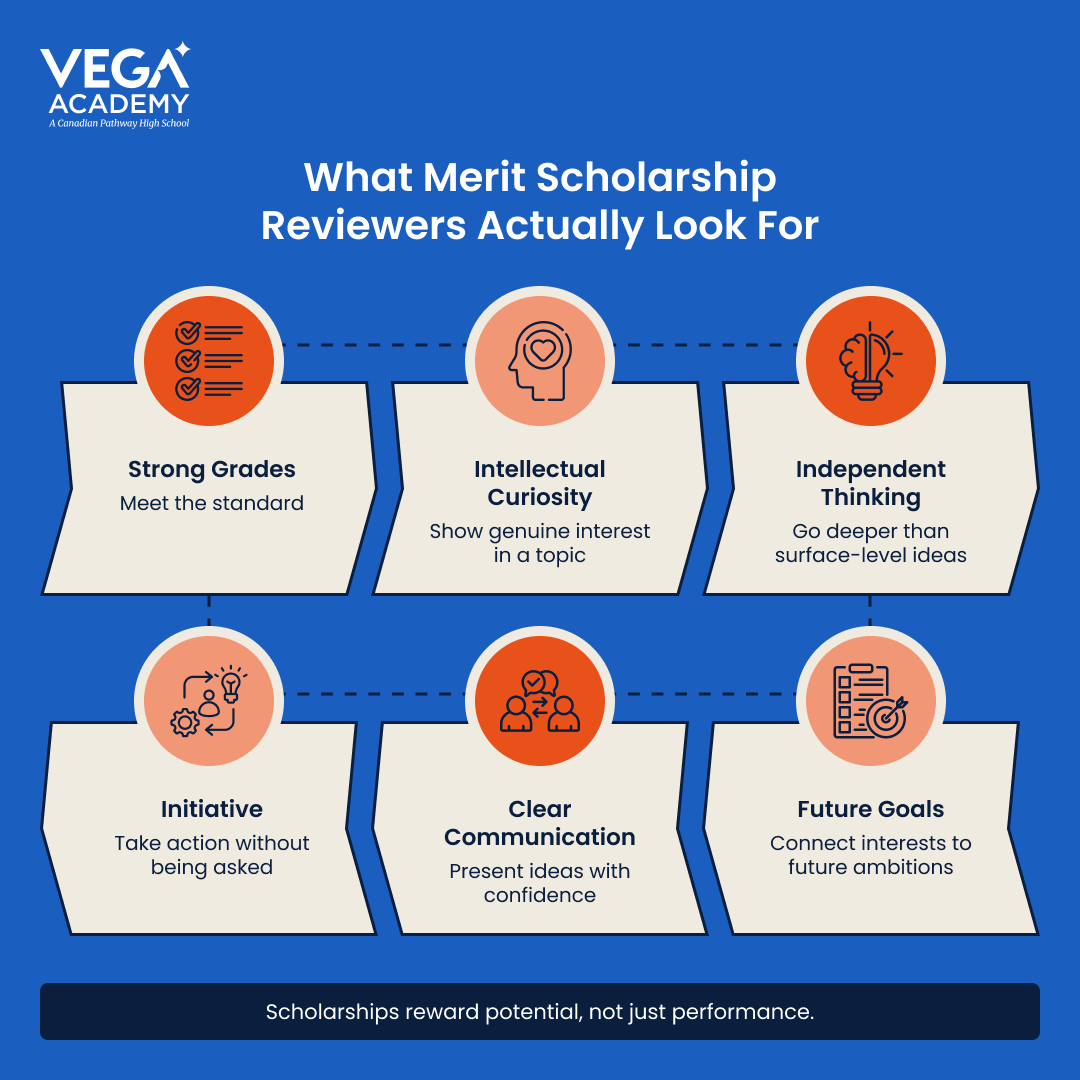
Every year, thousands of strong students apply for merit-based scholarships and walk away confused about why a classmate with a similar GPA was selected and they weren’t. The explanation almost always comes down to the same gap: applicants assume merit scholarships are measuring academic performance, when in practice most committees are measuring something closer to academic thinking. Grades establish that a student can meet a standard. They don’t, on their own, show a reviewer how a student approaches a problem, defends an idea, or connects their interests to a larger goal.
Understanding that distinction changes how a student should prepare an application. The goal isn’t to repeat achievements already listed on a transcript. It’s to demonstrate a way of thinking that a transcript cannot show.
What a Merit Scholarship Means for High School Students
A merit-based scholarship differs from need-based financial aid in one core respect: it’s awarded based on demonstrated potential and achievement rather than financial circumstances. For a high school student, this means the application is functioning less like a financial form and more like a condensed admissions interview, one where the committee is trying to predict how a student will perform and contribute once they’re actually in the program.
That predictive element matters more than most applicants realize. Reviewers aren’t simply crediting past performance. They’re trying to identify students who will continue to grow, take initiative, and represent the institution well, which is why applications built entirely around a list of accomplishments tend to underperform against applications that reveal genuine thinking and self-awareness.
Why Schools Offer Merit Scholarships
Institutions offer merit scholarships for reasons that go beyond simple generosity. Scholarships help schools attract students who raise the overall academic and intellectual environment of a cohort, and they help build a student body that reflects the kind of curiosity and initiative the institution wants associated with its name.
This is part of why merit scholarship committees place so much weight on qualities like intellectual curiosity and communication, rather than grades alone. A student who can think independently and communicate that thinking clearly tends to lift classroom discussion, contribute meaningfully to group work, and represent the school well in future settings, from a university interview to a co-op placement to eventually the workforce.
Academic Achievement Beyond Grades
Grades remain a baseline filter for most merit scholarships, but they rarely function as the deciding factor once a student clears the minimum threshold. Once that bar is met, committees shift their attention to a different question: what has this student done with their academic ability beyond simply earning marks?
This is where context starts to matter more than raw numbers. A student who maintained a strong average while taking on a demanding course load, pursuing an independent project, or working through a personal challenge demonstrates something a number alone cannot. Reviewers are trained to look for that context, which is why an application that explains the circumstances behind an achievement, briefly and honestly, tends to land better than one that simply restates the achievement itself.
Intellectual Curiosity and Independent Thinking
Intellectual curiosity is one of the hardest qualities to fake convincingly, which is exactly why scholarship committees weigh it so heavily. A student who has genuinely spent time investigating a topic, beyond what a class required, tends to speak and write about it differently than a student repeating talking points they researched the night before submitting an application.
VEGA Academy’s own Merit Scholarship rubric makes this distinction explicit, separating applicants who demonstrate substantive understanding and have engaged with complexity or competing perspectives from those whose treatment of a topic is surface-level, the kind of familiarity a quick search would produce without evidence of deeper engagement.
Demonstrating Intellectual Depth
The clearest way a student can show intellectual depth is by choosing a topic narrow enough to actually explore in depth, rather than a broad subject they can only summarize. A student who picks one specific question about renewable energy policy in their region and genuinely investigates it will almost always present better than a student who tries to cover the entire subject of climate change in the same amount of time. Depth beats breadth in nearly every merit scholarship evaluation.
Leadership, Initiative, and Community Impact
Leadership in a scholarship application doesn’t require a formal title. Reviewers are far more interested in evidence that a student noticed a problem and did something about it: organizing a small peer tutoring effort, starting a project no one asked them to start, or simply taking responsibility for a group outcome when things weren’t going well.
Initiative reads as more credible than a title precisely because it can’t be assigned to a student by someone else. A club presidency looks similar on every application. A specific story about identifying a gap and acting on it, even a small one, tends to stand out far more.
Show Your Thinking, Not Just Your Grades
Communication Skills Scholarship Committees Notice
Many merit scholarships, including those evaluated through a video submission rather than a written essay, place significant weight on how clearly and confidently a student communicates. This isn’t about polish for its own sake. It’s about how easily a reviewer can follow the student’s thinking.
A student who structures their points with a clear beginning, middle, and end, who paces themselves naturally rather than rushing through memorized lines, and who sounds genuinely engaged with the material communicates competence even before the content itself is fully evaluated. Communication and content work together; a strong idea delivered poorly often scores lower than a more modest idea delivered with clarity and confidence.
How to Present Your Ideas With Confidence
Confidence in a scholarship presentation comes less from sounding rehearsed and more from genuinely knowing the material well enough to speak about it naturally. Students who over-script and memorize their submissions word for word often come across as stiffer than students who outline their key points and speak more conversationally around them.
- Outline rather than script: know the structure of what needs to be said, but avoid memorizing exact sentences that can sound rehearsed under pressure.
- Practice out loud, not just in your head: the gap between thinking through an answer and actually saying it aloud is often larger than students expect.
- Leave space for natural pacing: a student who pauses briefly to think comes across as more genuine than one rushing to fill every second.
- Speak to the camera as if to an actual person: treating the recording like a conversation rather than a performance tends to produce a more authentic result.
Building a Strong Scholarship Application
A strong application connects four things clearly: a specific topic the student has genuinely explored, a clear point of view on that topic, a personal connection to why it matters to them, and a link forward to what they hope to do with that interest in the future. Applications that hit all four tend to score significantly better than those built around just one or two.
- Choose a topic that’s specific enough to explore properly in a short presentation.
- Take an actual position rather than just describing the topic neutrally.
- Explain why this topic matters personally, not just academically.
- Connect the topic to a future goal or area of study, including how it relates to the specific school being applied to.
Ready to Start Your Application?
Common Scholarship Application Mistakes
- Choosing a topic too broad to explore properly in the time available.
- Describing achievements without explaining the thinking or effort behind them.
- Treating the personal connection section as an afterthought rather than a core part of the application.
- Reading from a script word for word, which often reduces natural confidence and pacing.
- Submitting a presentation that runs significantly under the requested time, which can suggest limited depth.
- Failing to mention why the specific school or program is the right fit for the student’s goals.
Key Takeaways

Thinking matters more than grades alone: Merit scholarship committees evaluate thinking and potential, since grades alone don’t reveal how a student approaches a problem.
Depth beats breadth: Intellectual depth comes from exploring a narrow topic thoroughly rather than summarizing a broad one on the surface.
Actions outweigh titles: Leadership and initiative are judged by specific actions a student has taken, not by titles or positions alone.
Delivery shapes the score: Communication quality, including pacing, structure, and natural delivery, plays a clear role in how an application is scored.
Four elements build the strongest applications: a specific topic, a clear point of view, a personal reason it matters, and a future goal.
Frequently Asked Questions
If your question is not covered below, contact the admissions team directly at admission@vegaacademy.ca or call (437) 887-9332.
How important is GPA compared to other factors in a merit scholarship application?
GPA functions as a baseline requirement, not the primary deciding factor once a student clears the minimum threshold. After that point, committees focus on intellectual curiosity, communication, leadership, and how well the student connects their interests to future goals.
Can a student apply for a merit scholarship without extensive extracurricular involvement?
Yes. Most merit scholarship rubrics weight the depth and authenticity of involvement far more heavily than the number of activities listed. One or two activities explored with genuine initiative and reflection generally present better than a long list with little depth.
What should a student do if they are unsure which topic to choose for a video-based scholarship submission?
Start from genuine curiosity rather than guessing what a committee wants to hear. Narrow the topic until it’s specific enough to explore properly within the time limit, then confirm it can be explained clearly and personally.
Starting the Application Process
Students preparing a merit scholarship application benefit most from starting early enough to genuinely explore their topic rather than rushing to meet a deadline. The strongest submissions come from students who gave themselves time to think, revise, and practice rather than recording a single take the night before the deadline.
Families interested in VEGA Academy’s Merit Scholarship, which offers a 50 percent reduction in tuition for the 2026 to 2027 academic year to students entering Grade 11 or 12, can review the full assessment rubric and application steps directly on the scholarship page.