
University readiness means a student can research, write, manage time, and think independently at the level a Canadian university expects on day one. It is not the same as a strong report card. A student can hold high grades in every course and still struggle in first-year university if nobody taught them how to plan a research paper, manage a cluttered schedule, or work through a problem without step-by-step instructions. High schools that build readiness on purpose, rather than by accident, give students a clear advantage once they leave for campus.
Parents and students often assume readiness will develop naturally once university begins. Some of it does. But the students who adjust fastest in the first year are almost always the ones who practiced research, writing, and independent study long before their acceptance letter arrived. The sections below break down what readiness looks like in practice, the skills universities expect beyond grades, and how families can judge how well a high school actually prepares a student for what comes next.
What University Readiness Really Means
University readiness is the combined set of academic and personal skills a student needs to manage first-year coursework without constant supervision. It covers four areas:
- Academic skill: The ability to read, write, research, and think at a university standard
- Study habits: Planning workload and preparing without external prompts
- Independent thinking: Forming original arguments and correcting course without waiting for feedback
- Personal confidence: Trusting your own judgment enough to submit original ideas rather than defaulting to safe, generic answers
None of these skills appears overnight. High school is the training ground, and each year should add a layer of independence. A Grade 9 student needs close guidance. A Grade 12 student preparing for university should be managing deadlines, choosing their own research angles, and asking for help only when genuinely stuck.
Grades confirm subject knowledge, but they say very little about how a student handles a real university course load. Universities Canada reports that first-year retention correlates more strongly with study habits and self-directed learning than with incoming grade averages. Grades do not confirm that a student can synthesize sources into an original argument, manage an uneven semester, or meet academic integrity standards that are far less forgiving than anything they faced in high school. Many Canadian universities now publish first-year transition guides on time management and study strategies for this exact reason: averages alone do not predict how a student adjusts to university life.
The 6 Skills Every University-Ready Student Needs
University readiness is built through skills, not grades alone. While strong academic results open doors, it’s the foundational competencies students develop along the way that determine how well they thrive once they arrive on campus. At Vega Academy, we focus on building six core skills that prepare students for the real demands of university life.
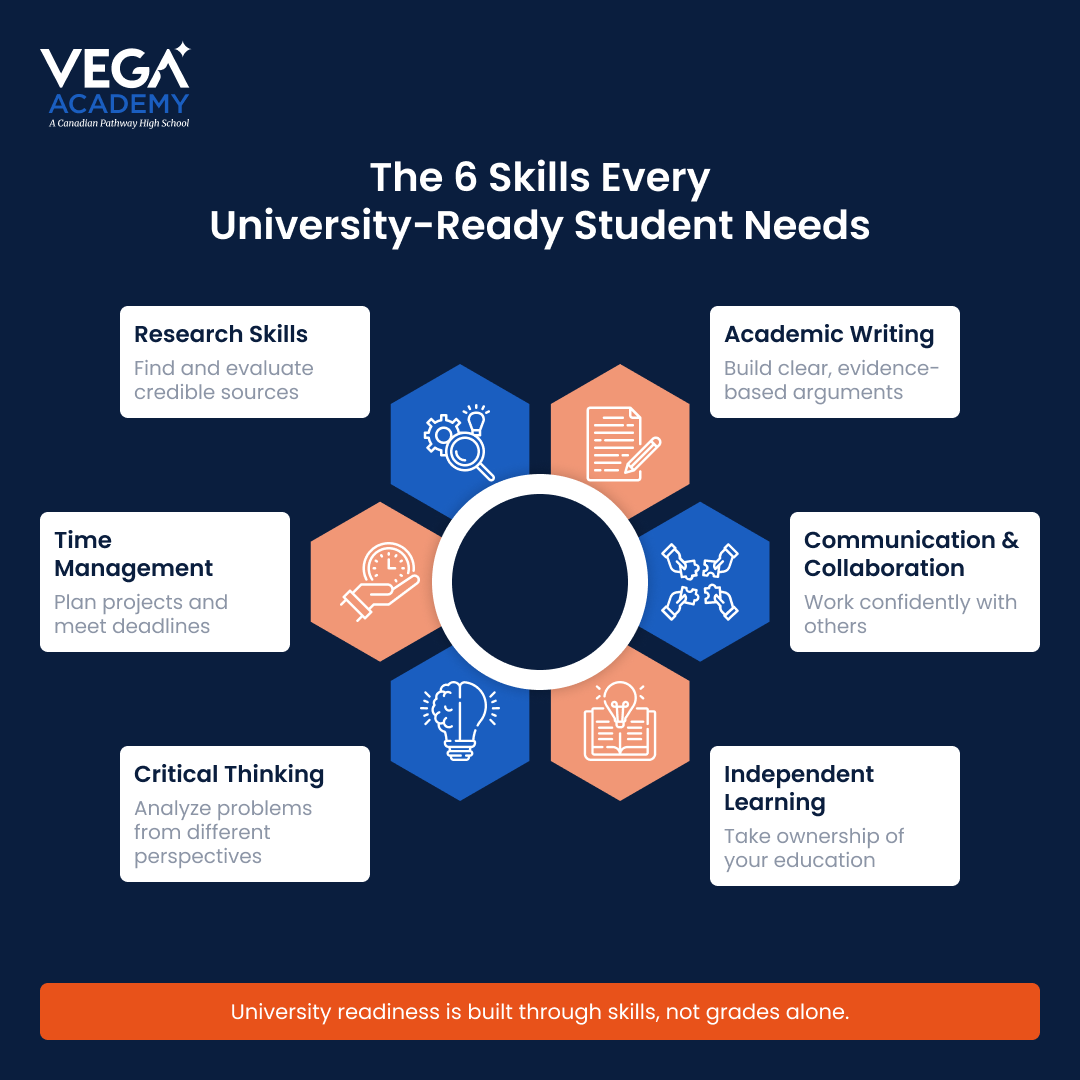
Research Skills
Research skills are the foundation of independent academic inquiry. At the university level, students are no longer handed a list of approved sources, they are expected to seek out information on their own, assess its credibility, and use it to support original thinking. This means knowing not just where to look, but how to evaluate what they find, distinguish reliable sources from unreliable ones, and synthesize information into something meaningful. Students who develop this habit early arrive at university ready to tackle research papers, independent projects, and evidence-based discussions with confidence and precision.
Academic Writing
Academic writing is one of the most direct indicators of a student’s readiness for university. It goes far beyond correct grammar and spelling, it is about constructing clear, logical arguments supported by evidence, staying focused on a central idea, and communicating complex thoughts with precision and purpose. Universities expect students to plan their writing, engage critically with their sources, and bring their ideas to well-reasoned conclusions. Students who arrive with a strong writing foundation are immediately at an advantage, because the ability to write well reflects the ability to think well, a skill that applies across every discipline.
Time Management
Time management is consistently one of the biggest challenges students face in their first year of university. Without teachers tracking deadlines or parents monitoring homework, students must take full responsibility for planning their workload across multiple courses, often with assignments due weeks or months in advance. Learning to break large tasks into manageable steps, set realistic daily goals, and protect focused study time from distraction is a skill that must be practiced before the transition to university, not figured out after. Students who arrive with strong time management habits are not only more productive, they are less stressed and better able to make the most of everything university life has to offer.
Communication & Collaboration
University is not a solitary experience. From group projects and seminars to presentations and peer review, students are constantly asked to express their ideas clearly and work effectively alongside others. Strong communication skills allow students to engage confidently with professors, contribute meaningfully in discussions, and adapt their tone for different audiences, whether writing a professional email or presenting to a class. Collaboration goes even further, teaching students how to navigate disagreement, share accountability, and produce better outcomes together than they could alone. These are skills that serve students not just in the classroom, but in every professional environment they will eventually enter.
Critical Thinking
Critical thinking is what separates surface-level understanding from genuine intellectual engagement. At university, professors do not reward students simply for recalling information, they reward students for demonstrating that they have thought deeply about it, questioned assumptions, considered multiple perspectives, and arrived at a well-reasoned conclusion. Developing this skill means becoming comfortable with complexity and ambiguity, recognizing bias in sources and in one’s own reasoning, and approaching problems with both curiosity and rigor. Students who practice critical thinking consistently are not only better prepared for academic challenges, they are better equipped to make sound decisions and navigate a world full of competing information.
Independent Learning
Of all the skills that define university readiness, independent learning may be the most transformative. It reflects a fundamental shift in a student’s relationship with their own education, from passively receiving instruction to actively taking ownership of it. University professors guide and challenge, but they do not follow up on every assignment or remind students when to study. Independent learners know how to identify gaps in their understanding, seek out additional resources, and stay motivated without constant direction. This mindset also builds resilience: when students encounter difficult material or unexpected setbacks, they have the tools and self-belief to work through challenges rather than disengage from them.
Research Skills Students Need Before University
First-year university coursework depends on independent research far more than most high school assignments do. Students need to locate credible sources, evaluate them for bias and reliability, and build an argument that goes beyond summarizing what they read.
Core Research Skills to Practice Before Grade 12
High school offers several natural opportunities to build these habits before students ever set foot in a university library. Each of the following skills shows up directly in first-year coursework.
- Source evaluation: comparing a peer-reviewed journal article against a general website builds judgment students will use in every research paper.
- Citation practice: learning APA or MLA formatting in high school removes a barrier that otherwise slows down first-year writing.
- Database searching: using library databases instead of open web searches trains students to find stronger academic sources faster.
- Note organization: tracking sources and quotes while reading prevents last-minute scrambling before a paper is due.
Students who practice these habits across multiple high school courses, not just one research project, arrive at university with a research process they can repeat under pressure.
Research skill also depends on comfort with academic ambiguity. High school assignments often name the exact sources to use. University assignments hand students a topic and expect them to find their own sources, judge which ones matter, and discard the rest. Practicing that judgment call in high school, even on a smaller assignment, removes much of the anxiety students feel when a university professor simply says: find five credible sources on your own.
Academic Writing Skills Universities Expect
University writing asks for a clear thesis, unformatted paragraphs, and evidence-based argument, all delivered with minimal guidance. Ontario’s Ministry of Education curriculum builds toward these expectations through senior English and social science courses, but the depth of practice varies widely between schools.
A student who writes only short-answer responses through Grade 11 will struggle with a ten-page research essay in first-year university. Writing skill develops through repetition: multiple drafts, feedback from a teacher, and revision based on that feedback. Schools that build in drafting and peer review before senior year give students a clear advantage once university writing demands increase.
Strong academic writing also depends on argument structure, not just grammar. A first-year essay needs a clear thesis in the opening paragraph, evidence organized paragraph by paragraph, and a conclusion that ties the argument together rather than repeating the introduction. Students who practice this structure across several high school essays internalize it. Students who only practice it once, in a single senior year assignment, tend to relearn the skill under pressure during their first university term.
Critical Thinking and Independent Learning
Critical thinking means questioning assumptions, weighing evidence, and forming a position rather than repeating what a textbook says. University courses reward students who can analyze a problem from multiple angles instead of looking for a single correct answer.
Independent Learning Strategies
Independent learning is the ability to direct one’s own study without a teacher setting every task. It becomes essential once university courses hand students a syllabus and expect them to structure their own preparation.
- Self-paced review: students who revisit material on their own, rather than waiting for a test date, retain content longer.
- Question generation: forming original questions about a topic builds the habit of active engagement rather than passive reading.
- Resource seeking: knowing how to find a tutor, office hours, or study group before falling behind prevents small gaps from becoming large ones.
These strategies work best when a school gives students proper chances to practice them in a lower-stakes environment, well before university removes the safety net.
Time Management and Study Habits
University students juggle several courses with staggered deadlines, no daily homework checks, and long gaps between classes. Without a plan, those gaps disappear into distraction rather than study time.
Time management is a skill built through practice, not instinct. Students benefit from tracking assignments across a calendar, breaking large projects into smaller deadlines, and protecting study blocks the same way they would protect a scheduled class. High schools that assign long-term projects with multiple checkpoints, rather than a single due date, give students a decent way to build this habit before university removes the checkpoints entirely.
Study habits matter as much as scheduling. A student who reviews material the night before a test relies on short-term memory that fades within days. A student who reviews material in short sessions spread across several weeks retains it far longer, a pattern well documented in cognitive research on spaced repetition. High school is the right place to test different study methods, since the stakes on any single assignment are lower than they will be in a university course worth a significant share of a final grade.
Leadership, Collaboration, and Communication Skills
Group projects, presentations, and class discussions all mirror what students will face in university seminars and eventually the workplace. The Conference Board of Canada has long identified communication, teamwork, and problem-solving among the employability skills employers expect from graduates, and these same skills shape how confidently a student participates in a university classroom.
Students who lead a group project, present findings to classmates, or resolve a disagreement within a team carry that confidence into first-year seminars where participation often affects a portion of the grade. Schools that build regular opportunities for group work and presentation, rather than treating them as occasional assignments, give students more practice with these skills before university raises the stakes.
Communication skills also cover writing for different audiences, not just speaking in front of a class. A lab report, a formal email to a professor, and a group project proposal each require a different tone and structure. Students who only practice one form of communication in high school often need extra time in university to adjust to the others. Exposure to varied formats, even in a single course, builds flexibility that pays off across an entire degree.
Group work also teaches students how to manage disagreement productively, a skill that rarely appears on a report card but shows up constantly in university group assignments. Students who practice resolving conflict over a shared project in high school, rather than avoiding it or deferring entirely to a teacher, carry a working method into university team assignments where no instructor is present to mediate.
See How Our Model Builds Readiness
How High Schools Build University Readiness
Schools shape readiness through structure, not slogans. A school’s daily choices, class size, mentorship access, and how assignments are built together determine how much readiness develops naturally, and how much gets left to chance.
- Small class sizes: closer teacher attention allows for individual feedback on research and writing rather than generic comments.
- Dual credit access: courses that carry university credit expose students to university-level pacing and expectations before graduation.
- Mentorship programs: regular contact with mentors familiar with university life helps students ask questions early rather than after enrollment.
- Formatted research projects: assignments that require outside sources and formal citation build habits that students will repeat in university.
VEGA Academy structures its day school program around this kind of preparation, pairing small class sizes with early exposure to university-style coursework through its academic partnership with International Business University.
Assignment design matters as much as any single program. A school that repeats the same essay format year after year gives students less practice than a school that varies research projects, presentations, and analytical writing across a range of subjects. Variety forces students to adapt their skills to new formats, which mirrors the shifting demands of a university course load far more closely than a predictable, repetitive assignment structure.
How Families Can Evaluate University Preparation
Families evaluating a high school should look past average grades and ask how the school builds independent skills. Questions about research assignments, writing feedback, and class size reveal more about readiness than a published average.
Building Academic Confidence
Confidence grows from repeated practice and honest feedback, not from praise alone. Students who receive specific, constructive feedback on drafts and projects learn what strong work actually looks like, which builds genuine confidence rather than a false sense of readiness.
- Feedback quality: ask if teachers return detailed comments on drafts or only a final grade.
- Revision opportunities: schools that allow students to revise major assignments teach that first drafts are a starting point, not a final answer.
- Mentor access: regular one-on-one conversations with a mentor help students track their own growth over time.
Families can start this conversation directly with a school’s admissions team. VEGA Academy’s student support team outlines the mentorship and tutoring structure available to every student throughout the program.
Class size deserves particular attention during a school visit or information session. In a class of thirty, a teacher may only manage to grade final submissions. In a smaller class, a teacher can return detailed comments on an early draft, catch a weak argument before it reaches the final version, and spend a few extra minutes with a student who is struggling with a specific skill. That difference compounds across a full high school career.
Why University Readiness Starts Before Grade 12
Readiness built only in the final year of high school rarely holds up under university pressure. Skills like research, writing, and time management need repeated practice across several years, not a single senior course added at the end.
Common Gaps Students Face in First-Year University
Students who arrive without consistent practice in these areas tend to hit the same predictable obstacles during their first semester.
- Weak citation habits: students unfamiliar with formal citation lose marks on formatting rather than content.
- Poor time estimation: students who never managed staggered deadlines often underestimate how long research and writing take.
- Limited office hour use: students who never asked a teacher for individual help in high school often avoid professors even when struggling.
- Passive study habits: students used to teacher-led review struggle to structure their own study sessions.
Starting these habits early gives students several years to refine them instead of learning through first-year setbacks. A student who begins practicing independent research in Grade 9 enters university with years of repetition behind them, not a single semester of preparation.
The transition from high school to university rarely announces itself in advance. A student’s first major research paper, first unorganized week, or first professor who does not follow up on missed readings often arrives within the opening month of first year. Students who spent their final two or three years of high school practicing these habits treat that first month as familiar territory rather than a shock to adjust to under pressure.
Key Takeaways

Grades are not the full picture: universities expect research, writing, and independent study skills that report cards do not measure.
Readiness builds over years: skills like time management and academic writing need repeated practice, not a single senior year course.
Schools shape outcomes: class size, mentorship, and dual credit access all affect how prepared a student feels on day one.
Frequently Asked Questions
What is the difference between good grades and university readiness?
Grades measure subject knowledge on a fixed curriculum. University readiness includes research, writing, and independent study skills that grades do not directly test. A student can hold strong grades and still lack the study habits university coursework demands, which often surface during the first disorganized semester away from home.
When should students start building university readiness?
Readiness builds most effectively across several years, starting as early as Grade 9. Skills like research, citation, and time management need repeated practice, so schools that introduce them early give students more chances to refine each skill before graduation instead of learning it under pressure in first year.
How can parents tell if a high school builds strong readiness?
Parents should ask about class size, feedback on drafts, and access to research-heavy assignments. Schools that offer dual credit courses and consistent mentorship typically prepare students more thoroughly than schools relying on grades alone, since these features create repeated chances to practice independent academic work.
Building Readiness That Lasts Beyond Grade 12
University readiness is not a single milestone reached in senior year. It is a set of academic and personal skills built gradually through research assignments, writing practice, group work, and honest feedback. Families evaluating a high school should look for a program that treats these skills as core curriculum, not an afterthought. VEGA Academy structures its academic model and mentorship programs around this kind of steady preparation, giving students years of practice before their first university deadline arrives.
Choosing a high school with this focus is one of the more consequential decisions a family makes during a student’s teenage years, since the habits formed between Grade 9 and Grade 12 carry directly into how a student performs during their first semester away from home. A program built around research, writing, independent study, and mentorship gives a student more than strong grades. It gives them a repeatable process for handling any unfamiliar academic challenge, a skill that continues to matter well past first year.