
Digital literacy is the foundation of how students research, communicate, and produce work at every level of education. Most students develop their digital habits early and informally, which means the way a student searches for a quick answer in Grade 9 quietly shapes how they approach a formal research assignment years later. It goes well beyond knowing how to use a search engine: it includes recognizing bias, understanding how algorithms shape what appears online, and knowing when a source needs to be verified before it can be trusted. Students who never practice these habits often struggle once university coursework expects judgment by default.
What Digital Literacy Means
Digital literacy covers three connected skills: finding information efficiently, judging how trustworthy that information is, and using digital tools and platforms responsibly. A student strong in one area but weak in another still struggles with academic research.
- Information finding: using search tools and academic databases efficiently rather than relying on the first result.
- Source evaluation: checking an author’s credentials, publication date, and potential bias before trusting a source.
- Responsible tool use: understanding privacy settings, digital citizenship, and appropriate use of collaborative platforms.
These three skills work together. A student who finds information quickly but never questions its accuracy risks building an argument on weak evidence, a problem that shows up clearly once a teacher or professor checks the sources behind a paper.
The reverse gap matters too. A student who evaluates sources carefully but cannot navigate an academic database efficiently spends far more time on research than necessary, often settling for weaker sources simply because they were easier to find. Strong digital literacy requires progress across all three areas at once, not strength in a single skill.
Why Students Need Digital Literacy Skills
Nearly every subject now involves some digital research component, from history essays that cite online archives to science projects that pull data from public databases. According to Statistics Canada’s 2022 Canadian Internet Use Survey, 99.2% of Canadians aged 15 to 24 are online, the highest rate of any age group, making digital research literacy a practical necessity rather than an optional extra.
Students entering university face an even sharper jump in expectations. First-year courses assume students can navigate academic databases, judge peer-reviewed sources against general websites, and manage citation software without step-by-step instructions. A student who never practiced these skills in high school spends valuable time catching up during their first semester instead of focusing on course content.
The consequences extend beyond a single course. A student who struggles with source evaluation in first year often carries that gap into every subsequent research assignment, since the skill rarely gets taught again once a student reaches university. High school remains the most practical window for building this habit under lower stakes, with a teacher available to correct mistakes before they become long-term patterns.
The 6 Digital Literacy Skills Every Student Needs
Digital literacy builds stronger students, researchers, and future professionals. Knowing how to use the internet is not the same as knowing how to use it well. Students who develop genuine digital literacy skills are better equipped to find accurate information, think critically about what they encounter online, and use technology as a tool for real academic and professional work, not just consumption.
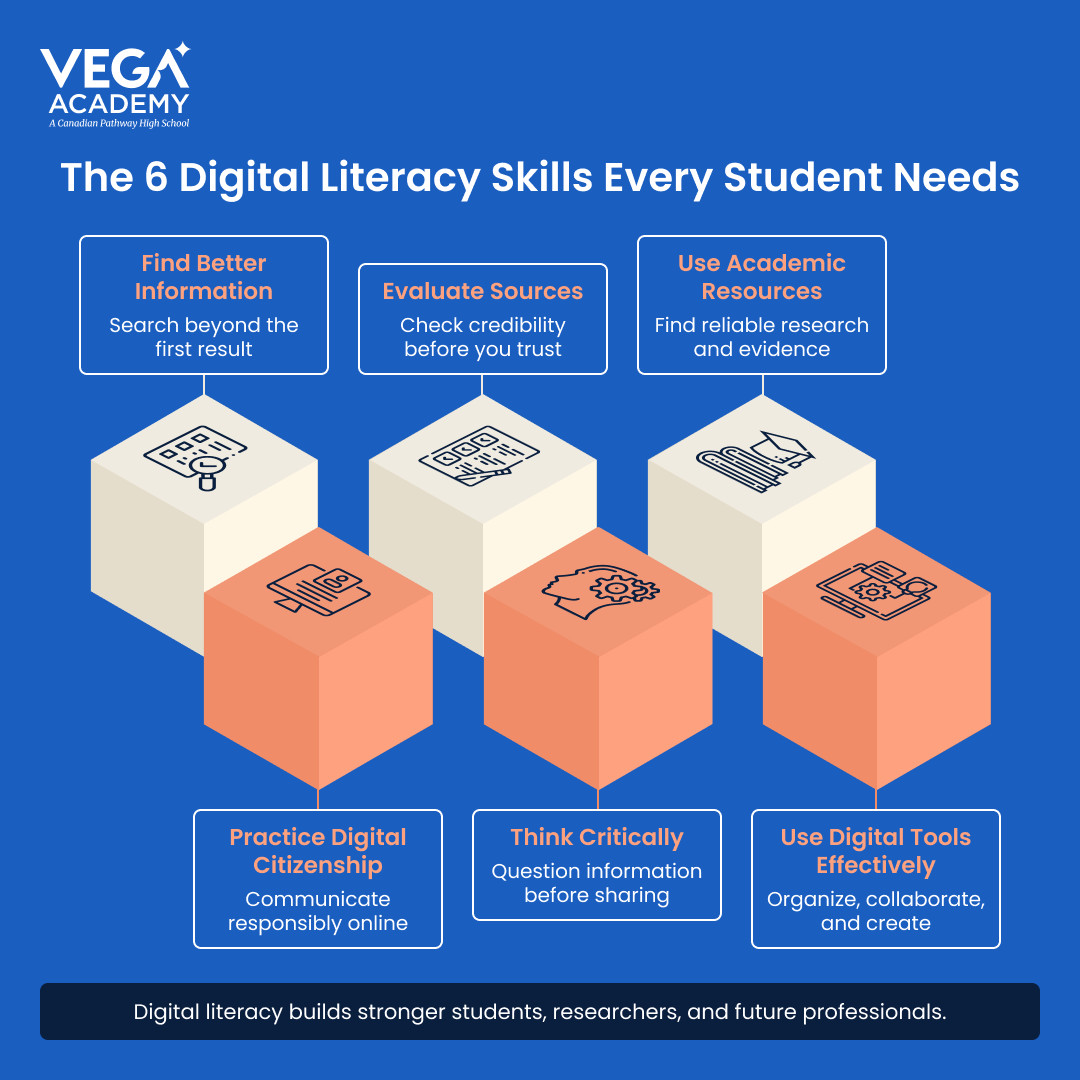
Find Better Information
Most students stop at the first search result they see, but strong digital research starts well beyond the first page. Knowing how to refine a search query, use filters, navigate databases, and look past surface-level results is what separates a credible academic argument from a quickly assembled one. Students who learn to search with intention rather than convenience build a research habit that serves them in every subject and every stage of their education.
Evaluate Sources
Finding information is only half the task, the other half is knowing whether to trust it. Students need to develop the habit of checking who created a source, when it was published, what evidence it uses, and whether it has been reviewed or verified by others. In an environment where misleading content is easy to produce and share, the ability to assess credibility before accepting or citing a source is one of the most important academic skills a student can have.
Use Academic Resources
Not all research tools are equal, and learning to access the right ones makes a measurable difference in the quality of a student’s work. Academic databases, peer-reviewed journals, institutional libraries, and government data sources offer a standard of evidence that general web searches simply cannot match. Students who know how to find and use these resources arrive at university with a significant advantage, because they are already comfortable working with the kinds of sources professors expect.
Practice Digital Citizenship
How a student communicates and behaves online is part of their academic and professional identity. Digital citizenship means understanding the responsibilities that come with being online, respecting privacy, crediting sources, engaging thoughtfully in digital spaces, and recognizing the real-world impact of what is said and shared. These habits matter in school, and they matter even more in the professional environments students will eventually enter.
Think Critically
The volume of information available online makes critical thinking more important than ever. Before sharing, citing, or acting on any piece of information, students need to pause and ask whether it is accurate, where it comes from, and what purpose it serves. This applies equally to news articles, social media posts, and AI-generated content. Students who make questioning a reflex rather than an afterthought are far less likely to spread misinformation and far more likely to produce work that holds up to scrutiny.
Use Digital Tools Effectively
The tools available to students for writing, organizing, collaborating, designing, and presenting are powerful, but only when used with purpose and skill. Knowing how to work across shared documents, manage project timelines digitally, and use the right tool for the right task makes students more productive and more capable of producing polished, professional-quality work. These are not just school skills; they are the baseline competencies expected in virtually every modern workplace.
Evaluating Information Online
The internet carries an enormous volume of unreliable information alongside credible academic sources, and most search engines make no distinction between the two in how results are ranked. Students need a repeatable method for judging what they find.
A Practical Method for Checking Sources
Teaching students a consistent evaluation habit removes the guesswork from source checking and gives them a method they can apply to any topic.
- Check the author: confirm the writer has relevant expertise or credentials on the topic.
- Check the date: older sources may carry outdated information, especially on fast-changing topics.
- Check the publisher: academic journals and established institutions carry more weight than unverified websites.
- Cross-reference claims: confirm a surprising or specific claim appears in more than one credible source.
Students who practice this method regularly develop an instinct for spotting unreliable sources quickly, a skill that saves considerable time once research assignments grow longer and more demanding.
This instinct also protects students outside the classroom. The same evaluation habits that catch a weak academic source apply just as well to news articles, social media claims, and marketing content students encounter daily. Building the skill through schoolwork gives students a transferable habit that extends well beyond any single assignment or subject.
See Our Academic Research Approach
Learn how VEGA Academy builds research and digital literacy skills.
Responsible Use of Digital Tools
Digital literacy also includes how students behave online, not just how they research. Responsible use covers privacy protection, appropriate communication, and understanding the permanence of what gets posted or shared.
- Privacy awareness: understanding what personal information is safe to share on school or academic platforms.
- Digital citizenship: communicating respectfully in online forums, group chats, and collaborative documents.
- Tool management: using citation managers, cloud storage, and collaborative software correctly to avoid lost or duplicated work.
VEGA Academy’s student support team works with students on these habits alongside academic mentorship, since responsible digital use affects both schoolwork and personal wellbeing.
Responsible use also covers how students handle group work on shared platforms. A student who edits a shared document without communicating changes, or who shares login credentials for a school account, creates problems that go beyond a single assignment. Teaching these habits directly, rather than assuming students already know them, prevents small mistakes from turning into larger conflicts or academic integrity issues.
How Digital Literacy Supports University Readiness
Digital literacy connects directly to broader university readiness. A student who can research efficiently, evaluate sources with sound judgment, and manage digital tools responsibly enters university with one less adjustment to make during an already demanding first semester.
This adjustment period matters more than it might appear from the outside. First-year students juggling several new demands at once, unfamiliar campuses, new social groups, and independent living, benefit from having at least one area of academic life already under control. Strong digital research habits remove one variable from an otherwise steep learning curve.
This connection is why schools with strong day school programs treat digital literacy as part of academic preparation rather than a separate technology class. Building the skill across multiple subjects, not just one course, gives students more consistent practice before it becomes a university expectation.
Key Takeaways

Digital literacy goes beyond typing skills: it includes evaluating sources, spotting bias, and using tools responsibly.
University research depends on it: students who cannot judge source credibility struggle with academic research assignments.
Responsible use matters early: habits formed in high school shape how students handle information for the rest of their academic careers.
Frequently Asked Questions
If your question is not covered below, contact the admissions team directly at admission@vegaacademy.ca or call (437) 887-9332.
What is digital literacy for high school students?
Digital literacy is the ability to find information online, judge how credible it is, and use digital tools responsibly. It covers research skills, source evaluation, and appropriate online behavior.
Why does digital literacy matter for university preparation?
University coursework assumes students can research using academic databases and judge source credibility without guidance. Students who build this skill in high school adjust faster to university-level research expectations.
How can schools help students build digital literacy?
Schools build digital literacy by teaching source evaluation methods across multiple subjects and giving students regular research assignments. Consistent practice across several years works better than a single dedicated technology course.
Building Digital Literacy That Lasts
Digital literacy has become as essential to academic success as strong writing or research skills. Students who learn to evaluate sources, manage digital tools responsibly, and research efficiently carry those habits directly into university coursework. VEGA Academy integrates these skills across its academic model, giving students consistent practice rather than a single isolated lesson on technology use.
Families evaluating a high school should ask directly how digital literacy gets taught across the curriculum, rather than assuming a single computer science course covers it. A program that builds source evaluation and responsible technology use into everyday assignments gives students far more practice than a course confined to one semester. VEGA Academy’s about us page outlines how this approach fits into the school’s broader academic philosophy.
Talk to Our Admissions Team
Ask how VEGA Academy builds research and digital skills.